
Why I Hate Being Called Asian
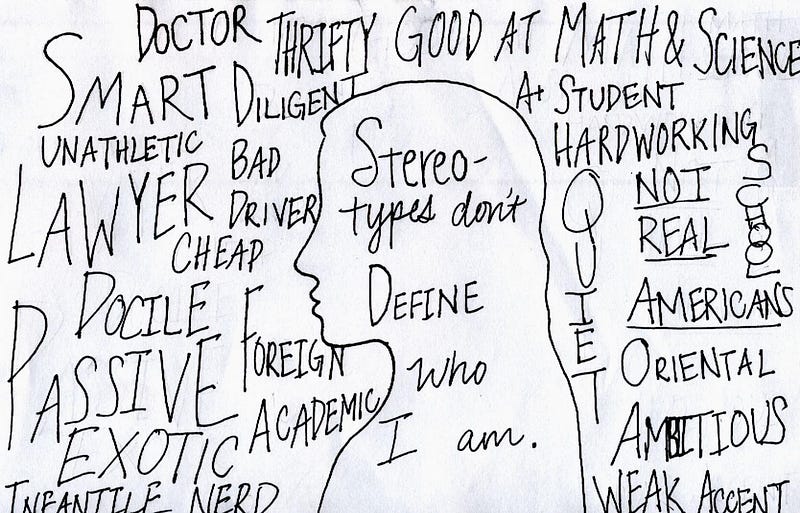
When you hear the term “Asian,” what comes to your mind? Food? Places? People? Cultures?
Now type “Asian” into your search engine and look at the photos that pop up. What do they look like? Do they match your instinctive image of “Asian?”
I am an Asian Indian woman, and I proudly identify as such. Yet the term “Asian” brings China to the forefront of my mind. How unfair is it that I don’t think of myself first when I hear the term “Asian,” despite it being an integral part of my identity?
A Brief History
Asian immigration to the United States began with hiring Southern Chinese men as contract workers in the 1850s. Integral to building American infrastructure and working essential jobs in factories, they made up roughly a fifth of California’s population, but represented less than 1% of the national population. The economic depression of 1867 gave birth to the modern-day anti-immigration sentiment. Cries of “They’re stealing our jobs!” quickly ran the Chinese out of the U.S. 1885 saw the birth of the Chinese Exclusion Act, and the increase in Korean and Japanese immigrants in the U.S., who took over the jobs the Chinese had left behind. But America hated them too, and 1907 saw restrictions on Japanese immigration. Around the same time, the U.S. saw an influx of South Asian immigrants. They initially pooled in Canada, and then spilled over into the American west coast. In 1917, Congress told them to go home too, citing India as a part of the Pacific-Barred Zone for excluded Asian countries. With Chinese, Korean, Japanese, and Indian immigration to the U.S. dwindling, Filipinos arrived in the 1920s. Although they weren’t initially shunned out of the country (the Philippines had already been annexed by the U.S. at the time), they faced violence and racism throughout the country. Eventually, they also faced the same restrictions on immigration, limiting their presence in the U.S. too. Is the pattern becoming visible now?
The term “Asian American” was coined in 1986, with the intent to give a common identity to the experiences shared by Asian immigrants. It aimed to promote solidarity, a feeling of unity for all the people who uprooted their lives to establish a new home in a country that didn’t want them. And the “Asian” label had succeeded, providing a new identity to loads of immigrants in label-obsessed America. But today, the same label has led to mass amounts of disparities and divisions.
The term “Asian American” is failing us today.
My Experience with Being Labeled “Asian”
Modern-day Asia includes 48 countries and 3 other territories (i.e. Taiwan, Hong Kong, and Macau). It is no secret that Asia is an enormous landmass, carrying generations of colorful cultures and varied backgrounds. 4.46 billion people are spread across 17.2 million square miles, who speak 2,300 languages (excluding regional and local dialects) — and this is just a humble brag about Asian diversity. The U.S. loves to pride itself for its diversity and its identity as a “melting pot” of cultures, yet it is nothing compared to Asia. This is exactly why it’s unfair to think of all of us as Asian.
Growing up, many of my peers asked me where I was from. As a native-born American citizen, this question was already offensive. Upon answering that my cultural background was Indian, they asked me, “Where’s India?” When I explained that India is part of Asia, I got looks ranging from shock to skepticism. “Indians are not Asian, Chinese and Japanese are,” I’d hear from my White peers, who assumed their racially-inherent smarts and tried to school me about my own origins. Upon entertaining their so-called intellectual superiority about my background, they would scoff and say, “Well obviously India is the Middle East.” See, to me, the Middle East 1) is neither an official continent nor race/ethnicity, and 2) is home to predominantly Muslims — which I am not. I would often have to agree to disagree with my peers and walk away, hoping that their high school geography class would teach them better. Unfortunately, high school geography failed them too.
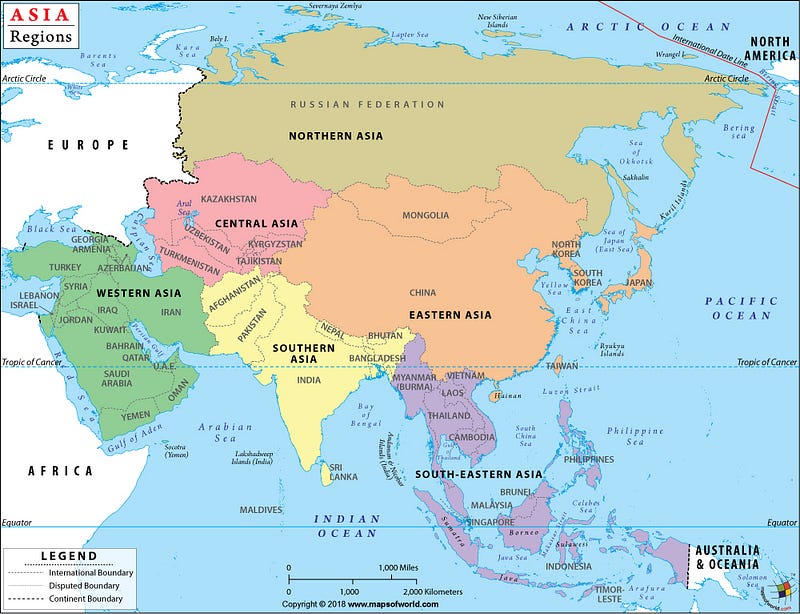
I was pestered by the “Is India Asian or Middle Eastern?” debate throughout college, engaging in conversations to prove my Asian-ness to a bunch of White colleagues who thought they knew better than me. I didn’t feel at home being labeled Middle Eastern because I did not identify with the culture and religion, and my White peers didn’t let me feel at home by calling myself Asian.
White people had given me my first identity crisis.
My identity crisis had already been in the making long before college though. In fifth grade, I learned about Columbus’ journey from Spain, searching for India. He encountered the Natives, who were labeled “American Indian.” As someone who was culturally Indian, but was born and raised in America — it only made sense that I identified as “American Indian,” right? This terminology confused 10-year-old me. At recess, when my friends asked me “what I was,” (a really stupid question, in my opinion), I proudly answered American Indian, only to be stumped by their follow-up question: “What tribe are you from?”
In hindsight, I suppose it shouldn’t surprise me that my high school and college friends didn’t understand anything about India — America failed to teach them.
In sixth grade, I was told that we would have an Asian history unit. I was excited, because I thought that I would finally learn about India. Having studied in India for four years as a child, colonial Indian history was the only topic in history that piqued my interest. Otherwise, I didn’t (and still don’t) understand the point in studying about White men fighting over land or money. I was disappointed when we started and ended our Asian history unit with China. But, I didn’t give up hope in the American education system, thinking that Indian history would be covered in a later class. In seventh grade, I was let down again, after learning only about the Chinese and Mongolians, with Japanese history haphazardly tossed in like an ice cream topping.
In high school, I took my first and only world history class. I was very excited to learn about events that didn’t revolve around White men fighting over land or money. I was a starry-eyed student who didn’t understand just how self-obsessed White people were, even in education, in a course that promised to teach me about world history. I came to class everyday hoping that would be the last day we covered Eurocentric history. I was exposed to Southern/Central American history for the first time, and I skimmed the surface of the African Apartheid. The only Asian history we covered was of China, Japan, Vietnam, and briefly Korea — in the context of the World Wars.
When I finally approached my senior year high school history teacher and asked why we didn’t cover any South Asian history, he said that there simply wasn’t enough time. I was disappointed beyond belief in his explanation. I had been learning history since fifth grade, and year after year, I was taught the same things about White European and American history. I had been studying history for seven years, yet the education system had no time to teach me South Asian history? My history education made it seem like the world began with North America and ended with Europe. In college, I didn’t have to take any history classes, but a quick catalog search of the history courses offered show the following:
- Three courses in ancient world civilizations (primarily Greco-Roman)
- Eight courses in American history (ranging from colonial period to the Civil War era, women’s history, etc.)
- Eight courses in European history (ranging from the early religious periods to the World Wars)
- One course in Chinese history
- One course in Latin American history
- One course in history of the Islamic world
- One course in South Asian history
- One course in East Asian history (which may or may not include Korea, Vietnam, and Japan)
- Zero courses in African history
This list contains most of the coursework offered for a BA in History at my undergraduate institution. Even in a degree concentrated only in history, students learn the history of entire continents (i.e. Latin America and Middle East), and subcontinents (i.e. China, S. and E. Asia) in a semester each, compared to a full four years worth of coursework for European and American history.
Not seeing myself represented in textbooks or education, it doesn’t take a rocket scientist to figure out why I don’t think of myself of Asian today.
Even in the Asian American diaspora — I don’t exist.
The “Asian” Label has Failed Us
Asians are regarded very highly in every industry. The stereotypical Asian is smart, possibly wealthy, and has a well-paying, highly reputable job. Because of the Asian emphasis on education, aided by so-called “tiger” and “helicopter” moms, Asians supposedly have very few problems in accessing higher education or completing it successfully.
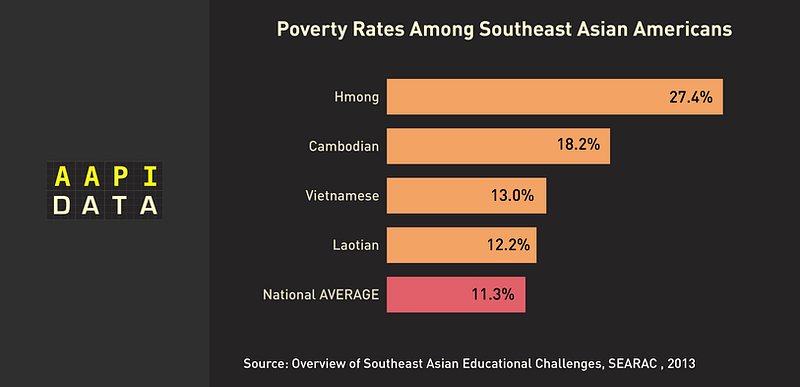
Since the U.S. focuses heavily on access to higher education as a measure of privilege and equity, Asians are considered privileged enough that their other disparities go unnoticed. But Americans forget about Asian minorities — like the Taiwanese, Bhutanese, Laotian, Hmong, Cambodians, and many more. Today, the Asian label has reduced multiple nationalities and our diverse cultures to one, monolithic people, conveniently allowing Americans to forget about the Asians left behind. This also becomes problematic when we discuss overrepresentation in professional fields. Sure, there are plenty of Chinese and Indian physicians. But how many do you know or see who are of an Asian minority? Asians aren’t overrepresented — only a select few subgroups in the Asian population are. But because of our singular identity as “the Asians,” the minorities are forgotten about.
In fact, the label Asian has further exacerbated existing disparities, especially in healthcare. In 2017, 5.7% of Americans identified as Asian — that’s 22.4 million people. Yet, we are the least studied in research. Any study about Asian populations usually contains samples from Chinese, Korean, Japanese, and Filipino identities, with the occasional Indian subjects thrown in for good measure. It’s as if American research slaps the Asian label onto the title of a paper containing mostly East Asian sample groups, and dusts off their hands in accomplishment of “increasing diversity” in scientific studies. But obviously, not enough is being done. Asians are still at high risk of cardiovascular disease and cancer. We also suffer from depression and other mental health disorders at high rates. In fact, depression is extremely understudied in Asian populations. The lack of language-accessible and culturally-competent mental healthcare for Asians, combined with the extremely negative stigmas associated with therapy in our cultures, exacerbate the existing disparity for Asians compared to our racial counterparts.
What about our median income? Surely Asians are the most successful in this country, perhaps even more so than Whites. Well — that’s right. The Pew Research Center reported in 2018 that Asians had the highest standards of living at the 90th percentile, even higher than White people. This is no reason to worry, right? We seem to be doing pretty well for immigrants. But if you separate the Asian race into its subpopulations, you would learn that while the median annual income for Indians is $100k, it’s only $36k for the Burmese. Poverty rates for the Burmese are as high as 35%, and 33% for the Bhutanese. But as an Asian Indian, my annual household income is still well below the median. Where does that put me on the social hierarchy of Asian success and prestige?
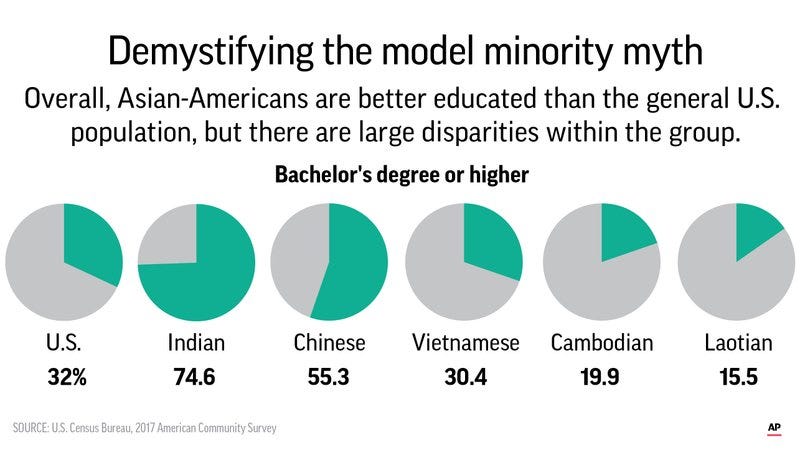
But that’s not all — remember our extremely high access to education? Here’s another shocker: While 72% of Indians have bachelor’s degrees, only 9% of Bhutanese people have the same. In fact, Asians displaced Blacks as the most economically divided racial/ethnic group, according to the Pew’s analysis of government-provided data. While I could go on all day about what the data says, this short summary paints a substandard picture of the supposed highly privileged Asian American.
And then to top it off: racism. Many Americans, White or people of color, believe that Asians cannot face racism. Anti-Asian sentiment has come to the forefront of the media due to the COVID-19 pandemic, with slurs directed at anyone who even remotely “looks Chinese,” even if they aren’t. But again, who do you generally see on TV when racism against Asians is discussed? It’s the same East Asian subpopulation; you don’t hear about racism against South Asians. But it’s happening, even if it’s invisible.
In sixth grade. I was waiting to be picked up by my mom after school when a fellow Latino classmate came up to me and demanded that I “go back to where [I] came from because nobody wanted [me] here.” This interaction thoroughly confused me in my youth, but I understand it now. Throughout middle school, my peers only talked to me if they needed help with homework — because as an Asian, I inherited the smart gene. Otherwise, I hardly had friends. In high school, I received anonymous hate notes in my locker on 9/11, accusing me of being bin Laden’s granddaughter who was also a terrorist in the making. Americans are so blatantly and boldly ignorant. They saw my brown skin and immediately designated me a terrorist, even though I was not even remotely related to bin Laden.
Throughout college, my friends continuously called me “smart” or a “know-it-all.” It seemed like a compliment, so I let it slide. But when I finally asked someone why they thought I was so smart, they said that it was because I was Asian. While I was happy that they saw me as Asian and not Middle Eastern, I was very upset that they didn’t see my efforts and work ethic. They instead assumed wrongly that I was the next Einstein-to-be, from the womb.
How damaging it is to have your success chalked up to a stereotype, is something that many Americans will fail to understand.
And of course, this assumption extended to my professors too. Many refused to make time for me because they assumed I would be okay. Even when I was stressed out and expressed my frustration or worries to my professors, they would tell me that they knew I would figure it out. They were right, but for the wrong reasons.
Thanks to America, the model minority myth has created an image of what an Asian student looks like in higher education. I was just expected to figure it out, to understand it on my own, and to seek my own answers to my questions. Sure, I’m hardworking, but only because my accomplishments rely on it. Throughout my academic career, I have only been given two choices: either I figure it out without help, or I fail because nobody is willing to understand that I too, despite being an Asian student, need help. The model minority myth, deeply embedded in every person’s intellect, denied me any fair chance of getting guidance or help from my professors.
For all the instances my university cried “diversity and inclusion,” they still managed to fail me in an unprecedented way, because the model minority myth had been made one with my identity.
When I confided in a staff member of color during college, they told me that it was impossible for me to face racism. It’s as if my racial designation put up a one-way mirror between them and I, in which they were ready to hear my appreciation for them and their work done for me, but they could not hear me when I tried to yell at them about the system’s failings against me. I am convinced that in this country, Asians are prime examples of the good, but vanish when they complain about the bad in the U.S.
Otherwise, how would this label- and image-loving nation portray just how “successful” the failing American Dream is?
Even when we talk about education, not all Asians are equally educated. Bhutan borders India on its far east side. Yet, the educational discrepancies are enormous, with 72% of Indian Americans reporting a bachelor’s while only 9% of Bhutanese Americans report the same. How do you explain the difference? It can’t be geographical location, so it must be some internal factor, such as culture or emphasized personal values. If we understand that these disparties exist because of something beyond a physical border, we know that these two cultures are different. So why are we treated as if we carry the same privileges?
Here’s the last thing that irks me. We know that higher education in the U.S. is 90% a numbers game. The higher the standardized test score, the better your chances of being admitted into a prestigious school. If you were to consider the same statistics of Indian and Bhutanese children, and applied it to higher education, without considering their backgrounds, two things would happen. Firstly, both students would be compared to each other, and if our assumption about the numbers game holds true, the Bhutanese student will automatically be taken out of the running. Secondly, both the Indian and Bhutanese students would be compared to the rest of the Asian applicant pool — whose backgrounds would range from Chinese to Laotian. We know for a fact that Chinese and Laotians are at two opposite ends of the stick, yet they are compared as if they were equals because they both fall under the Asian designation. If you threw the Indian and Bhutanese students into the mix, would that be a fair comparison? Furthermore, what if the Indian student is first-generation and of a low-income background? Will their application also be tossed out because they didn’t meet societal expectations of what an Asian Indian student should be achieving? What if the same story applied to the Chinese student instead? We are not all the same, even if we are named as one. Our backgrounds are no longer identical, and neither are our stories.
Final Thoughts
I am not saying that Asians are extremely unprivileged in this nation; they are undoubtedly the most successful group of people of color. But this fact, combined with the Asian label designed to unify us, has continually divided us. A single storyline about the most successful of us has conveniently allowed America to sideline us. It has pitted us against other minorities via the model minority myth, and against White people because our maximum social standing will be only parallel to them, never equal. It has pitted us against each other, in our racial subgroups, each competing to be the best candidate for the job or school. It has unified us so well that scientific research uses East Asian groups as the model subject in any study to represent all Asians. In America, Asian diversity starts with the Chinese, and ends with the Filipinos — the rest are forgotten. As integral a part of my identity the racial designation Asian is, it has also boxed me in. I hate that it has trapped me out from access to guidance in education, denied me the knowledge of my own history, and weighed me down with societal stereotypes and expectations.
I am the embodiment of Asian, and at the same time, I am only one small fraction of it. Yet somehow, I am invisible to myself in the Asian American diaspora.
I don’t want to be called Asian anymore. Start calling me Indian, without adding Asian or American to tack on a patriarchal identity and origin. Free me of the demographic box I check off on a form. Let me live as an Indian, without any of the preconceived notions that surround my identity, or the singular storyline that is attached to being part of the Asian population.
I just want one thing, and that is to be visible in dimensions that extend beyond my legal racial designation.