
The Meat Shortage Myth
‘You may not have gotten the exact cut of meat that you were looking for, but the meat was there’
In March and April, workers at a Tyson pork plant in Logansport, Indiana, filed 11 complaints with the Occupational Safety and Health Administration (OSHA), reporting packed areas with no social distancing, lack of personal protective equipment (PPE), and workers who had tested positive continuing to work.
“There are so many positive Covid-19 cases,” one complaint read. “An employee was tested positive, and there are three people that ride with the employee and are now showing symptoms. The employer refused to tell the employees that the employee was tested positive.” On April 25, the plant shut down temporarily. By that time, close to half of its workforce tested positive.
As situations like this one played out around the country, companies began publicly speaking out about imminent “meat shortages.” Smithfield put out a press release stating that the closure of its Sioux Falls, South Dakota, pork plant would push “our country perilously close to the edge in terms of our meat supply.” Tyson ran a full-page ad in national newspapers stating that the company was being “forced to shutter our doors” and, as a result, “there will be limited supply of our products in grocery stores.”
Based on evidence and expert insights, taking the time to shut plants long enough to truly protect workers would not likely have led to increased food insecurity in the U.S. And if it did, that raises profound questions about the system we’re working with.
In response, on April 28, President Donald Trump used the Defense Production Act to order meatpacking plants to remain open, drawing a direct line between corporate meatpackers and the nation’s food security.
Three days later, the Logansport Tyson plant reopened, just five days after it closed. Since the start of the pandemic, according to the Food and Environment Reporting Network, more than 40,000 meatpacking workers have contracted Covid-19, and close to 200 have died. A recent analysis conducted by the Environmental Working Group found that counties within 15 miles of a meatpacking plant have had about double the infection rate compared to the national average. And the Centers for Disease Control and Prevention recently released a study that tracked the spread of the coronavirus at one plant in South Dakota. Between March 16 and April 25, 929 of the more than 3,600 employees were infected, and two died. Workers infected an additional 210 people in the surrounding community.
Covid-19 has undoubtedly caused upheaval in the meat industry, with plant shutdowns causing incredibly difficult situations, especially for farmers with animals ready to go to market and nowhere to send them. But based on evidence and expert insights, taking the time to shut plants long enough to truly protect workers would not likely have led to increased food insecurity in the U.S. And if it did, that raises profound questions about the system we’re working with.
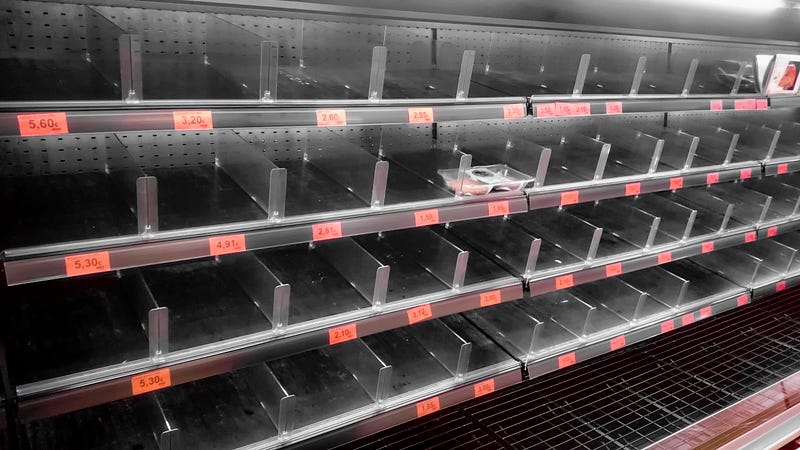
Yes, Wendy’s briefly ran out of hamburger meat, but the media and the public were quick to confuse a temporary lack of fast food burgers and occasional empty cases at grocery stores with a situation that would cause Americans to go hungry. Why?
The media and the public were quick to confuse a temporary lack of fast food burgers and occasional empty cases at grocery stores with a situation that would cause Americans to go hungry. Why?
One reason the myth of a meat shortage took hold so easily was that few Americans know (or care to know) how supply chains work. Often, they’re long and complicated and super-efficient, so any change can cause major hiccups. “There was some panic buying, and a disruption in the supply chain did happen,” said Tony Corbo, who works on food system issues and policies for Food & Water Watch. Food destined for restaurants, for example, can’t immediately be rerouted to grocery stores. It likely needs to be packaged, priced, and distributed differently. Those kinks take time to work out, especially in consolidated systems that work at high volumes. But Corbo said the argument that companies needed to maintain meat processing at the same volume to keep people fed at the height of the emergency is undermined by two facts: cold storage and exports.
“You had all of this excess meat sitting in cold storage,” he said. “You may not have gotten the exact cut of meat that you were looking for, but the meat was there.” In fact, U.S. Department of Agriculture data show that at the end of April, there was over a billion pounds of frozen red meat in the U.S., up 5 percent compared to a year earlier. By the end of June, stocks had gone down due to processing slowdowns, but total red meat in storage was still down only 12 percent compared to a year earlier. (Those numbers do not include chicken.)
Meanwhile, as Trump ordered plants open in the name of national defense, companies like Tyson, Smithfield, and JBS were exporting a record amount of pork — the meat sector most affected — to China, with June exports up 135 percent compared to the previous year. At the same time, while workers and farmers suffered, many of these companies saw their profit margins increase. Cargill reported a net income of $3 billion, up 17 percent compared to the year before, and paid its family owners record dividends.
And while companies did begin instituting Covid-19 protections like temperature checks, routine testing, plastic dividers, and PPE, in many cases it was after outbreaks had occurred.
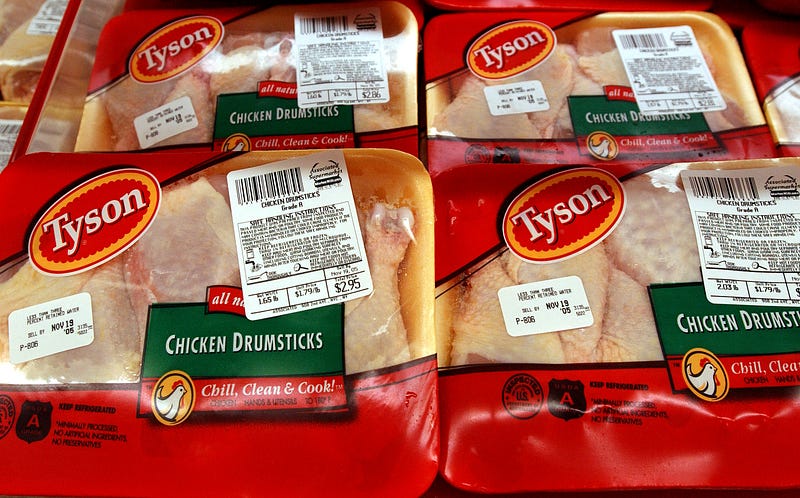
One Tyson plant worker in Arkansas, who wished to remain anonymous, told me that the company began implementing limited protective measures in April and then was forced to enact more after an outbreak in June. She described her job as “opening the chicken and removing the guts that the machine doesn’t get,” and said she makes $13.35 per hour and has been working for the company for nearly 20 years. After more than 200 employees at the plant tested positive, the worker said those without symptoms were told to return to work after just one week. “The workers who came back after a week, they infected other workers. After that time, a lot more workers began getting sick,” she said. “Really, Tyson has never treated workers right, but now with the pandemic, it adds more fear, and you don’t have other options, and you just keep working.”
Like many aspects of the food system, Covid-19 exposed longstanding food system issues that are often ignored. Meatpacking workers, who are primarily immigrants and people of color, are paid low wages in often poor conditions to do some of the most dangerous jobs in the country. And the companies that employ them have a disproportionate amount of power over both workers and farmers, thanks to increasing consolidation and vertical integration in the industry.
In response to increasing Covid-19 cases and reports of rising meat exports, Democratic Senators Cory Booker of New Jersey and Elizabeth Warren of Massachusetts requested detailed information on plant outbreaks, production capacity, and exports from Tyson, Smithfield, Cargill, and JBS. In a press release detailing their findings, the senators said none of the companies provided “straightforward and complete” responses.
“Their responses — or lack thereof — fail to sufficiently explain why they claimed there were pending domestic shortages only to go on and export record quantities of meat to China, which recent reports indicate they continue to do even as frozen supplies fall. And their failure to provide information on the spread of Covid-19 in their plants hides the impact that their decisions had on frontline workers,” the release stated.
In its response to the inquiry, Tyson’s Dan Turton claimed that the company prioritized the American market and that much of the meat exported was organ meats and other cuts not popular with American consumers. “Because export markets do not generally desire the same commodity products as those sold in the U.S. market, exporting does not threaten the American meat supply,” he said.
In Smithfield’s response, CEO Kenneth Sullivan doubled down on the claim that it was committed to feeding the country. “We have continued to run our processing plants, distribution centers, farms, and feed mills for one reason: to sustain our nation’s food supply during the Covid-19 pandemic. Operating is not a question of profits; it is a question of necessity,” he wrote. “Candidly, we are weary of critics in the media who are detached from the realities of this worldwide pandemic. Namely, that we must produce food, and somebody has to do it.”
That statement provokes knee-jerk empathy but also raises subsequent questions. What kind of food? And how much? And, maybe most important, do corporate meatpackers have to be that “somebody”?
Based on USDA dietary guidelines, a healthy individual on a 2,000-calorie diet should eat up to 84.5 pounds of red meat, poultry, and eggs annually. USDA data show that in 2017, there were 163 pounds of meat and poultry — nearly double that amount— available per person, and that’s without factoring in egg production. In fact, in Smithfield’s own letter, Sullivan stated, “In the normal course, the U.S. has an abundant surplus of meat and produces roughly 25-30 percent more pork than can be consumed within our shores.” And the U.S. has been overproducing so much dairy that farmers have been dumping milk for decades.
A meat shortage does not necessarily a food shortage — or even a protein shortage — make.
Plus, a growing body of research shows eating less meat and more plant protein is better for both human health and the environment. Since the pandemic started, consumers have been buying beans more than ever, with no shortages in sight, and makers of plant-based meats are ramping up production at a quick clip. There are many valid, complicated health and environmental arguments about meat vs. plant-based diets to be made, but the mere existence of alternatives is a fact. In other words, a meat shortage does not necessarily a food shortage — or even a protein shortage — make.
(And overall, at this point in history, food insecurity in the U.S. is a consequence of poverty and injustice. An abundance of food is available, but many households cannot purchase it because of low wages and other systemic social and economic inequalities.)
As for the assertion that “somebody” has to produce meat: While industrial meat production, despite its vast resources, was thrown into chaos, small livestock farms and processors that exist outside the consolidated corporate system showed resilience. “Those farmers that sell directly to the consumer…their businesses skyrocketed,” said Michael Baker, a senior extension associate at Cornell University who specializes in small livestock operations. Baker thinks big companies acted as quickly as possible to deal with coronavirus-related disruptions and protect workers, but he said that consumer demand, since before the pandemic, was shifting toward knowing your farmer, adding that “there’s plenty of room to grow that.”
While multi-billion-dollar meat companies buckled in the face of a global emergency, at Horse Shoe Ranch, Bryan and Brittany Donovan hustled to feed customers in their surrounding communities creatively, switching from farmers market sales to online ordering and home deliveries. When I spoke with Bryan, it had been a challenging few weeks. The couple runs the farm near Lancaster, Pennsylvania, without outside help. They had just welcomed their first child; the pigs escaped; and they were tweaking their sales model — again.
Still, they had secured a $5,000 loan through Steward, an investment platform that raises capital for farms that prioritize environmental stewardship, to increase freezer space to store more pasture-raised chickens to sell over the winter.
Far from slowing down, they are looking to ramp up meat production for the future and are hoping new customers that found them while panicking over potential shortages in grocery supply chains will stick with them as they work to build healthy soil and produce as much healthy food as possible.
“Our customers know that we’re going to give them the highest quality chicken or eggs or vegetables that we possibly can,” Bryan said. “We focus on transparency with our farm.” What they need is for more eaters to take a look.


