avatarCaleb

Free AI web copilot to create summaries, insights and extended knowledge, download it at here

3373

Abstract

<p id="3cd2">Each of these types can be seen as a “component”.</p><p id="69e7">When you design a new neighborhood, you don’t start from zero; you use the building designs you’ve already created, placing them in different arrangements to create diverse and vibrant areas. This is the power of components!</p><p id="3b8b">Components enable us to write reusable code. We write once and use it multiple times, reducing redundancy. It’s like the philosophy behind “DRY” (Don’t Repeat Yourself) met web development and they became best friends.</p><h1 id="ec61">Unraveling Props and State</h1><p id="5283">In our journey with React, two of the most crucial concepts that we encounter are “Props” and “State”.</p><p id="00d2">Props (short for properties) allow components to communicate with each other. They are similar to function arguments: they pass information from one component to another.</p><p id="099c">State, on the other hand, is like a component’s personal data store. It’s where a component keeps track of information that can change over time, and affect what the component outputs.</p><h1 id="daad">React and the Virtual DOM</h1><p id="84d9">React makes use of a concept called the Virtual DOM.</p><p id="5712">You can think of the Virtual DOM as a lightweight copy of the actual DOM.</p><p id="09d7">Whenever a component’s state changes, a new Virtual DOM gets created. This Virtual DOM is then compared with the old one, and only the changes (differences) are updated in the real DOM.</p><p id="4584">This diffing algorithm, as it is called, makes React fast and efficient.</p><h1 id="6f34">Conclusion</h1><p id="8ddd">React offers a powerful approach to building fast and scalable applications. It does this by providing us with a component-based architecture, encouraging code reusability, and enhancing performance with the Virtual DOM. For those starting their journey into this star called React, understanding its core principle — the component-based architecture — is the key to unlocking its full potential.</p><p id="025b">React’s component architecture is a powerful ally. It allows us to think about our application as a modular and reusable set of pieces, enhancing our code’s readability, maintainability, and scalability. It’s like being handed the keys to a powerful spaceship, capable of taking us on incredible journeys through the universe of web development.</p><p id="0cf2">As we continue exploring, we’ll discover that this is only the beginning of what React has to offer.</p><ol><li><b><i>Official React Documentation:</i></b><i> This is the perfect place to start. It covers everything you need to know about React and is the most reliable source of information. <a href="https://react.dev/">Official React Documentation</a></i></li><li><b><i>React Component:</i></b><i> To gain a deeper understanding of components in React, this page in the official documentation will be very helpful. <a href="https://react.dev/reference/react-dom/components">React Component Documentation</a></i></li><li><b><i>React State and Lifecycle:</i></b><i> This link will help you understand the concepts of state and lifecycle in a React component. <a href="https://react.dev/learn/state-a-components-memory">State and Lifecycle</a></i></li><li><b><i>Thinking in React:</i></b><i> This official guide is great for understanding how to start building in Reac # Options t, especially when it comes to component-based architecture. <a href="https://react.dev/learn/thinking-in-react">Thinking in React</a></i></li><li><b><i>The Beginner’s Guide to React:</i></b><i> This free course on Egghead.io by Kent C. Dodds is an excellent resource for beginners to React. <a href="https://egghead.io/courses/the-beginner-s-guide-to-react">The Beginner’s Guide to React</a></i></li><li><b><i>Learn React for free:</i></b><i> This interactive course by Scrimba lets you learn React by doing, with plenty of exercises and projects. <a href="https://scrimba.com/learn/learnreact">Learn React for free</a></i></li></ol><p id="5b23"><i>Enjoyed the read? For more on Web Development, JavaScript, Next.js, Cybersecurity, and Blockchain, check out my other articles here:</i></p><div id="7e3a" class="link-block"> <a href="https://readmedium.com/a-roadmap-to-my-medium-writings-fd04e14cffd7"> <div> <div> <h2>A Roadmap to My Medium Writings</h2> <div><h3>undefined</h3></div> <div><p>undefined</p></div> </div> <div> <div style="background-image: url(https://miro.readmedium.com/v2/resize:fit:320/1*AlnhijwuyBibB3GNPODX5Q.png)"></div> </div> </div> </a> </div><p id="8496"><i>If you have questions or feedback, don’t hesitate to reach out at [email protected] or in the comments section.</i></p><p id="c73a"><i>[Disclosure: Every article I pen is a fusion of my ideas and the supportive capabilities of artificial intelligence. While AI assists in refining and elaborating, the core thoughts and concepts stem from my perspective and knowledge. <a href="https://readmedium.com/how-does-ai-help-me-write-my-articles-5df265d16527">To know more about my creative process, read this article.</a>]</i></p><div id="6d09" class="link-block"> <a href="https://readmedium.com/how-does-ai-help-me-write-my-articles-5df265d16527"> <div> <div> <h2>How Does AI Help Me Write My Articles?</h2> <div><h3>The Medium landscape has seen a transformation, with an increasing number of articles appearing to have the distinct…</h3></div> <div><p>medium.com</p></div> </div> <div> <div style="background-image: url(https://miro.readmedium.com/v2/resize:fit:320/1*sURudlO3SS5ntthELFumcg.jpeg)"></div> </div> </div> </a> </div><h1 id="b5bb">In Plain English</h1><p id="a08f"><i>Thank you for being a part of our community! Before you go:</i></p><ul><li><i>Be sure to <b>clap</b> and <b>follow</b> the writer! 👏</i></li><li><i>You can find even more content at <a href="https://plainenglish.io/"><b>PlainEnglish.io</b></a><b> 🚀</b></i></li><li><i>Sign up for our <a href="http://newsletter.plainenglish.io/"><b>free weekly newsletter</b></a>. 🗞️</i></li><li><i>Follow us on <a href="https://twitter.com/inPlainEngHQ"><b>Twitter</b></a><b>(X</b></i>), <a href="https://www.linkedin.com/company/inplainenglish/"><b><i>LinkedIn</i></b></a>, <a href="https://www.youtube.com/channel/UCtipWUghju290NWcn8jhyAw"><b><i>YouTube</i></b></a>, and <a href="https://discord.gg/XxRS92b2"><b><i>Discord</i></b></a><b><i>.</i></b></li></ul></article></body>

Unlock the Power of React: Component-Based Architecture Decoded

In the vast cosmos of web development, there are numerous galaxies, each comprising myriad stars representing different tools, libraries, and frameworks.

Among these, a bright star named React has been capturing the fascination of developers globally.

Today, we are going to embark on a journey to this star and uncover the powers it holds: its component-based architecture.

Unsplash

What is React?

React is a Javascript library for building user interfaces, and it was created by a team at Facebook.

Its claim to fame has been the simplicity, speed, and scalability it provides in the creation of complex applications.

Imagine a construction set. You get individual bricks, and you combine them to create structures. We call these bricks “components”.

Understanding Components

Let’s think about a web page for a moment. Almost every web page we see on the internet is made up of smaller, reusable pieces.

For example, a header, a footer, a sidebar, and a main content area.

These pieces can be considered as components.
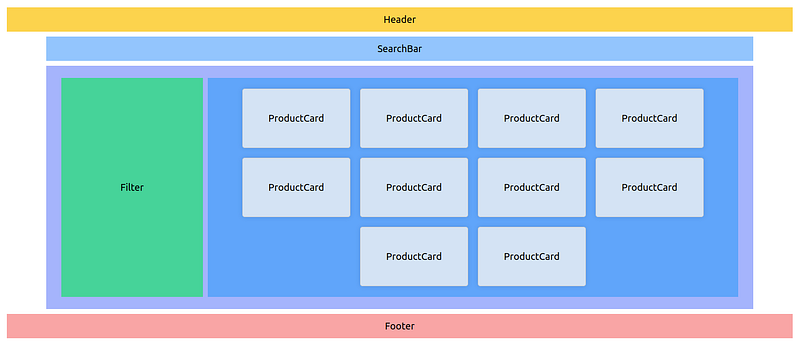
Classic Component-Based Architecture for e-commerce

Each component in React is an independent, reusable piece of code that controls a part of the UI.

They are like the ingredients in a recipe.

Each has its unique properties, but when combined, they make a complete dish. In React, we combine components to build more complex UIs.

A React component can be as simple as a button with an onClick event or as complex as a whole page.

Each component has its lifecycle, its state, and its properties (props).

Here is an example of a very basic React component:

function Welcome(props) {
  return <h1>Hello, {props.name}</h1>;
}

In this code, Welcome is a function component that accepts an object props as a parameter and returns a React element. This function is being used like an HTML tag in the render method <Welcome name="Sara" /> and the rendered HTML will be <h1>Hello, Sara</h1>.

The Beauty of Component-Based Architecture

Component-based architecture, which is at the heart of React, promotes reusability, maintainability, and readability.

Imagine you’re an architect designing a city. You don’t create every building from scratch. You design different types of buildings: houses, skyscrapers, malls, etc.

Each of these types can be seen as a “component”.

When you design a new neighborhood, you don’t start from zero; you use the building designs you’ve already created, placing them in different arrangements to create diverse and vibrant areas. This is the power of components!

Components enable us to write reusable code. We write once and use it multiple times, reducing redundancy. It’s like the philosophy behind “DRY” (Don’t Repeat Yourself) met web development and they became best friends.

Unraveling Props and State

In our journey with React, two of the most crucial concepts that we encounter are “Props” and “State”.

Props (short for properties) allow components to communicate with each other. They are similar to function arguments: they pass information from one component to another.

State, on the other hand, is like a component’s personal data store. It’s where a component keeps track of information that can change over time, and affect what the component outputs.

React and the Virtual DOM

React makes use of a concept called the Virtual DOM.

You can think of the Virtual DOM as a lightweight copy of the actual DOM.

Whenever a component’s state changes, a new Virtual DOM gets created. This Virtual DOM is then compared with the old one, and only the changes (differences) are updated in the real DOM.

This diffing algorithm, as it is called, makes React fast and efficient.

Conclusion

React offers a powerful approach to building fast and scalable applications. It does this by providing us with a component-based architecture, encouraging code reusability, and enhancing performance with the Virtual DOM. For those starting their journey into this star called React, understanding its core principle — the component-based architecture — is the key to unlocking its full potential.

React’s component architecture is a powerful ally. It allows us to think about our application as a modular and reusable set of pieces, enhancing our code’s readability, maintainability, and scalability. It’s like being handed the keys to a powerful spaceship, capable of taking us on incredible journeys through the universe of web development.

As we continue exploring, we’ll discover that this is only the beginning of what React has to offer.

  1. Official React Documentation: This is the perfect place to start. It covers everything you need to know about React and is the most reliable source of information. Official React Documentation
  2. React Component: To gain a deeper understanding of components in React, this page in the official documentation will be very helpful. React Component Documentation
  3. React State and Lifecycle: This link will help you understand the concepts of state and lifecycle in a React component. State and Lifecycle
  4. Thinking in React: This official guide is great for understanding how to start building in React, especially when it comes to component-based architecture. Thinking in React
  5. The Beginner’s Guide to React: This free course on Egghead.io by Kent C. Dodds is an excellent resource for beginners to React. The Beginner’s Guide to React
  6. Learn React for free: This interactive course by Scrimba lets you learn React by doing, with plenty of exercises and projects. Learn React for free

Enjoyed the read? For more on Web Development, JavaScript, Next.js, Cybersecurity, and Blockchain, check out my other articles here:

If you have questions or feedback, don’t hesitate to reach out at [email protected] or in the comments section.

[Disclosure: Every article I pen is a fusion of my ideas and the supportive capabilities of artificial intelligence. While AI assists in refining and elaborating, the core thoughts and concepts stem from my perspective and knowledge. To know more about my creative process, read this article.]

In Plain English

Thank you for being a part of our community! Before you go:

Reactjs
Programming
JavaScript
Technology
Web Development
Recommended from ReadMedium