
Use Ethers.js to Interact With the Ethereum Virtual Machine in Remix
A beginner’s guide for ethers.js

Ethers.js and web3.js are two JavaScript libraries that allow developers to interact with the Ethereum blockchain. Both of them are open-source libraries that can accomplish the tasks for Ethereum developers.
The following is a diagram of npm trends between ethers.js and web3.js:
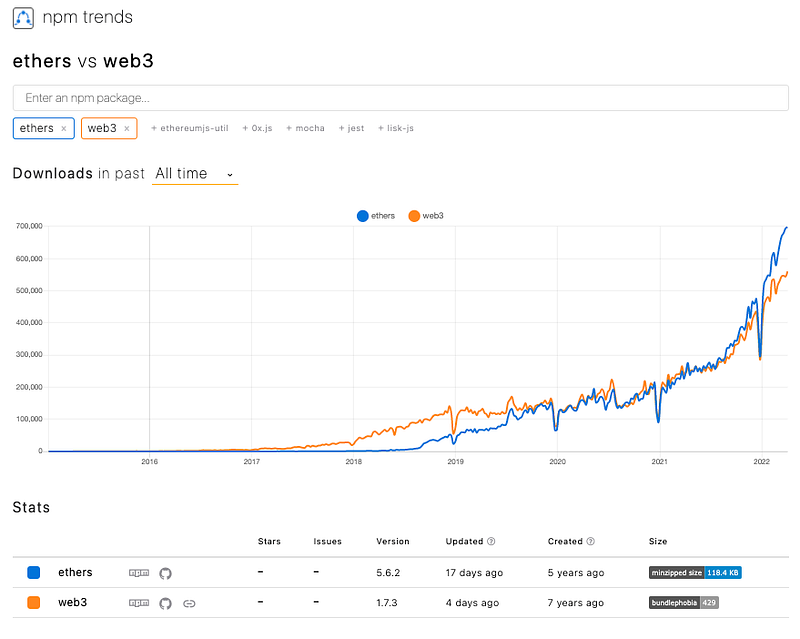
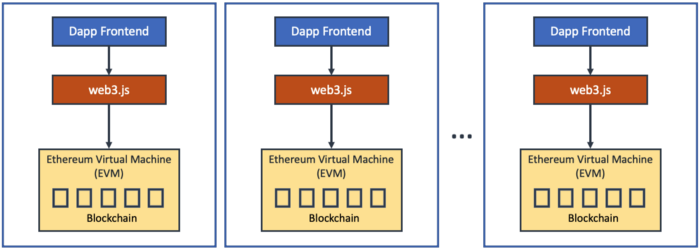
Web3.js is built by the Ethereum Foundation, with 281 contributors. The library has been extensively adopted by many projects. We have written an article on how to use web3.js in Remix.
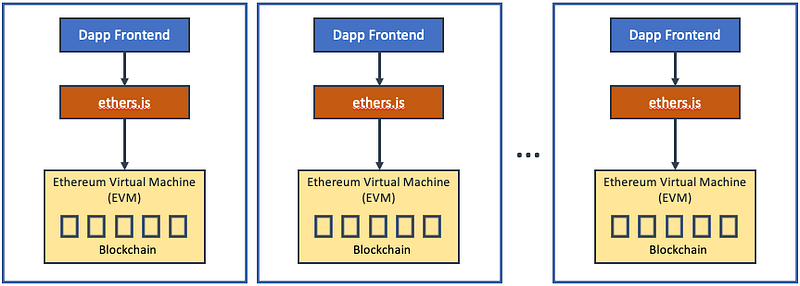
In this article, we take a close look at ethers.js, which was initially developed and maintained by Rick Moore, a Canadian developer. Currently, it has 14 contributors. The library has a smaller bundle size, is well tested, documented, and maintained.
The Working Environment
We use Remix, a full-stack React framework, as a base to explore ethers.js. The following command creates a Remix project:
% npx create-remix my-remix-app
% cd my-remix-app
Set up ethers, along with react-json-pretty:
npm i ethers react-json-prettyThese packages become part of dependencies in package.json:
The Remix working environment is ready to explore ethers.js.
Provider, Signer, and Contract
Provider, Signer, and Contract are three essential classes in ether.js. They are used to communicate with a smart contract.
Provider
Provider is a class that provides a connection to the Ethereum Network. It provides read-only access to the Blockchain and its state.
getDefaultProvider, exported from ethers, can be used to construct a provider. It takes two parameters — the first one is network, which takes one of the following values:
homestead- Homestead (Mainnet)ropsten- Ropsten (proof-of-work testnet)rinkeby- Rinkeby (proof-of-authority testnet)goerli- Görli (clique testnet)kovan- Kovan (proof-of-authority testnet)
The second parameter is options, which supports the following key/value pairs:
etherscan:ETHERSCAN_API_KEYinfura:INFURA_PROJECT_IDalchemy:ALCHEMY_API_KEYpocket:POCKET_APPLICATION_KEYankr:ANKR_API_KEY
In the following code, we choose the infura network, along with the INFURA_PROJECT_ID, 57e665ef67b44c4687ad529b8b89397c, created from our web3.js project.
Alternatively, we can crate a provider by importing provides from ethers, and new providers.InfuraProvider with the same parameters.
Signer
Signer is a class that uses a private key to sign messages/transactions to authorize the operations. It is an abstraction of the user’s wallet address. It can be instantiated by the Wallet’s static method.
Contract
Contract is a class that represents a connection to a specific contract on the Ethereum Network.
We can import Contract from ethers, and create an instance with new Contract(daiAddress, daiAbi, provider).
daiAddressis the Ethereum name service. We set it to"dai.tokens.ethers.eth". Dai is a stablecoin cryptocurrency which aims to keep its value as close to one United States dollar (USD) as possible.daiAbispecifies a contract with an Application Binary Interface (ABI), which describes the methods and events it has. These methods are used to communicate with a contract on-chain (governed contract), and to encode and decode the data.
provideris the connection to the Ethereum Network.
Using Provider, Signer, and Contract in Remix
We use Remix as working environment. app/entry.server.jsx is the first bit of JavaScript that will run when a request hits the server. It loads only the necessary data, but developers need to handle the response. This file renders the React app to a string/stream that is sent as a response to the client.
Here is the modified app/entry.server.jsx, which creates a provider (line 6), a signer (line 11), and a contract (line 33).
These instances are imported to app/routes/index.jsx, the indexed route that is invoked by default.
In line 2, react-json-pretty is imported as JSONPretty, which prettifies JSON data. This component is used at line 60.
In line 3, utils, a utility collection, is imported from ethers.
In line 4, daiContract, provider, signer are imported from app/entry.server.jsx.
The loader function (lines 6–56) is a special API. It is exported to be called on the server before rendering. We use it to show the content of signer, daiContract, and provider.
For signer, we can view private key (line 7), public key (line 11), and address (line 15).
Signing messages can be used for various methods of authentication and off-chain (ungoverned contract) operations, which can be put on-chain if necessary.
In line 19, it signs a string message.
At line 31, it signs a digest hash.
In line 35, it retrieves the contact name.
In line 39, it retrieves the symbol name.
In line 43, it retrieves the balance in BigNumber format, which is an object that safely allows mathematical operations on numbers of any magnitude.
The default unit is Wei, which is the smallest denomination of Ether (ETH), the native cryptocurrency of Ethereum. The following is the conversion rate between different units.
1 Ether = 10³Finney = 10⁶Szabo = 10⁹Gwei = 10¹²Mwei = 10¹⁵Kwei = 10¹⁸WeiIn lines 47–53, the balance is formatted by various units.
In line 55, the loader function is resolved with the provider object.
On line 59, useLoaderData is invoked to retrieve the loaded data, result.
Line 60, JSONPretty shows result on the browser.
Execute the Remix app by npm run dev, and go to the browser window. We see a long list of the provider object.
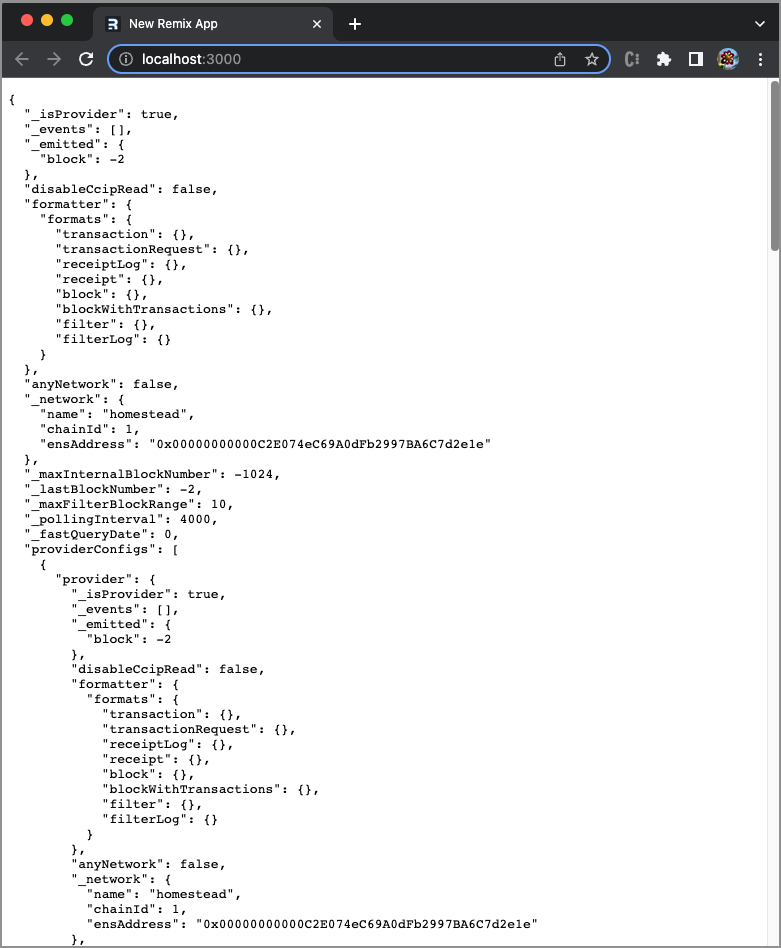
Collapse the provider object by http://jsonviewer.stack.hu/:
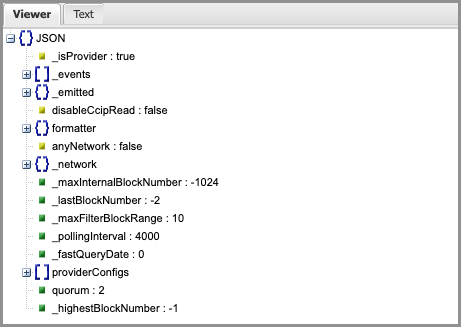
It shows the first-level props and methods.
Comparing to web3.js, the data structure in ethers.js is more concise, and there is no circular reference issue. Otherwise, they accomplish similar operations.
Conclusion
We have shown how to use ethers.js to interact with the Ethereum virtual machine, via Infura.
ethers.js and web3.js are two JavaScript libraries that allow developers to interact with the Ethereum blockchain. Both of them grow exponentially during Web3 development. These JavaScript packages are developed to shape the internet’s future.
Thanks for reading. I hope this was helpful. If you are interested, check out my other Medium articles.


