
THE GUMROAD GUIDE
A Year of Selling eBooks on Gumroad — Here’s What Doesn’t Work
How not to sell ebooks on Gumroad
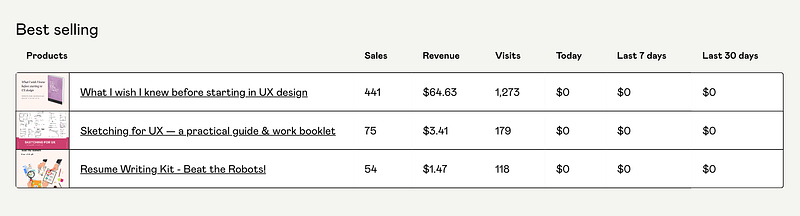
This morning, I looked at my Gumroad statistics for the past year, and the result was insane.
Insanely bad.
I’m not going to make you wait for a big bang at the end of this article because I respect your time, and I know that’s why you’re here. So, here it is:
I’ve made a whopping $64.63 selling an ebook on Gumroad.
But I could have earned more. Way more.
I hope you won’t leave this article just yet because I want to share my failure on Gumroad. If you’re going to sell digital products online (using platforms like Gumroad), my mistake will definitely help you.
Every day, we read success stories.
But every success story has a backstory of failed experiments.
Now, I’ll give you mine.
My book didn’t solve the right problem
My book was a passion project.
It was a story I wanted to tell.
I spent countless hours during NaNoWriMo to finish a draft of my book.
The draft ended up over 50K words which I edited it down to just about 37K words — it’s a length you can read within 4 hours.
During the editing process, I had to admit some parts of the book were more useful than others, and occasionally I was biased and shared too much about my personal life. So I cut the book short(er).
My book didn’t solve the big problems of my customers.
It’s 30% autobiography, 50% UX design-related topics, and 20% Notion library template with valuable links.
I received countless messages about the best part of the book, which was a how-to guide to solving whiteboard design challenges.
Funnily enough, this part was the only content you could find online at the time, as it’s one of my oldest articles on Medium from 2019.
I didn’t do market research before writing
Rather than spending a month buried in my apartment, I should’ve turned to Google Trends or AnswerThePublic before working even a minute on the book.
Market research would’ve helped me
- understand what my readers wanted,
- ensure the book was in demand,
- increase chances of sales,
- and avoid wasting time on topics with little interest.
Doing market research would’ve been wise.
If I’m honest, I likely would’ve ignored the research findings because I felt strongly about writing this book. You know the feeling — the feeling when you can’t not write.
I picked a title that didn’t sell
The title of my book is What I wish I knew before starting in UX design.
Is it an ok title? Meh.
Is it a great title that helps with selling? 1000% no.
It’s a title picked by someone who knew nothing about SEO or selling things online — after 18 months, I’m still only scratching the surface. However, I’m learning tons in the past couple of months.
A title should be relevant, short, memorable, clear, searchable, and keyword optimized.
I only had UX design in the title, but the phrase wasn’t strong enough to drive sales to my Gumroad product.
In a world of thousands of design products, where each competes for attention and buyers’ money, my ebook didn’t even stand a chance on Gumroad.
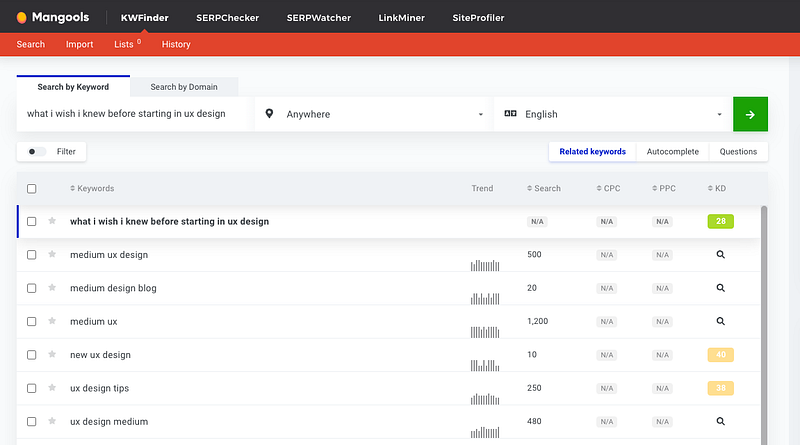
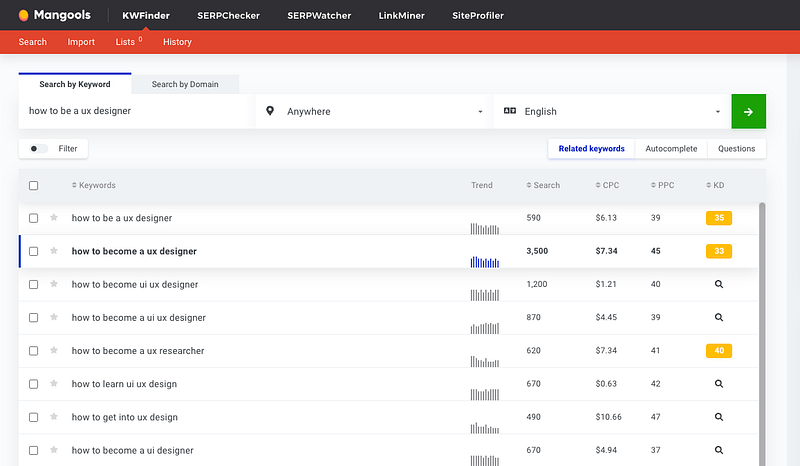
Instead, at least I should’ve done a 5-minute keyword research. It would’ve told me ‘How to become a UX designer — my story’ would’ve been a more searchable and sellable title.
I picked a cover that wasn’t eye-catching
Let’s take a look at the book cover.
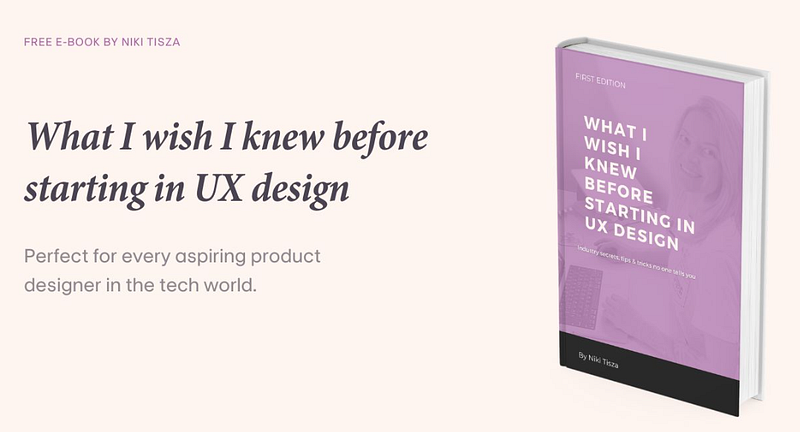
I missed asking the following questions regarding the cover design:
- Is it attention-grabbing?
- Is it relevant to reflect the content?
- Does it show quality?
- Does it show originality?
- Does it evoke emotion and curiosity?
- Does it appeal to my target audience?
If I asked these questions, I would’ve known the book cover won’t drive enough sales.
The cover is a reader’s first interaction with a book. It must be compelling enough for readers to click the ‘I want this!’ button.
I didn’t create sales funnels
I collected the email addresses of people interested in my ebook for a couple of months before launching my ebook.
I utilized the bird app for lead generation, using Google Forms to sign up for the launch.
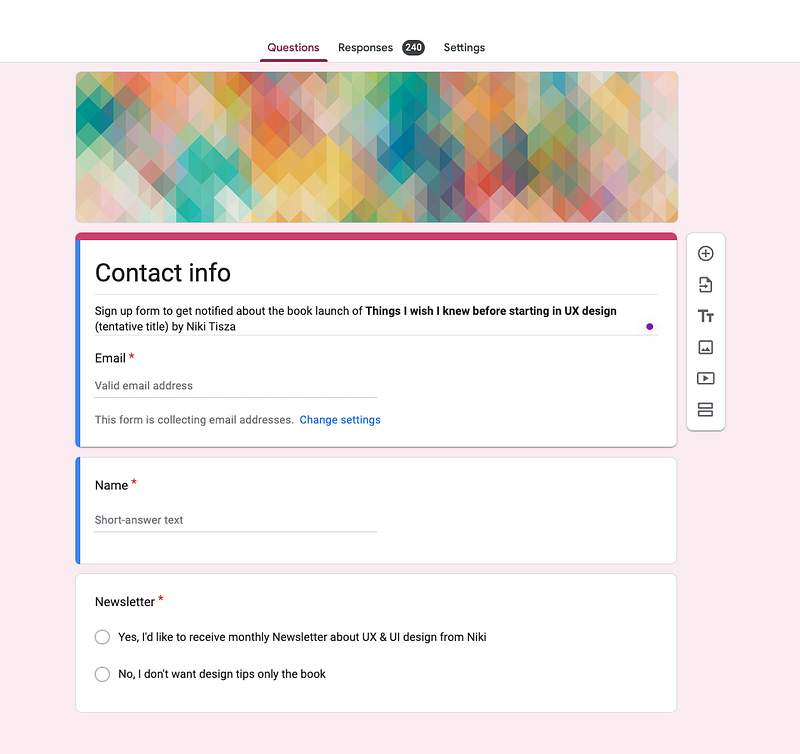
I had close to 1000 followers on Twitter, and a few people shared my tweet about the book, so it eventually reached thousands. 240 people signed up, which made me super happy. That was exciting and more than I imagined.
Today, I know better.
My marketing efforts should’ve been more aggressive to attract buyers. Here are the mistakes I made:
- I underutilized my social media, Medium, and YouTube.
- I didn’t create enough teaser content. I should’ve written more articles and product more videos about the topic.
- I didn’t create a lead magnet, e.g. I didn’t offer a free chapter in exchange for an email address.
- I didn’t do a launch promotion.
- I didn’t ask for early testimonials to showcase endorsement.
- I didn’t offer the book on multiple platforms.
- I didn’t do any post-purchase activity, e.g. no thank you emails.
- I didn’t introduce referral programmes early enough.
Where did people come from?
When writing this article, the book received 1,273 visits and had 441 sales.

We can look at the referrer breakdown in different ways; however, I find money speaks the loudest. With a 29% conversion rate, the ‘Direct, email, IM’ source performed the best, resulting in 144 sales and $35.83 revenue.
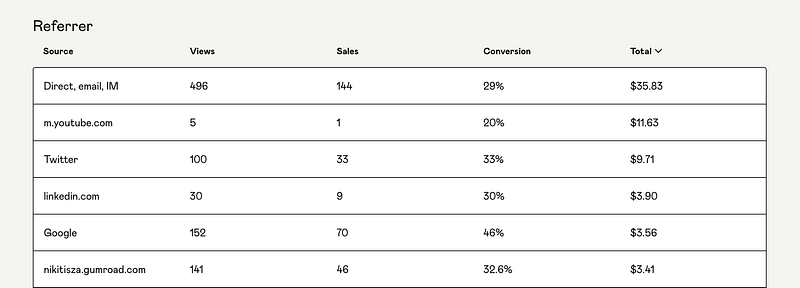
Based on this result, I assume that people who know me would be interested in purchasing my products.
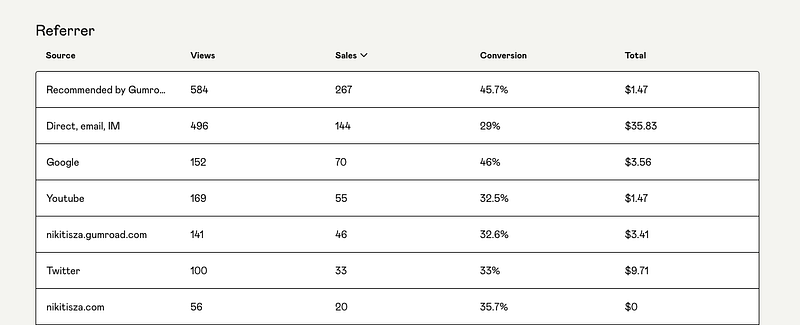
However, there are other avenues for profit. For example, ads could be a great option. ‘Recommended by Gumroad’ and ‘Google’ brought in $5.03 each, with 45.7% and 46% conversion rates, respectively. As an experiment, I’ll test Gumroad and Google ads next time.
The formula for selling online successfully is simple
- Choose a problem you can solve.
- Research the market before doing anything.
- Choose a title that will sell.
- Pick the most suitable format for your product.
- Create an outline for your entire product.
- Outsource or create the product yourself.
- Create a sales funnel.
- Cha-ching!
- Repeat.
Would I do it again?
Despite earning so little, my answer is still: Absolutely!
I’ve learnt tons since I started my online solopreneur journey.
I would do it again but in a smarter way.
I put my heart and soul into this book and produced the best writing I could.
The book has gone through a few price iterations in the past year. It was free for a short time. Then I tried to sell it for $5, and then I gave it away for free. Finally, I introduced a 2-tier pricing scheme:
- Supporter — $5 contribution
- Freemium — pay as much as you want, including $0
I’m contemplating the idea of releasing a second edition of the book with a different title & cover, proper market & keyword research, and a sales funnel while putting my audience’s interest first. And, of course, with religious monitoring, tracking, and constant refinement of strategies to see what works best.
Stay tuned!
If you’re new to me, my name is Niki. Writing about my design solopreneur experiments and adventures is one of my favourite things to do. If you’d like to know more about me:


