
A Year of Living Carefully
I picked up a bottle of Montepulciano this morning.
The only reason that’s remarkable is it’s a sort of thing I haven’t done in more than a year. Meaning, run out to pick up a bottle of wine to bring to a dinner with friends.
Everything in the past year has been carefully managed to minimize the number of visits to places where I might encounter other human beings. We do errands on days when the stores tend to be uncrowded, and stick with what’s on the list. Life neatly choreographed to eliminate frivolous trips — like running out to get a bottle of Montepulciano.
The dinner with our friends was eaten in the new fashion. Outside. Socially distanced. With a toasty firepit between us and robes across our laps. It is, after all, March in Minnesota.
My friends have been “jabbed.” My wife and I have not. I don’t know what the proper etiquette is for dinner conversation between the vaccinated and unvaccinated. Does one avoid the topic altogether, for fear of triggering vaccine envy? We’re good enough friends that it wasn’t an issue. We’re happy for them and their newfound ability to hold the grandkids. They empathized with us and the relative youth that’s kept us off the list of eligible for a shot. The conversation moved on.
I should note we were a bit more cavalier about the dinner than we might have been last summer. Back then we would have brought our own paper plates and plastic cutlery, not to mention our own food and separate bottles of wine.
I bring all this up because we’re officially a year into the global pandemic and its associated deprivations. I keep reading there are two kinds of response. Pandemic fatigue — a burning need to just sit in a coffee shop or bar once again. And pandemic rage — a burning anger at the universe now focused on being asked to deal with this strange and deadly virus come upon our shores. Both conditions result in people crowding into places they probably shouldn’t just yet, with the rage variant most often accompanied by unmasked mouth breathing.
I’d suggest there’s a third response. Pandemic familiarity. A lot of us have been paying attention. Calculating risks. Making adjustments. We learned we didn’t need to scrub the groceries with Clorox. We learned we did need to wear masks. That adding them to the equation made everyone a little safer, and our worlds incrementally larger. A trip to the store became less terrifying once we learned how to do it carefully. So the next logical step would be to ask what other sorts of trips can be safely put back on the agenda.
I wonder if some of what gets dismissed as pandemic fatigue isn’t actually this methodical expansion of the boundaries that have kept us safe so far. A kind of crowd-sourced public health. Not a perfect system. But thinking of it this way puts a finer point on how we understand human activity a year into a killer pandemic. We can distinguish between behavior that is calculated and behavior that is knuckleheaded.
Maybe it’s because I work as a storyteller, but the idea of pandemic familiarity marks the distance between a year ago and now with chilling clarity. In a good dystopian science fiction movie, the way to signal a terrifying future where monsters roam the streets isn’t to show the monsters. It’s to show the minor adjustments made to the daily routine so a remnant of normal can go on and you hopefully avoid ending up in the jaws of a monster.
For me, that’s grabbing the trusty N95 off the peg by the door so I feel relatively safe going out into the world to pick up a bottle of Italian table wine for the evening’s dinner.
We are seeing signs that all this anxiousness may become less necessary at some not-so-far-off point, although we still don’t know when. Shots are going into arms, but none of the waiting lists I’m promises to send one in my direction. So mostly what I do is watch. Texas opened up. Parts of Florida are shutting down as spring break mobs slosh overboard. The Tokyo Olympics will perform to empty stadiums. Dr. Anthony S. Fauci is on the TV cautioning that variants threaten to become the new monsters in the street.
I made two purchases at the beginning of last year, before the world slid into the pandemic. Maybe it’s because I’ve made so few since other than groceries and paper products, but they still peg for me how life has altered in the year since.
I bought a pair of shoes, comfortable and stylish, perfect for some travel I had planned over the summer. 12 months later they remain unworn in their box at the bottom of the closet.
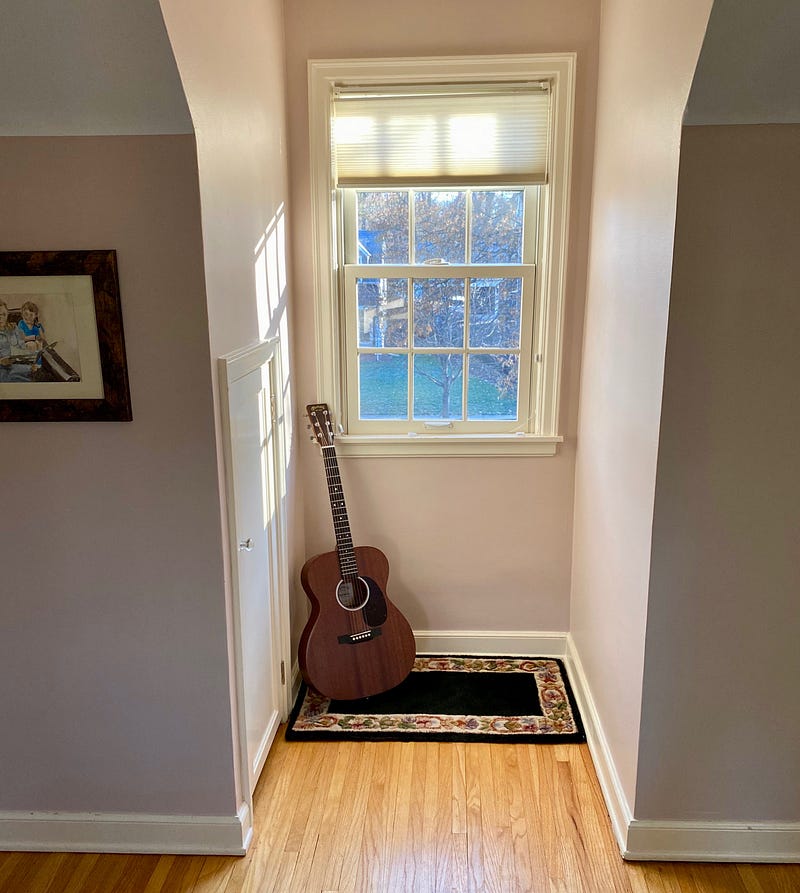
I bought a new guitar, just the right size and construction for playing old blues songs. It has become my constant creative partner in the long days of working from home. Its shape and warm tone serve as an imperfect stand-in for the human collaboration I used to experience, showing up for work every day in a creative department. And the perfect way to express its loss.