
A Wild Swim, Joy Ride & Rock Star Run
The power of counting to ten and living the dream
“The swim will be a nightmare,” I whispered. Me and a slew of bodies splashing in the rocky waves in skin-numbing temperature. I was hyped up on nerves and adrenaline on Race Day — but I had zero sleep the night before.
One hundred nineteen women of different ages and sizes stood barefoot — scattered along the shoreline at Second Beach. Some shivered, a few did jumping jacks, and others dipped their toes into the water.
The wind lashed my hair across my face beneath the grey skies that September morning. It was high tide, the water was a cool 15 degrees C (59F), and wetsuits were mandatory. I scanned the race course — three yellow buoys set up in a triangle, each spaced 250 meters apart, floating in the Pacific Ocean. I hoped to swim the 750m distance portion of the Vancouver Triathlon without stopping, but I was scared and dreading the experience.
Ready, set, go! No, wait…
When the race horn blasted, the throng of wet-suited bodies charged into the water. I took a deep breath and reminded myself of my swim coach’s advice.
“Slowly count to 10 after the start. Let some of the chaos leave you behind. Then start your swim.”
The theory behind this advice is that 10 seconds is not going to make or break the race, but it will give a swimmer more space, less anxiety, and reduce the chance of bumping into bodies.
Last year, when I did the same triathlon (but the shorter 300-metre ocean swim distance), it was a frantic, chaotic swim with bodies flailing in every direction. I was breathless, anxious, and terrified the whole time. I was still trying to regain my breath and slow down my nervous system halfway into my bike ride. The experience was horrible.
Coach Stewart gave me that same advice last year, but I didn’t take it. But this year, I did.
Counting to 10
I’m an open-water beginner swimmer, and my swim pace is on the slow side. A 750m pool swim takes me between 26-35 minutes. I estimated the 750m ocean swim would take me 45+ minutes to finish as I was averaging 100 meters every six minutes. Typically, that’s how long it took whenever I was practicing open water swims without a wetsuit.
I don’t wear wetsuits for practice because I like the sensation of water on my bare skin, and I dislike the tediousness of squeezing into one and peeling it off. Instead, I wear my bikini or one-piece swimsuit to test how long my body can last in the water before the cold becomes unbearable. Swimming regularly in cold waters activates adipose tissue (brown fat), which helps me stay warmer in the water.
After the race horn started — I told myself to relax, breathe, swim at my own pace, and pretend I was swimming alone.
I counted to ten and stepped into the water.
With focus and calmness — I glided through the water using breaststroke for the first minute and then freestyle form (front crawl) and took a breath every second stroke. By the time I neared the first buoy, I caught up with about a dozen swimmers. I got kicked in the head by a few, and a couple of bodies bumped into my left side. I swam away from them, regained composure, and kept swimming.
The Pacific Ocean was choppy and wild as hell — but I loved it!
Swimming in crazy waters forces me to push myself to survive — a test of will and strength. The suffering I experience is what I term “scary-fun” because it’s scary as hell but makes me vibrant and alive, but simultaneously — I need to chill and let go of my anxiety in order to stay calm and maneuver the waves. I’m drawn to the unpredictability of the waters because it makes me pay attention— right to the millisecond — because there is only one other choice.
Drowning.
Cold Water Swim Practice
My swimming practice in rough waters without a wetsuit paid off. Wearing a wetsuit on Race Day made the swim easier, gave me buoyancy, and kept me warm. I was used to swimming in boisterous, cold waters throughout the seasons in different types of weather in my swimsuit.
The wetsuit did wonders — it kept me safe and provided me with a layer of trust. If I got too fatigued or stressed during the swim, I could pause, take a moment, float on my stomach, and believe that the wetsuit would keep me afloat — but I didn’t need to stop.
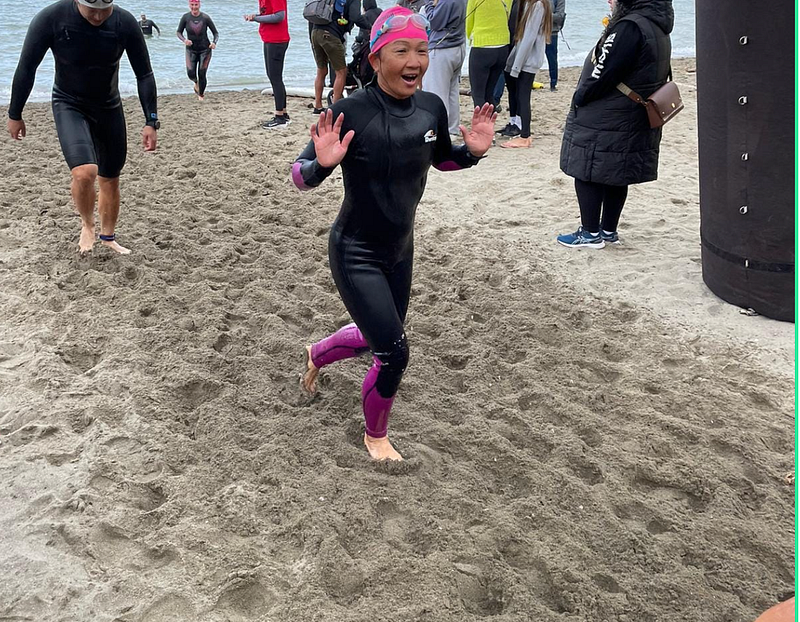
A proud swim and running with AC/DC
I was beaming when I finished the swim because it took me 25:33 minutes. This is not considered a fast swim time, but for me — it was a personal record. Most female racers completed the swim between 15–20 minutes. The fastest swim time for women was 11:16, and the slowest time was 31:52. I tackled each wave with confidence while getting thrust up, down, and sideways with the bouncy currents.
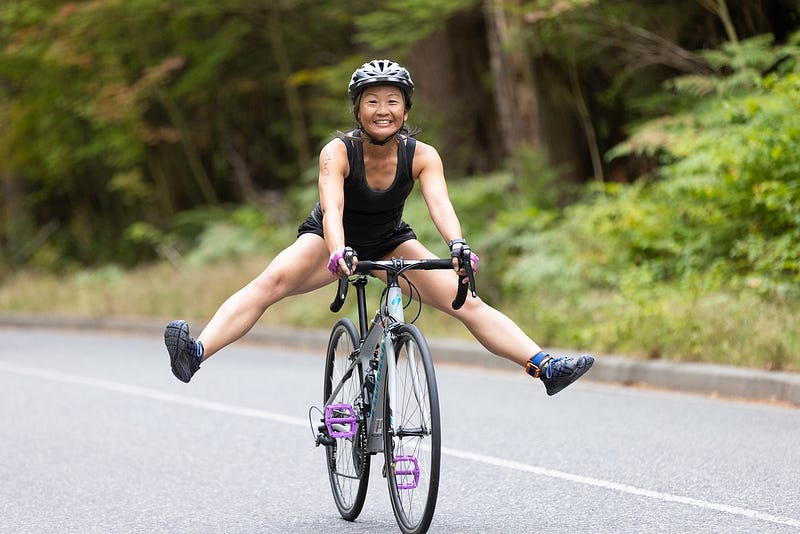
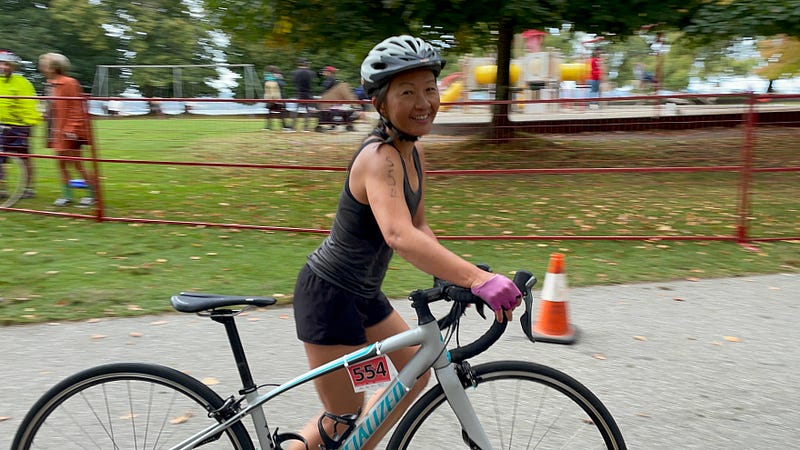
I pedaled with delight through the 19km undulating course — embracing the downhill like a joy ride of a rollercoaster. The final leg of the race was a flat 5km seawall run, but the distance was on hard, unforgiving pavement — and my feet were killing me from my plantar fasciitis.
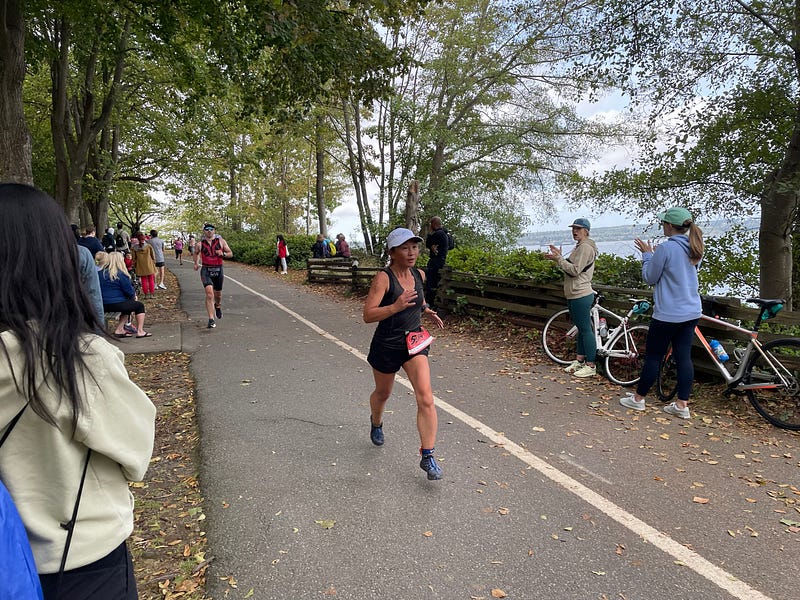
At the last 500 meters of the run course, a spectator was cheering and blasting “Back in Black” by AC/DC — and that sultry, heart-pounding song gave me a shot of energy and pumped me up to cross the finish line like a rock star belting out her final tune.
Race stats for the Vancouver Triathlon Sprint
I did the swim in 25:33 (750m), the bike in 43:18 (19km), and the 5km run in 28:24. My first transition after the swim was 6:15, and my second transition after the bike was 2:48. Overall, my time was 1:46:16. I placed 2nd out of 5 racers for my gender/age group, 77/119 female racers, and 195/256 racers overall.

I trusted the advice of my swim coach and learned that the key to finishing strong in the swim is to let the swimmers go ahead after the race start, hold myself back, and then start the swim at my own pace. I focused on my own swim, tuned out the other swimmers, and pretended that I was swimming alone.
I let go of my anxiety and flowed with the water instead of fighting it.
Never say never
Three summers ago, I wouldn’t dare to swim in open water if my feet couldn’t touch the bottom. Back then, I never imagined I’d do a triathlon, but last year, I did two “mini-sprint” triathlons, and this year I did my first official Sprint distance triathlon.
It was a three-year process of teaching myself to swim in open waters to face my fear of drowning, taking swim lessons, and practicing whenever I could — to cross the finish line.
Going the distance of a race isn’t just stress, pressure, and anxiety. It’s about putting the time, hard work, and effort into achieving a goal I once thought was impossible. I tested the human spirit and my endurance — and by slowing down for just 10 seconds — it inadvertently gave me the space and clarity to unleash my fun-loving spirit during the race and truly embrace the experience through a wild swim, roller-coaster bike ride, and seawall run.
Triathlons are about trying one’s best and having fun
The Vancouver Triathlon was a milestone because it was the most fun race I’ve done to date. At age 53, it was my third triathlon — I followed my self-mantra “Try, Mary, Try!” and earned a finishing medal. The triathlon is the quintessential race to test my self-mantra in three different sports.
Unexpectedly, I earned a place on the podium — a silver medal for placing 2nd in my division (Females ages 50–54) — it’s the first time in my adult life that I’ve placed in the top three for a race. However, I didn’t know about this until two weeks later when I was chatting with my swim group about the triathlon. I left the race after I finished and didn’t stay for the awards ceremony. I assumed only the top three finishers overall would make the podium.
The advantage of being my age combined with the chances of reaching the podium is that fewer people dare to attempt triathlons after age 50!
I wasn’t the fastest or slowest swimmer, cyclist, or runner, but I conquered a self-challenge and experienced an extraordinary “racer’s high.” My race times were average, but my smile was not. I swear — the proud smile on my face was the biggest and brightest one out of the 256 racers on Race Day. Check out the feature photo.
It was a race that gave me the most joy and self-validation because I thought the swim would be a nightmare — but it turned out to be my personal best, and on that day — I was living the dream. I’ll never know the outcome of a goal I set unless I let go, believe in myself, and trust the process — all while embracing the spirit of fun.
About the writer
Mary Chang is a writer, creator, and editor of the Six Word Photo Story Challenge publication. Visit the submission guidelines if you’d like to submit a story. She’s also a parent and fitness enthusiast who loves creating monthly challenges. Mary believes that if she can push herself to take on new challenges, it may inspire others to try, too. Her self-mantra is “Try, Mary, Try!” Fueled by cartwheels, cold open water swimming, and the spirit of fun. Defying and embracing middle age.
Other stories published in Age of Empathy.


