
A Veterans Instinct: Why We Run Towards Fire
The training and the duty behind every veteran called to continue influencing and serving others after service
When I was discharged we didn’t have the same transition services that were available to us today. With a handshake, we returned our kit, and over a brief interview (don’t call us we’ll call you) we were dumped back into civilian life.
I found myself thrown to a house shared with my girlfriend of the time. As an 18 year old I didn’t want to return to my parents.
It was a two-story home. I struggled to find a routine in the absence of the military discipline I had grown accoustomed to. I took to running to maintain a sense of what I thought was normal.
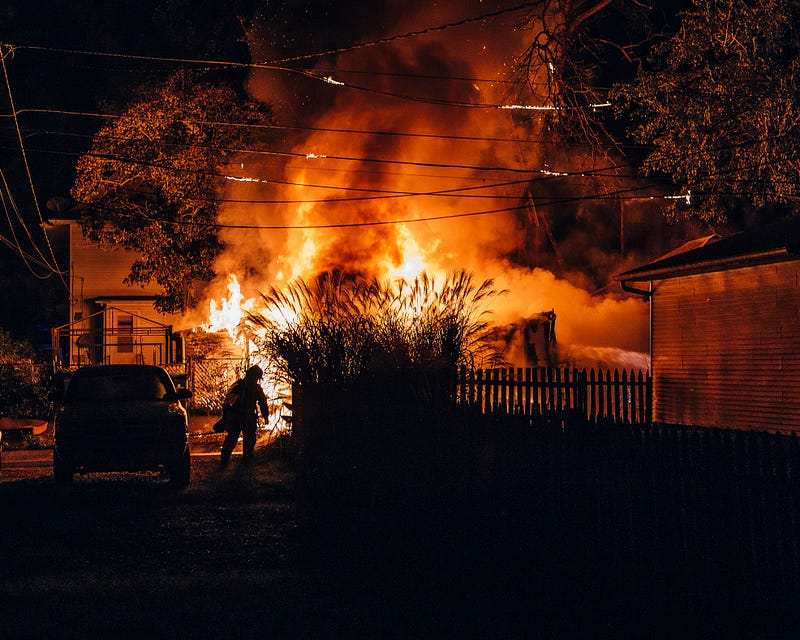
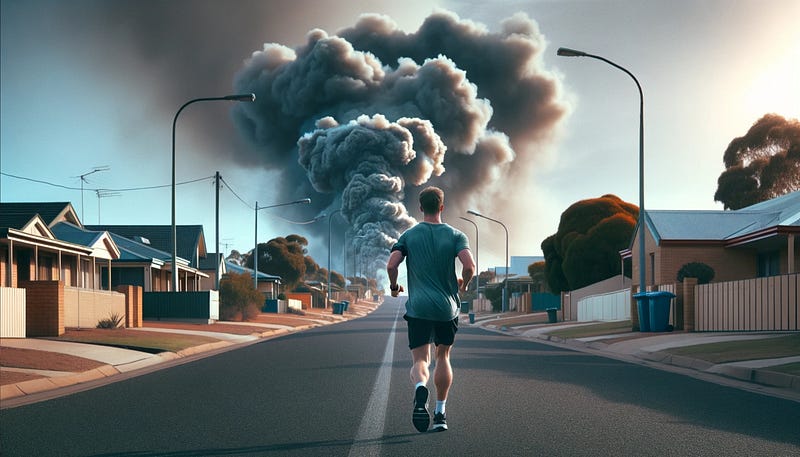
A month after discharge I was looking from the window of this second story house and I saw a great smoke plume rising in a neighbouring street that was on my running routes. To this day I don’t know why I did what I did next.
Without a second thought, I sprinted down the stairs and out the door towards the scene.
One second I’m in the middle of a conversation with my girlfriend, the next minute I’m sprinting towards a fire.
I look back and want to think it shows how our basic training worked to condition us to serve. We run towards danger. We don’t run from it.
The Incident and Response
Someone had firebombed a car a few blocks away from where I lived. I would find out later that the fire was gang-related. A nearby neighbour had rang police but, the address wasn’t communicated. The residents weren’t the ones who had contacted emergency services for fear of reprisals.
Importantly though, no one on scene was trained for such an event. There was no basic knowledge of what to do. No one had any foresight to head down to guide local services.
The houses were built in a relatively new area of development. It was not the easiest to get into. While there was a main street the roads themselves could be an inevitable rabbit warren for the unknown. I knew this as I’d been regularly runing through these streets during my morning and evening runs.
As I sprinted towards the fire, emergency services were likewise racing towards the scene. As I rounded the corner of the main street to connect into the development I could see a fire truck hurtling down the main street towards me.
It completely missed the entry to the development and raced straight past me, continuing to accelerate around the corner and out of sight.
Having seen where the fire was from my two-story vantage point on the hill I knew where the fire was. My morning runs likewise meant I knew which roads were used to get into the development. I also knew that vital time was now being lost as the first truck dispatched had just missed where they needed to go.
I continued to run down the main street towards the corner that the truck was supposed to have taken. I was within about 30 meters when a second truck came hurtling down the street, once again showing no signs of stopping to make the turn.
I knew immediately what needed to happen. Instinctually training kicked in.
I took command.
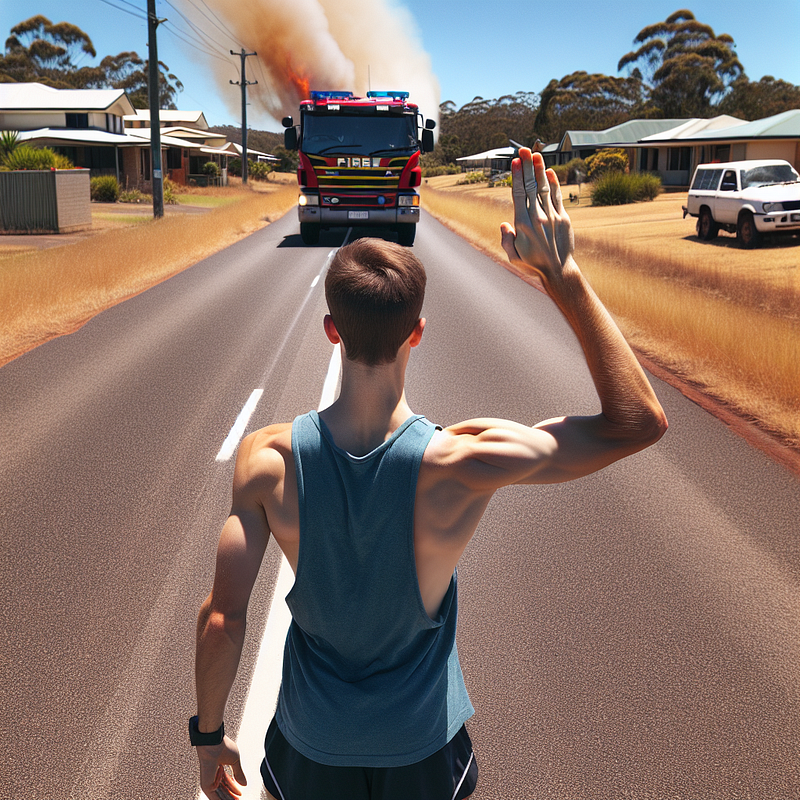
I locked eyes with the driver and with a single commanding gesture, knife handed towards the right street that they needed to turn.
The effect was immediate.
The truck locked brakes and in a squeal of brakes and smoking tyres, cornered into the street; overfilled water spilling from the top of the tank onto the road, marking the way forward.
I continued to the scene.
As I crossed the road and headed another 50m up the hill into the development. I could now hear the sirens of the first fire truck returning and turning into the right road; guided by the spilled hydration.
When I arrived on the scene, the civilians who had been attacked by local gang were distraught. Their car was engulfed. Their house was smoke-damaged but the second truck had managed to deploy hoses and put water down to extinguish the car. The fire was prevented from spreading to the house.
I stood for a few seconds to watch the scene. The professionals had it well in control. There was no need for further intervention. Local police were starting to arrive on the scene. Realising there was nothing more I needed to do. I started to head back home.
That happened over a decade ago. I don’t think I’ve told many people about it. I’ve never really thought it important.
But, it is.
This story effectively tells what most in the Veteran Community already know. We don’t do things because we want recognition. We do them because we have this deeply rooted, deeply seated need to serve others.
That same training that we all go through is part of a wider psychological effort to take well-meaning individuals and position them as the type of person who will, willingly run towards danger while maintaining effective control and command of a scene to ensure the right information is relayed to the right people at the right time to achieve maximum results.
But that same training is where many of us come unstuck when transitioning.
While it is known it is an effective process for taking us to our most basic and then rebuilding in the image needed for defence, without that purpose we suddenly become lost.
It certainly happened to me for many years post defence.
Its an issue I’ve been reflecting on recently and working on with our mission and focus at RHEM Labs. While we have a clear vision to revolutionise accessibility through AI, our mission to acehive that vision is multi faceted.
One of the pillars of that mission is to enable Wounded Warriors to communicate so they can continue to influence and serve. Another is to disrupt societal norms using AI.
Fundamentally, we exist to revolutionise the concept of accessibility through the use of AI as a reasonable adjustment to many of humanity’s most debilitating disabilities, and we do this by removing biases and fostering inclusive processes in the models and tools we use.
That has different applications and comes about in different ways.
Focusing on veterans as a great example, they have a skillset that has been honed by millions of dollars worth of training.
It is a tragedy if those skills — that innate ability to run towards danger; that deeply ingrained value system that attracts civilians to become members — becomes lost when members transition to become veterans.
If veterans are unable to continue their own personal mission, their own personal calling to influence and serve then society loses.
And I think that is a real tragedy.
That’s why a driving force behind the tools we create at RHEM Labs is focused on empowering, and boost productivity. It’s why we focus on mental resilience. It’s why we focus on building businesses. Because, we know that Veterans are an untapped source of wealth for not just our nation, but for our society and culture at large.
And we know this because we live it.
—
Dr. Richard Matthews is the founder and CAIO of RHEM Labs.
As a military veteran he created LoganAI, an advanced Al agent that acts as a virtual therapist, offering companionship and counselling in between appointments. Their most recent offering includes Business-in-a-Box, a transformative tool to assist entrepreneurs boost their productivity using AI — based on the very tools he uses himself at RHEM Labs.
With personal experience navigating mental health challenges, he’s leading his team at RHEM Labs to reshape perceptions around what it means to be disabled through accessible AI solutions which prioritise empathy and human centric thinking.