
A Veteran, A Woman, and A Pacifist Walk Into A Bar
Plot twist: they’re all me.
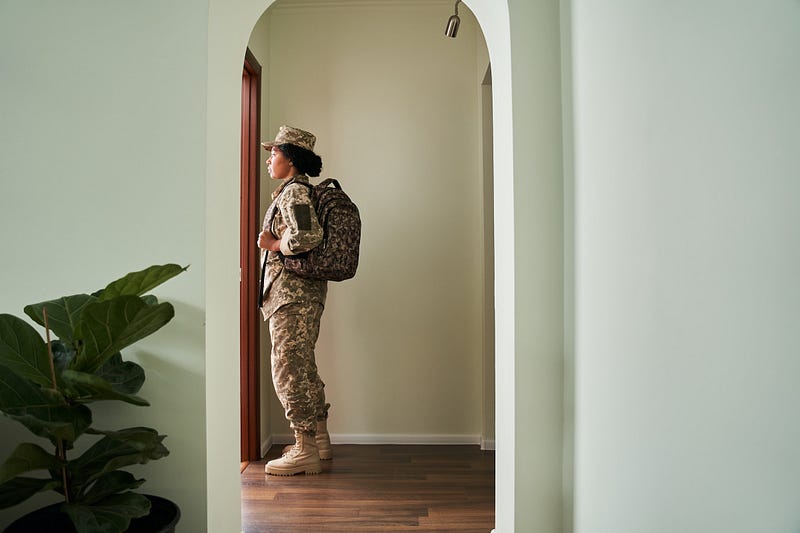
An older gentleman slaps me on the back as he bellows a robust, “Happy Veteran’s Day! Thank you for your service!”
I feel a blush creep up my neck and cheeks as I nod and say thanks, but I’m shrinking down, down into my shirt, into my seat, into my conscience.
I’ve gone out less and less on Veteran’s Day, unless it’s to Colonial Williamsburg because my history-loving ass can’t pass up free admission to a historic site. Otherwise, I shy away from large gatherings and ceremonies.
Despite everything, my pride in having served and my reservations about my part in what our military was doing at the time, I don’t feel like a veteran-veteran.
I’ll pass on the free coffee, thanks.
What does a veteran look like?
Growing up in the 80’s, a veteran looked like one. Either a strong, buff younger man with a buzz cut and sharp creases on all his clothing, or an older gentleman, perhaps missing a limb or boasting an eye patch and perpetually donning a worn baseball cap adorned with the name or number of a platoon, a ship, a division, an aircraft.
Long-haired grizzled men sat on sidewalks and street corners, holding small cardboard signs declaring their veteran status while their eyes were glassy, lost forever in the thousand-yard stare we were all taught. We were looking at a homeless vet on a sidewalk, but he was miles and years away, his mind lost forever to the horrors that he found in the jungles of Vietnam.
If, and I mean if, I met a female veteran, she was most likely a former WAP, with a dignified sepia-toned photo of herself in a trim nurse uniform or dress suit, hardly resembling the easily recognizable uniforms of their male counterparts, or a tough looking sporty type with short hair and muscular arms.
I didn’t see myself in either. Ever.
When terror came knocking on our doorstep in 2001, I was a skinny emo scene kid in South Carolina. I listened to the Bouncing Souls and Dashboard Confessional, I went to shows and moshed and drank PBR with a fake ID, I went to house parties and smoked a little weed and drank cheap beer.
A disciplined young lady I was not.
But I also was a kid without a plan, floating through time and space just winging it until, I don’t know, some plan presented itself to me.
That plan came in the form of airplanes, wall-to-wall 24/7 news coverage, sleepless nights, and the realization we were experiencing an abrupt end to childhood innocence for our entire generation.
I enlisted out of a combination of a sense of duty, a bit of desperation, and a resignation that this singular event presented an option to me that I previously hadn’t considered: go enlist, be part of this collective exacting of revenge for the attack of civilians on our soil, and receive a decent paycheck and benefits for the next four years of my life.
Out of a clear blue September sky, the door I’d been waiting for, as so many other doors had been closed to me, opened, and I stepped through it.
I boarded an airplane wearing JNCO sweatpants, Converse, and a band T-shirt. Four months later, I was a United States Navy Sailor in a nation at war.
The enlistment
Just two weeks into basic training, gossip began buzzing amongst the recruits with fervor. The news that the U.S. was on the cusp of actually declaring war was tearing through the ranks like wildfire. In some divisions, recruits were claiming to be gay, intentionally pissing their beds, or trying to escape the grounds altogether.
I watched as my younger counterparts contemplated their options and chewed on their terror. Most of them were barely 18 and came from home environments that gave them virtually no option but to enlist. They enlisted far more out of desperation or lack of options than any sense of patriotic duty. When the big W word, War, landed on the table, they panicked and wanted out.
Although I was only a few years older, a few years of living on your own and making your own way lends to a vastly more mature and reasoned outlook on life. From where I sat, I was getting a paycheck to get in shape, and I had pretty much guessed some kind of warfare was coming out of the 9/11 attacks and this had informed my very intentional selection of the Navy, the sea-going branch of the military, in the face of a potential war in a desert.
As cold as it sounds, all I kept thinking was, “I’m glad I passed on the Marines. I’m so glad I passed on the Marines.”
The fervor reached a tipping point when rumors spread that a recruit, in a desperate attempt to avoid going to war, had jumped the brick wall of the base where he was instantly struck and killed by a passing train, and it stopped us all in our tracks.
I have no way of knowing if the story is true, but I do know that immediately following news of this incident, we had a unique experience in our divisions. Chaplains came around to each division, stood shoulder to shoulder with our Recruit Division Commanders as they gently but firmly informed us that yes, the United States had basically declared war. They paused for a moment to allow us all to process.
Continuing on, they confirmed that yes, there had been some incidents on base that were causing deep concern for the safety of all recruits, and so in consideration for the safety and interest of all involved, we were given the option, a rare one-time opportunity, a golden ticket if you were: we could walk away.
I still can’t quite recollect if I’m remembering this correctly, or if it was said with sarcasm, or said as some kind of test. I do remember that people left. Our division lost bodies, that’s for sure.
In the days after, we all looked at each other in a different light. If we were still there, we were either just desperate enough or we were resolved to this mission. Either way, in that week, we truly became sisters and brothers in arms. Still several weeks from graduation, but bonded forever in that moment on that cold tile floor, being informed we were now not just enlisted sailors but we were warriors in an active war.
I never had a thought of leaving. In my mind, I scoffed at those who did.
‘You enlisted in the Navy, you didn’t rush a sorority. What did you think would happen?’ I thought as I watched some of my fellow recruits trickle away from our ranks.
I didn’t allow my mind to dwell on the details: that we were declaring war on a nation when all we’d heard for the past 18 months was that this was an act of terror perpetrated by a terrorist group, not another nation’s military, that being in the Navy certainly wouldn’t protect most of us from being engaged in active combat on some level, and that another option for my life had suddenly been placed on the table: the option that ended abruptly with a folded flag.
I focused on the immediate mission: graduate boot camp. That’s all I could possibly do to make it. Just focus on the here and now and push through.
I did. I graduated boot camp, furiously charging at the head of the pack through our final evening of basic training, the grueling and exciting ‘Battle Stations’ event that lasted through the night and had us performing physical and mental tasks over several hours.
In my self-constructed bubble of intentional ignorance, I soared. I accomplished physical and mental tasks I never thought I was capable of. I was energized and charged to head into battle.
‘Just keep it up. Don’t think about it. Keep following orders and keep advancing. Whatever you do… don’t. Think. About it.”
I continued on through A School, the schools in which we received our specific training for the job we’d been assigned, and we had access to the news and the outside world, unlike basic training. Coverage of the war was thick, graphic, and inescapable.
The dive bar just off base helped me stay focused on my not focusing.
‘Don’t think about it. Have another drink. Liquor, straight… shots for everyone!’
I partied like I was in college again, going to school during the day to learn the trade of radio, communications, and IT for the military, and skating off at night to get drunk and avoid any news from the Middle East.
Upon graduating A School, reality partially set in as I was assigned to an aircraft carrier, the USS Dwight D. Eisenhower, CVN 69, which was currently stationed… in the shipyard.
Relief.
Nothing remotely near a combat zone.
And then instant shame at my relief.
The avoidance was starting to develop holes, and in those holes I was seeing images of little brown babies with blood and dust on their faces, buildings blasted to bits, our soldiers armed to the teeth kicking in door after door.
I was seeing “news” anchors positively yelling at us about how we should feel and what we should think, even while the reality was so clearly not what they claimed.
I stepped aboard my first duty station on the last day of September 2003. Our nation was heavily at war. I was 21 years old. I was a child in a uniform, grasping at the frayed ends of the ropes available to me: pulled between the rope of my morals, values, and ideals, and then the rope of my enlistment, participating in military action, engaging in a questionable war with dubious roots and problematic intentions from the start.
But I was not a child. I was a Sailor. I put my head down, and I did my job.
What choice did we have?
Regardless of where one stands on their ideas and ideals around war while actively serving, they have no choice but to follow orders. There was, of course, the black sheep of “Conscientious Objectors.”
Conscientious Objection is a loophole that was whispered about on smoke decks and in quiet corners of berthing among people who keenly felt their own discomfort with the actions of our military and yet who desperately could not afford to have a Dishonorable Discharge on their record.
Since none of the details were provided to us about how to properly request and obtain a discharge based on Conscientious Objection, and it was far too risky to ask our leadership about it and put ourselves on their radar in that way, we just stayed.
We stayed through deployments, we stayed through sending our friends off to tours in Baghdad with rowdy nights of drinking and receiving them home in flag-draped caskets, we stayed through exposé after exposé about what cruelties our military was enacting on a nation that had not ordered the attack on 9/11 and yet was eating every bite of the consequences.
We shoved down our shame, discomfort, our outright horror sometimes, at being part of the collective military that was getting so much wrong and doing so much harm. There was no virtuous mission like facing down a tyrannical, genocidal government like during World War II; there were dishonest allegations about weapons of mass destruction, dubious ties to personal and corporate oil interests, and a general opaqueness about the overall mission to those in the lower enlisted ranks that led to us feeling led on and used.
We completed our enlistments, got that Honorable Discharge, and walked out, feeling aged, worn, disillusioned, and cheated.
What the hell did we just do?
The Aftermath
On a spring morning ten years ago, I opened my Facebook and the first post I saw took my breath away. A friend from high school, who had been my close friend’s boyfriend and we’d all double-dated for prom, had taken his life a mere two weeks before his own wedding.
After multiple tours in Iraq and subsequent mental health issues, he’d finally completed his enlistment. He came home and prepared to “get on with his life.” And then he got the letter, the letter many young men of my generation received. The recall letter.
When faced with the option of returning to the battlefield or escaping the recall forever, he made his decision, shattering the lives of dozens of people who called him family and friend.
He was a casualty of this war.
Thousands of young men have made the choice he did. Haunted by the mind-numbing horrors of combat, they’ve chosen escape via the only path they saw left.
The flag-draped coffins keep coming, two decades after that declaration of war.
The war “ended” when President Bush stood on that aircraft carrier and declared Mission Accomplished, but we all knew that wasn’t true. The war actually didn’t end, in reality, or in the minds and souls of our nation’s veterans.
Those of us who did not see active combat feel shame that we weren’t kicking down doors in Baghdad while simultaneously feeling consistent relief that we weren’t kicking down doors in Baghdad.
When we’re slapped on the back and thanked for our service, we cringe away and look down, we dismiss our service and contributions, we shrink into the shame of somehow not having made it to the front lines while also being profoundly disturbed by our mere involvement in some of the problematic missions of our nation’s military at the time.
The illumination of time, reflection, and independent journalism has brought to light many atrocities committed by our military on the ground in Afghanistan and Iraq in the years following 9/11. Our DD-214s say we participated in that, even if by extension.
I witnessed things in a clinical, removed way. I monitored and routed message traffic on classified networks. I read them. A lot of them. I read information I didn’t want to know. I passed on messages I wanted to destroy. Certain words jumped off the screen at me and I cringed, and sometimes even cried.
After a while, I stopped reading them and passed them on, my conscience temporarily intact.
Of course, the agreement I made with the federal government and the US military when they issued that security clearance is that those words are between me and the US military; mine to ponder, mine to absorb, mine to contemplate for all of my time here. I am never to share them, never to tell their secrets.
While politicians and even Presidents can break security clearances and protocol seemingly at will with no recourse, if I break my oath, I’ll end up in Leavenworth.
So those words — the ugly truths of our military and what we did — are mine, to sit like lead in my belly, for time eternal.
I don’t want a free coffee for that.
… with their tanks and their bombs, in your head, they are crying…
To be a veteran of America’s wars is to reflect on the brave, selfless younger you who stepped up with all the naiveté and earnestness of youth to ‘beat the bad guys.’ To remember who you were before you wore that uniform, and to mourn that person who is gone forever.
To be a veteran of America’s wars is to become adept at living with levels of daily grief that would destroy others, and, multiple times every day, ends up killing one of us.
We’re not stronger than you. We’re not braver than you. We made a decision and followed through with it, but we are just humans.
Honoring veterans means beating down the doors of your senators and representatives and demanding full, robust, and free mental health services for every single person who served.
For the soldiers who kicked down doors. For the female veterans who were raped while serving their nation, by their own fellow servicemen at that. For those who sat in dark control rooms, miles away, and watched a missile drop, the explosion of a direct hit, the abrupt end of hundreds of human lives, in a room silent save for the beeping of consoles.
We all bear weight in some way.
Honoring veterans means also demanding full, robust, and free medical treatment for those who stood by burn pits, who used foam earplugs next to jets and artillery and now can’t hear their child whispering to them from across the room, for those who burned with Agent Orange cooking them from the inside out, for those who showered in JP5 jet fuel and other random chemicals, chemicals that sank into our skin and cells and left cancerous seeds to sprout decades later.
I like a free coffee. I love medical treatment.
I’m still a veteran, and I’m still a pacifist. That’s something I reconcile with myself every day. I’m proud to have stepped up and served, and I’m ashamed of what the military did while I was a part of it.
Thank me for my service? Thank you for being open to receiving the realities of what that meant. Thank you for reading my work and being open to receiving a perspective you perhaps hadn’t considered. Thank you for being present to hear about my experience.
Thank you for your service
When you thank a veteran, pause a moment to look in their eyes. It’s uncomfortable. I know. Take just a beat to absorb what you find there, be sincere, and don’t be flippant. And if they rebuff your words, don’t be offended.
We are not here for your platitudes and empty words of gratitude, especially when we suspect that you may consistently vote against our best interests, our medical treatment, our healing, and the restoration of our humanity, or that you are bloodthirsty, eager to send off another batch of young souls to die.
If you want to thank veterans, maybe we should start with working towards the elimination of the term altogether. Maybe we could evolve as a species to resolve conflict without millions of needless deaths.
Maybe we could just learn to use our fucking words, you know?
Until then, to the hundreds of thousands of my brothers and sisters in arms, I salute you, I thank you, and I’m honored to stand beside you.
May we all find healing and peace.
If you are a veteran and looking to share your unique stories of military service, please consider submitting to my newest publication, Served. I’m looking to uplift the voices of veterans themselves to better expose and highlight the realities of war and the modern warrior. I would be honored to help elevate your words. Click below for more!

My name is Melissa Corrigan, and I’m a freelance writer/thought sharer/philosopher in coastal Virginia. I am a mom, a wife, a veteran, and so much more. I deeply enjoy sharing my thoughts and receiving feedback that sparks genuine, respectful conversation.
If you like my content, please consider subscribing… click here and follow along as I explore the themes of parenting, political ideologies, religious deconstruction, life as an adoptee, and LGBT allyship and family.
If you love my work, consider buying me a coffee? Or further, become a member for exclusive content and more!