
A Very Late and Very Intimate Evening with the Queen of Pop
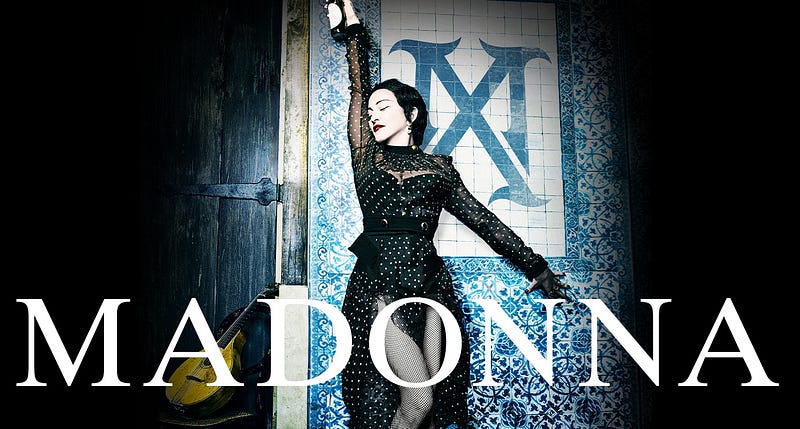
After being a fan since I heard “Vogue” for the first time at age 6, I finally saw Madonna in concert this past Sunday. Her intimate and very, very late show was full of surprises, technical wizardry, confounding contradictions, surprise guests, and ended with my husband getting a fist bump from the Queen of Pop herself.
Explaining Madonna’s Persistent Success as a Touring Artist
Despite the fact that she is no longer the Billboard chart-dominating trendsetter that she was at the height of her fame three decades ago, Madonna’s status as one of the most successful and influential forces in pop music history is largely undisputed. I have written about her astonishing musical legacy before (click here to read), but I barely touched on her unfathomable success and influence as a live act. Now that I have fulfilled a lifelong goal of seeing her perform live, I can dive a bit deeper into that legacy.
Madonna’s first ten concert tours (1985’s The Virgin Tour through 2015/2016’s Rebel Heart Tour) included 592 performances, grossed over $1.3 billion (unadjusted for inflation), and sold over 12 million tickets. She is the third highest grossing live music performer in history behind only The Rolling Stones and U2 (which also makes her the highest grossing female and highest grossing solo artist of all time). Despite the rise of touring behemoths like Taylor Swift, Beyonce, and Pink, she still holds the record for most successful tour by a female artist (her 2008–2009 Sticky & Sweet Tour grossed an astonishing $408 million and is the 9th highest grossing tour of all time). It is notable that this success persists even though her recent albums have failed to produce notable hits, most of her contemporaries (save Celine Dion and Cher) fail to pack arenas, and the fact that she doggedly adheres to the model of focusing her setlists on new music as opposed to past hits.
So how did Madonna earn the title of most successful solo touring act of all time and how does she maintain it? Well, first and foremost, she has an astonishing array of hits that people want to see live. Over the 33 year period from 1983 to 2015, she charted 57 songs chart on the Billboard Hot 100 and many of them made a large, lasting impact on pop culture (for example: “Like a Virgin,” “Material Girl,” “Like a Prayer,” “Express Yourself,” and “Vogue”). But there is a handful of other artists who have had similarly epic chart runs who never amassed the success she did as a touring artist. So what makes Madonna unique?
Click here for my ranking of Madonna’s 57 Billboard-charting singles
The first thing that many people point out when this question is posed is that her live performances tend to be a lightning rod for controversy. Pope John Paul II called The Blond Ambition Tour (1990) “one of the most satanic shows in the history of humanity” due to its mix of provocative sexual and Catholic imagery and the Toronto police almost shut down the show over outcries of indecency related to simulated sex acts she performed on stage. Madonna herself described the visual theme of The Girlie Show Tour (1993) as a “sex circus.” She made pointed protests against the war in Iraq during The Re-Invention World Tour (2004). She performed “Live to Tell” while wearing a crown of thorns and affixed to a cross during The Confessions Tour (2006), prompting international outrage. The MDNA Tour (2012) included nudity, swastikas, and (fake) fire arms. And then there’s the allegations of lip syncing (including by Sir Elton John) and her notorious tardiness. Certainly, there are people who keep going to her shows to see what controversy Madonna will stir up next.
Beyond controversy, however, there are two factors that drive Madonna’s success as a touring act. The first is her penchant for constant reinvention and the second is the consistently high quality of the production of her shows. Among music legends, only Cher can claim as many successful stylistic reinventions as Madonna and no one has so consistently raised the bar with the production values of their tours in a way that compares to Madonna. Her shows are often divided into distinct segments that each come with elaborate set pieces, intricate costumes, cutting edge visual effects, and thoughtful song selection (with familiar songs often presented in atypical formats, such as dance remixes, complete orchestral rearrangements, a cappella, and spoken word). For example, The Confessions Tour (2006) was separated into four wildly divergent themes — equestrian, Bedouin, glam-punk, and disco. Madonna doesn’t just put on a concert, she puts on a spectacle.
One additional factor that helps her remain a force as a touring artist is that her live performances have always been made accessible to the general public through multimedia formats. Performances from her early tours were simulcast on television. The Blond Ambition Tour (1990) was turned into the critically and commercially successful film documentary Truth or Dare. Her recent tours have all been made available on CD, DVD, and streaming. In large part, she remains on top of the touring game because she always remains on the cutting edge.
The Madame X Tour: Unexpectedly Intimate and Predictably Controversial
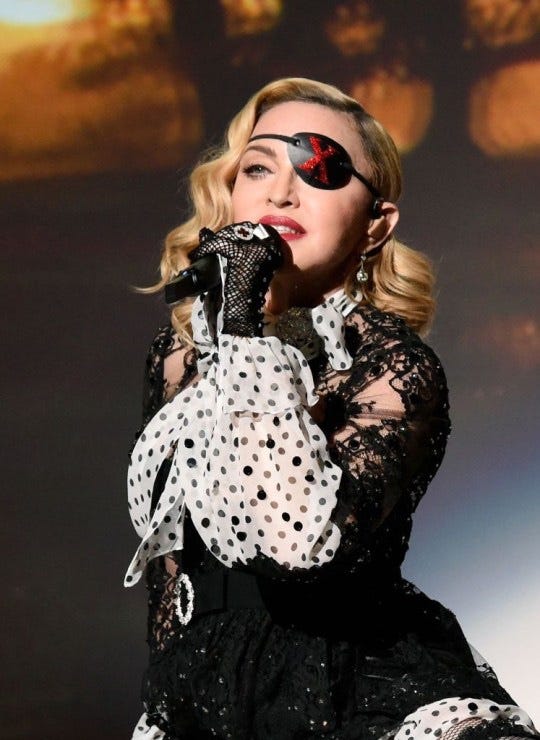
When Madonna announced the upcoming release of her 14th studio album Madame X earlier this year, it was largely expected that a tour announcement was imminent. What was unexpected was that Madonna had decided to forgo sports arenas and stadiums for intimate venues for the first time in her 30+ years of performing. She claimed that it was a longstanding desire to play more intimate venues that drove the decision and, given the success of her most recent tour, it is hard to argue that the decision was driven by a fear that she could no longer fill large venues.
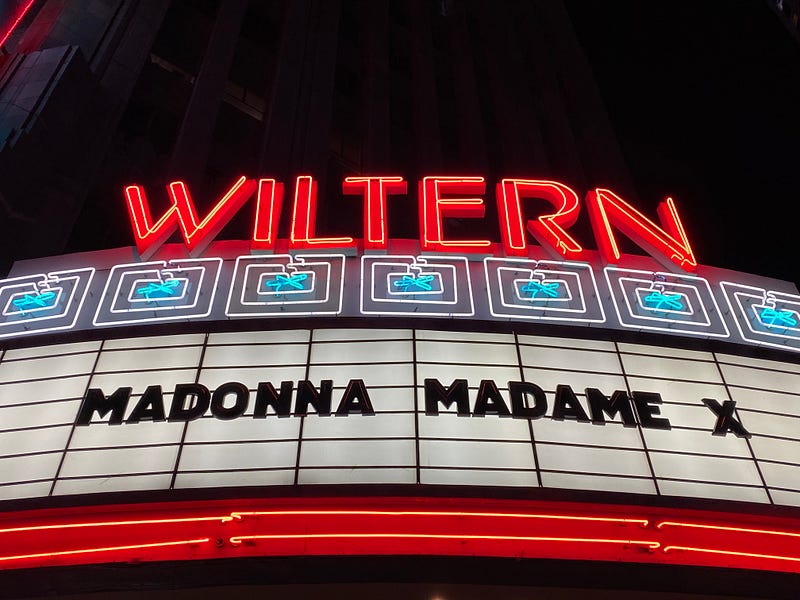
The show started with a 16-show residency at the Howard Gilman Opera House in Brooklyn, New York, which only has a capacity of 2,109. She then moved on to a 7-show residency at the Chicago Theater (capacity = 3,600), a 3-show residency at the Golden Gate Theater in San Francisco (capacity = 2,293), and a 3-show residency at the Colosseum at Caesar’s Palace in Las Vegas (capacity = 4,100). The first 23 shows (in New York and Chicago) were complete sell outs with 54,634 tickets sold and over $15 million in box office revenue. The show just wrapped up a 10-show residency at the Wiltern in Los Angeles, her smallest venue yet with a capacity of only 1,850. She then moves on to Boston, Philadelphia, and Miami before crossing the Atlantic for shows in Lisbon, London, and Paris. She has an astonishing 90 dates scheduled in total.
Like all of Madonna’s shows, the Madame X Tour courted controversy but probably not for the reasons Madonna expected. It wasn’t the show’s many provocative elements (which I touch on below in my review) that garnered press, but rather production issues. The show’s repeatedly late start times prompted the promoter and venues to change the official start time from 7:30pm to 10:30pm, prompting responses ranging from annoyance to a lawsuit. Then there’s the phone-free policy, which prevents concertgoers from using their phones during the show by requiring them to seal their phones in Yondr cases, which are only openable by the venue staff with a special tool. This drew applause from some and more annoyance from others. Yet neither of these controversies seem to have affected ticket sales.
My Review of the November 24th Show in Los Angeles
I rose to pop culture consciousness around the young age of 6, when I started listening to Casey Kasem’s Top 40 countdown on the radio every Sunday morning with my older brother. I became instantly familiar with Madonna, who was at what was arguably the height of her success and influence (this was around 1990, when she was fresh off the success of Like a Prayer, starring in the blockbuster Dick Tracy, and releasing The Immaculate Collection, which would go on to become one of the most successful greatest hits compilations of all time.) I was instantly smitten with “Vogue,” a dancehall anthem that was at once an earworm, an education, and what I now realize was probably the first queer-positive message I ever received.
Shortly after my initial fascination with Madonna, my brothers and I were ostensibly banned from consuming her songs, albums, and videos. Although it felt oppressive at the time, I can now see why my parents went this route. I would never be one to promote censorship but the products Madonna was pushing at the time (her album Erotica, her book Sex, and the movie Body of Evidence) were something no child should be near. However, I became an autonomous teenager as she experienced her spiritual rebirth (and critical and commercial comeback) with Ray of Light, reigniting my fandom.
I have found her musical output since Music (her audacious 2000 follow up to Ray of Light) to be highly variable. 2005’s Confessions on a Dance Floor was a work of genius, but 2003’s American Life was mostly an embarrassment, 2008’s Hard Candy and 2012’s MDNA were fine but unspectacular, and 2015’s Rebel Heart had its moments but was generally overstuffed and uneven. My lukewarm reaction to these albums — combined with the fact that I was not in a financial position to spend hundreds of dollars on a single concert ticket until recently—resulted in me never seeing Madonna live until this past Sunday.
I decided to buy tickets to The Madame X Tour for a number of reasons. For one, I genuinely love the new album that the tour is promoting (easily her best since 2005’s Confessions). Another is that I loved the idea of seeing such a larger-than-life persona in an intimate venue. But mostly, I was afraid of missing my chance. Given that her 1980s pop music mega-star contemporaries Whitney Houston, Michael Jackson, Prince, and George Michael all died before I could see them live, I am especially aware that despite what she may say, she is a mere mortal.
After convincing my husband that going to a concert with a 10:30pm start time on a week night was not actually insane (clearly we are getting old), we made our way to the Wiltern, an Art Deco landmark in the Koreatown area of Los Angeles. We headed to our seats around 10:15pm. Without phones to distract us and virtually no air circulation in the overheated theater, the wait for Madonna to go on was tedious and uncomfortable. But when she took the stage shortly after 11:00pm, she utterly commanded it until the show wrapped around 1:35am.
Despite having a significantly smaller space to work with than she is used to, Madonna and her creative team concocted a versatile, two story modular unit that took on various arrangements throughout the evening. Stellar lighting and creative visual effects were projected onto the set throughout the show, which further enhanced and expanded the relatively minor space.
The show ambitiously started with the two weirdest and most challenging tracks from her latest album. The first, “God Control,” is part haunting requiem and part disco anthem and makes a passionate plea for gun control. (It’s accompanying music video portraying a mass shooting at a dance club generated its fair share of controversy). The second, “Dark Ballet,” interpolates Tchaikovsky’s “The Nutcracker Suite” into a dark techno song that is paired with disturbing visuals of religious persecution. Despite being deeply unsettling, the opening numbers were visually arresting and clearly announced what a challenging and spectacular evening was in store.
Madonna then moved onto a trio of familiar hits. She did a slightly off-key but nevertheless entertaining rendition of “Human Nature,” her provocative feminist R&B-inspired anthem from 1994’s Bedtime Stories. She then spoke to the audience and gathered some of her backup singers and dancers for an a cappella snippet of “Express Yourself,” one of her most enduring hits. And then she turned in the night’s first showstopper — a rendition of “Vogue” (in my opinion, one of the greatest pop songs ever recorded). She executed impressive choreography alongside a troupe of doppelgangers, who each resembled a female James Bond. She then continues the dance hall vibe with a spirited rendition of “I Don’t Search I Find,” one of the best cuts from her latest album.
During this opening stretch, she introduced the audience to Madame X, the persona she has adopted for her latest album. Much like Lady Gaga’s “Enigma” from her Las Vegas residency, the persona is half-baked, confusing, and adds little to the proceedings. Madame X is a “spy in the house of love” (?) as well as a whore, a saint, and a woman who (conveniently) really, really loves to dance. She is also a poet (quoting James Baldwin) and a champion for social justice. The latter becomes readily apparent when she converts “Papa Don’t Preach,” her 1980s smash hit about an unplanned pregnancy, into a pro-choice anthem followed by a politically charged speech. The speech segues into a rendition of “American Life,” one of the worst songs she has ever recorded, but one she nevertheless keeps trying to justify the existence of.
The show then takes a marked turn to highlighting the recent sojourn to Portugal that inspired much of the album. In one of the show’s most inspired moments, she brings a troupe of batuque musicians on stage. Batuque is a music and dance genre that originated in Cape Verde (which is believed to be the origin of the slave trade) and it is an art form born of oppression and rebellion. She then moves into a decidedly lighter tone, converting the set into a fado club. Fado is a distinctly Portuguese musical style that Madonna became enamored with during her visit. She introduces us to the instruments and language of the music, including doing a particularly impressive snippet of an actual fado song in Portuguese. She then performs a quartet of fado-inspired songs. This is a joyous feast for the eyes and ears and as a result is one of the liveliest and most successful segments of the show.
The evening then slows down considerably with a largely unnecessary performance of one of her latest album’s weakest songs (“Extreme Occident”). There is then a dance interlude set to a pre-recorded spoken word rendition of her 1990 single “Rescue Me,” which is bizarre but mostly works. Madonna then returns to the stage (sort of), delivering a stirring rendition of “Frozen” (her haunting electronica ballad from Ray of Light) behind a transparent screen on which transfixing images of her daughter Lourdes unfold.
As the show stretched on past 1am, she delivered a trio of tracks from Madame X, that were each notably reinterpreted for the show. The percussion and gospel elements of “Come Alive” were significantly enhanced, while “Future” was decidedly slowed down and “Crave” was turned into a dance hall banger complete with strutting drag queens (and a surprise appearance from collaborator Swae Lee who took the stage to do his part live).
Just when it seemed the curtain was about to fall, she broke into a full rendition of “Like a Prayer,” her best song (and one of the best songs ever recorded). She performed the song confidently and was backed by a resplendent gospel choir. It was the show’s most transcendent moment and the entire audience was utterly transfixed.
After a few minutes of darkness, she returned for an encore. She performed “I Rise” her anthem celebrating activism and perseverance with a giant rainbow flag unfurling in the background. As the sang the song’s extended outro, she walked up the aisle, smiling and fist-bumping fans. This included my husband, much to my great joy (and mild jealously).
As we all filed out around 1:45am, desperate to regain access to our phones and get home to bed, I heard people murmuring about what an impressive show it was and I enthusiastically agreed. It was a wildly entertaining, ambitious, and technically marvelous show that sustained its energy for nearly two and a half hours. Madonna commanded the stage throughout and much to my satisfaction appeared to be singing live throughout most of the show. She has never been known as a particularly exceptional vocalist, but I applaud her willingness to bear it in all of its imperfections. And in the moments when she nailed it vocally, she truly impressed.
Like Madonna, however, the show was also flawed, confounding, aggressive, arrogant, and uneven. I could have done without some of her audience banter, which included cheap and crass jokes about “small dicks,” a stint where she tried to develop a polaroid in her genitals (don’t ask), and some condescending political preachiness. But there were moments when Madonna was more endearing and relatable than I ever thought possible. When she recounted her eye-opening experiences in Portugal and joked about aging and being a mother, she actually felt like a real human. When she headed into the audience to make delightfully awkward banter with Lil Nas X (the young rapper who dominated the Billboard charts with his debut song “Old Town Road” earlier this year), she was unpredictable and charming.
One moment that was particularly stirring came late in the show when she expressed her hope that the audience was full of people willing to take risks to be their true selves and fight for what is right whatever the cost. You could hear the rawness in her voice when she said, “We are not here to be loved. We are here to be free.” But when she walked up the aisle as the show ended, you could also see the joy in her eyes as her adoring fans swooned upon seeing the elusive icon up close and personal. She may be here to be free, but she also doesn’t mind being loved. And her fans don’t mind letting her be both.
Madame X Setlist:
- God Control (Madame X, 2019)
- Dark Ballet (Madame X, 2019)
- Human Nature (Bedtime Stories, 1994)
- Express Yourself (a cappella) (Like a Prayer, 1989)
- Vogue (I’m Breathless, 1990)
- I Don’t Search I Find (Madame X, 2019)
- Papa Don’t Preach (True Blue, 1986)
- American Life (American Life, 2003)
- Batuka (Madame X, 2019)
- Fado Pechincha (unreleased cover)
- Killers Who Are Partying (Madame X, 2019)
- Crazy (Madame X, 2019)
- Mashup: Welcome to My Fado Club (unreleased cover)/La Isla Bonita (True Blue, 1986)
- Medellin (Madame X, 2019)
- Extreme Occident (Madame X, 2019)
- Rescue Me (spoken word snippet) (The Immaculate Collection, 1990)
- Frozen (Ray of Light, 1998)
- Come Alive (Madame X, 2019)
- Future (Madame X, 2019)
- Crave (Dance Remix) (Madame X, 2019)
- Like a Prayer (Like a Prayer, 1989)
- I Rise (Madame X, 2019)
Read other articles about live music performances by this author: