
American History
A US President Has Been Arrested Before
But for a very different reason than what’s happening now
On August 8th, 2022 the FBI raided the former president’s house in Florida. And that’s a big deal.
More details about the seriousness of this investigation are still emerging, but it’s still an unprecedented move by law enforcement for a number of reasons. The biggest reason is simply that there has never been “probable cause” to collect evidence of a crime from any former U.S. President.
Because, while many people might not like former presidents, allegations of possible criminal conduct aren’t just rare —they’re unheard of.
If the former president is indicted or arrested, it will be a defining moment in American democracy. But it won’t be the first time that a U.S. president or former president has been arrested.
In fact, a U.S. president has been arrested, booked, and charged with a crime. And last time it happened, he was still in the Oval Office.
How to arrest a US president
In 1872, then president Ulysses S. Grant was arrested on the streets of Washington D.C. for speeding. He wasn’t just fined for speeding but was actually arrested, booked at the police station, and had to post $20 bail to leave.
Remember, this wasn’t a former U.S. president. This was the sitting President of the United States and a recent Civil War hero and commanding general. (Grant served as the 18th president from 1869–1877).
And it gets better because the police officer who arrested the (literal) Commander in Chief was William H. West, a formerly enslaved man and Civil War veteran himself.
After he retired from the force in 1908, West finally shared his account of what it was like to arrest the president for the Washington Evening Star. Here are a few excerpts from West’s story.
No one is above the law
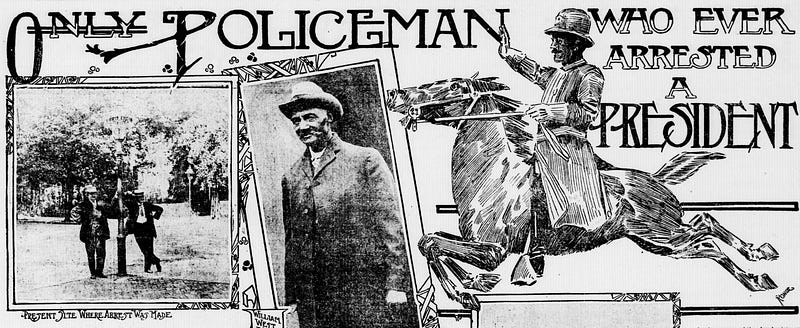
After a few serious carriage-pedestrian accidents in his district, Officer West was asked to patrol for speeding carriages. Shortly after this, he caught President Grant going well over the speed limit.
West told Grant, “I want to inform you, Mr. President, that you are violating the law by speeding along this street. Your fast driving, sir, has set the example for a lot of other gentlemen.”
Grant apologized and promised to be more careful, and West let him off with a warning.
But the very next evening, West caught Grant speeding again through the same area — the corner of 13th and M streets. Except, this time Grant was speeding so fast that it took him an “entire block to stop.”
Apparently, the “S” in Ulysses S. Grant’s name stood for “Speed.” Historians still debate whether Grant was a “good” president, but one thing about his presidency is very clear. He loved fast horses.
When stopped again Grant reportedly said, “Do you think, officer, that I was violating the speed laws?”
“I do, Mr. President,” West said. He went on to say, “I am very sorry, Mr. President, to have to do it, for you are the chief of the nation, and I am nothing but a policeman, but duty is duty, sir, and I will have to place you under arrest.”
Grant was then taken to the police station and booked for speeding. He posted $20 bail for the trial that was to take place the next day for all the speeding drivers.
Grant, of course, never showed up for his court date.
What it means to arrest the president
Arresting the most powerful man in the country (the U.S. wasn’t a global superpower like today) exemplifies a core part of democracy — that no one is above the law.
Democracy “of the people” can’t exist without accountability — for everyone. If the rules don’t apply to people that are wealthy enough and powerful enough to skirt the consequences of their actions, it leads to abuses of power that trickle down until no one thinks the law applies to them.
And that’s a very dangerous place to be.
And while Grant never showing up for his court date shows that people in power will always have contempt for actual justice, his arrest still speaks to the best parts of the American experiment.
Before the Civil War ended in 1865, William West had been held in chattel slavery for his entire life. He wasn’t seen as a human being by half of the American people but also by half (or at least 3/5ths) of the American legal system.
But less than a decade later, he would be a war veteran, police officer, and the only person to ever arrest a U.S. president. When West arrested President Grant, he was doing “his duty” to “set an example” for the rest of the country.
Certain politicians claim to care about “law and order,” but it seems like they’ve forgotten that everyone being held accountable to the “law” has to come before we have any semblance of “order” in this country.
The ‘law & order’ president
If the former president is arrested and indicted for any of the number of active criminal investigations he’s involved in, it will be a defining moment in American democracy.
Bigly.
Because while a U.S. president has been arrested before, no sitting or former president has ever been charged or tried for a serious crime.
And this time, it’s not about a speeding ticket.
Shawn Forno is a travel writer with 15+ years of experience, (Lonely Planet, Tortuga Backpacks, Unbound Merino). He’s also created and managed content strategies for creators like Matt D’Avella (Netflix director, The Minimalists). Shoot him an email if you want to work together or check out the travel channel he runs with his wife.