
“A Twin Policy”
How the U.S. weaponized treaties and education to take Indigenous lands
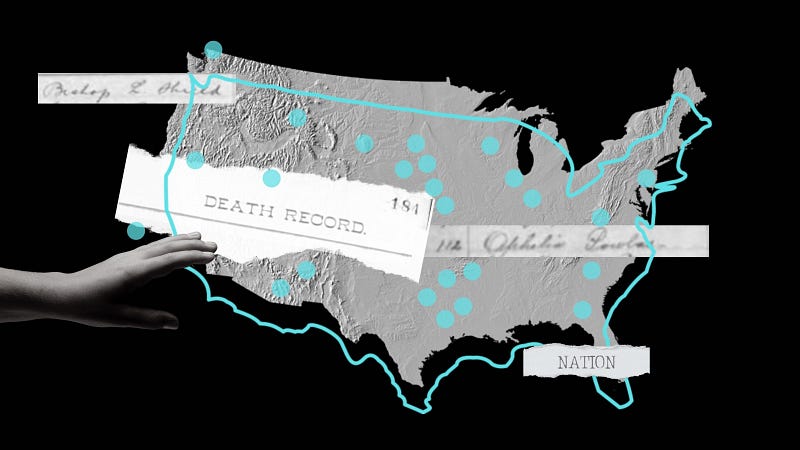
Only recently, the legacy of Federal Indian boarding schools was a national secret — everywhere, that is but in Indian Country. Now such truths about the violence, the rapes, the orchestrated plan to seize Indigenous lands have many Americans grappling to understand such tucked-away atrocity. Instead of discounting the deaths of Native children at these schools, there is now an investigation underway in search of more graves, more bodies, and more answers. “It has taken generations for us to get to this point of public truth and accountability,” said Deb Parker, the Tulalip policy advocate leading a coalition of survivors and descendants on a historic reconciliation campaign that spans nearly two centuries. But such reach for closure and healing can only be met with meaningful inquiry.
The Department of the Interior’s Assistant Secretary of Indian Affairs, Bryan Newland released a report this week that effectively makes the case for future probing. The Federal Indian Boarding School Initiative Investigative Report is some 100 pages of insider analysis driven by his legal background, his former role as a tribal chairman, and more distinctly, his direct ties to boarding school survivors. A citizen of the Bay Mills Indian Community in Michigan, Newland spoke of the personal toll of carrying out a coordinated examination of these schools, an assignment ordered last June by Interior Secretary Deb Haaland. “It’s been an exhausting and emotional effort to confront this horror on a daily basis,” Newland said at a press conference upon announcing his findings, Wednesday. But if such hardships were reflected anywhere, it was in his deeply reported overview which dropped just enough below victimization to bring fresh focus to perhaps one of the most ruthless and overtly racist plans ever plotted — what Newland described as “a twin policy” first idealized by Thomas Jefferson: Indian territorial dispossession by way of Indian assimilation, or better stated, by way of outright extermination. It’s a depressing saga, and Newland, Haaland, Parker and so many others who were weepy on Wednesday were right to be depressed about it.
The emotional burden of the Federal Indian boarding school system has long been understood. However, the finer details of the colonial framework is lesser-known, particularly in the role education played in the seizure of tribal territories, and how it was carried out across all three branches of government. At the end of treaty-making in 1871, which also marked a period of economic recovery after the Civil War, Congress passed a slew of desperate laws designed to permanently break up Native families and also Indigenous lands — what would then advance the twin policy objective. As many as 150 land cession treaties carried education clauses. The later pacts such as the 1868 Fort Laramie Treaty between the U.S. and the Oceti Ŝakowiŋ (The Great Sioux Nation), read more like a mandate: “In order to ensure the civilization of the Indians entering into this treaty, the necessity of education is admitted.”
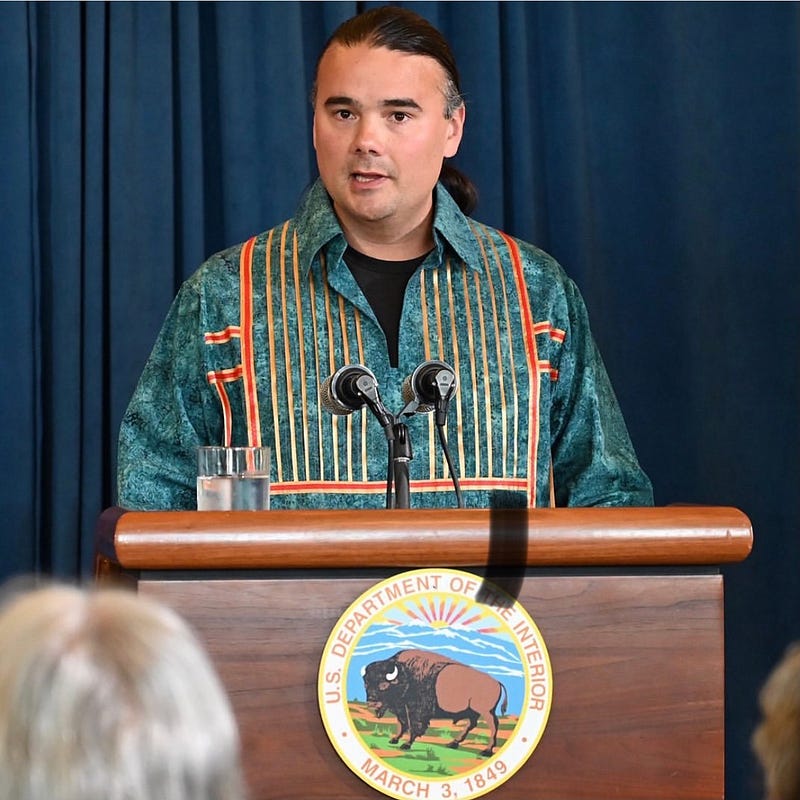
Newland emphasized that these education agreements were weaponized on Indigenous Peoples, and not by government terrorism alone but paired with an unprecedented relationship with organized religions. Army officers and missionaries acted together to carry out laws that withheld rations as a form of punishment for parents whose children did not attend school. Indian police were also ordered to enforce student attendance. For fifty years, religious groups were paid by the federal government through The Civilization (Fund) Act of 1819, legislation intended for “the final extinction of Indian tribes.”
Meanwhile, treaty funds from land cessions made with Native nations were primarily used by the federal government to try and erase tribes through a network of boarding schools, many led by churches. “For example, between 1845 and 1855, while over $2 million was spent on the Federal Indian boarding school system, Federal appropriations accounted for only 1/20th, of $10,000 per year, of the sum, with Indian trust fund monies supplying the rest,” the report states.
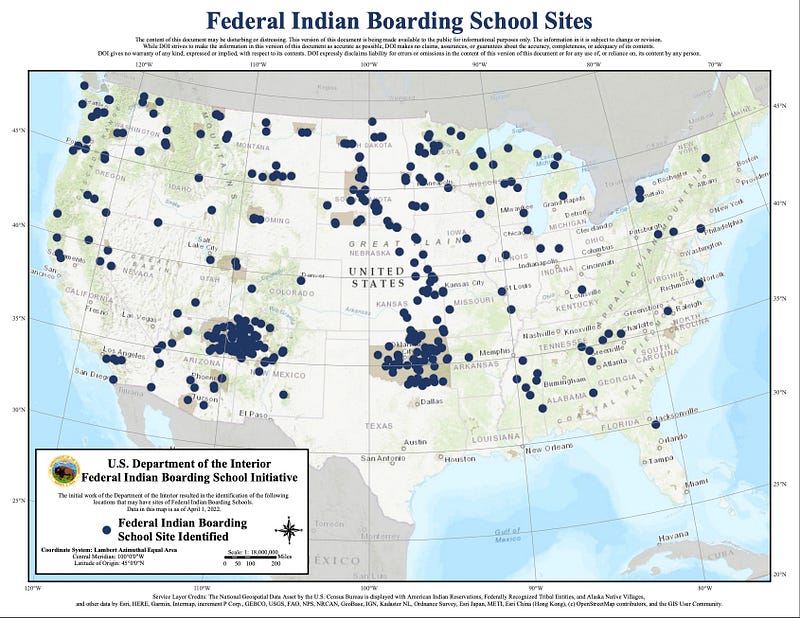
It is the first time the federal government has officially examined and listed these schools: 408, across 37 states (or then territories), and comprising a total of 53 burial sites at 19 schools, though more graves are likely to be detected. And there is more work to do. Congress has appropriated $7 million to continue the investigation and two bills in the House and the Senate aim to deliver a full inquiry into the Federal Indian boarding school network akin to the Truth and Reconciliation Commission of Canada. That process resulted in the largest class-action settlement in Canadian history — $1.9 billion in reparations. But what justice might look like for U.S. survivors and descendants of Indian boarding schools remains unclear. Unlike Canada, there is no legal recourse due to the statute of limitations in place here in the U.S.
Already, there’s pushback. The day after the Interior released its report, the House Natural Resources Subcommittee for Indigenous Peoples hosted a hearing to address HR 5444, the proposed legislation seeking to form a truth commission which would also hold unique authority to subpeona institutions such as churches to access private records. “That might be adversarial to the goal of healing,” said Rep. Jay Obernolte, the Republican congressman from California. He also expressed concerns about the compensation of commission members: $200,000 annually.
If such political waxing seemed off-putting to Matthew War Bonnet, a Sicangu Lakota boarding school survivor sharing testimony virtually that day, he didn’t show it. The Elder showed a picture of his extended family and spoke of how he approached the Catholic diocese nine years ago in search of dialogue, documents, or maybe even acknowledgment for the intergenerational trauma he and his kin have endured as a result of the abuse experienced from the St. Francis Boarding School in South Dakota. “I told them that if we could sit down and come up with a plan to help our children and our grandchildren, that I would come back and work with them to do this,” War Bonnet told the subcommittee. “I have not heard from them.” ♠️
This essay was first published in the weekend email newsletter, Indigenously. Sample an edition here.