A Tuskegee Airman Sacrifices His Career For Justice in WW2
Black bomber pilots were court-martialed for resisting segregation in the military
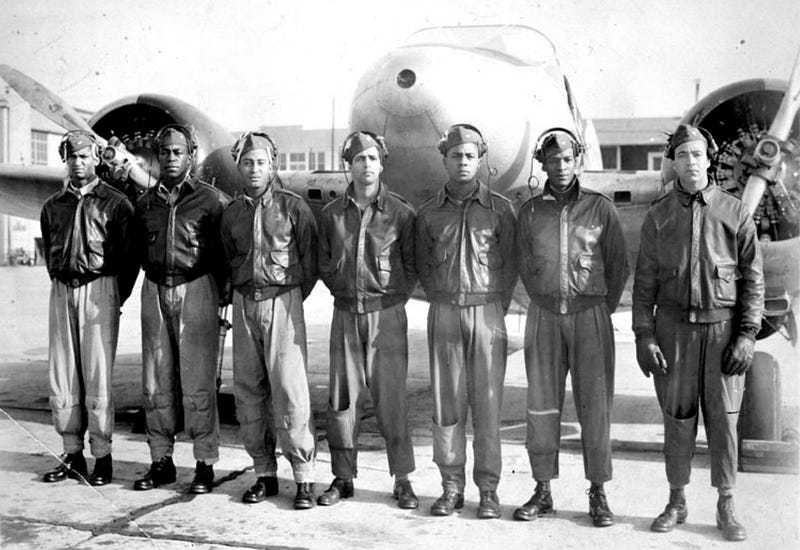
Roger C. Terry (1921–2009) was a U. S. Army Air Forces (AAF) officer in World War II. In his short military career, Terry compiled a record most people would classify as shameful: he was court-martialed for assaulting a superior officer, convicted, fined, reduced in rank, and kicked out of the service with a dishonorable discharge.
But for the rest of his life, Roger Terry was proud of what he accomplished in his brief time in the U. S. Army Air Forces.
Roger Terry becomes a Tuskegee Airman
Lt. Roger “Bill” Terry was one of that group of pioneer African American military aviators known as the Tuskegee Airmen. He was a 1941 graduate of UCLA, where he roomed with Jackie Robinson, the future baseball star who would himself be court-martialed as an Army officer for resisting segregation.
When an “experimental” flying school to train black military pilots was set up at Tuskegee University in Alabama (the Army was convinced that blacks couldn’t fly), Terry was accepted into the program. He proved that he could indeed fly, and earned his pilot’s wings in February of 1945. His first assignment was to the 477th Bombardment Group at Freeman Field in Indiana.
The Tuskegee Airmen had already compiled an enviable record as fighter pilots in the war. Now they were going to have the opportunity to prove they could fly the big birds as well.
The 477th — A Bomber Group the Air Forces didn’t want
The 477th was kind of an orphan child from the beginning. The Army Air Forces didn’t really want it, feeling that it had been forced on them by political pressure. That was because everybody from the NAACP to first lady Eleanor Roosevelt had been pressing for African Americans to be allowed full participation in the war effort. The 477th was to be the first bomber group staffed by African American air and ground crews.
But in 1944 the American military was still a highly segregated institution. Though the 477th was staffed by black pilots and crews, its chain of command was strictly white. When the the bomber group was activated in January of that year, the senior officers in charge had no intention of loosening any of the traditional constraints of segregation.
The 477th commanders were committed to racial segregation
Both the commander of the 477th, Col. Robert Selway, and Selway’s immediate superior, Maj. General Frank O’Driscoll Hunter, were rabid segregationists. They were determined that the 477th would always be a segregated operation. In his first briefing to the black officers of the 477th, General Hunter told them:
“This is not the time for blacks to fight for equal rights or personal advantages. They should prove themselves in combat first. There will be no race problem here, for I will not tolerate any mixing of the races. Anyone who protests will be classed as an agitator, sought out, and dealt with accordingly. This is my base and, as long as I am in command, there will be no social mixing of the white and colored officers.”
But the officers of the 477th didn’t believe that men who were fighting, and potentially dying, to defend their country should be expected to be content with being treated like second class citizens in that country. They were determined to receive the respect and the equal treatment that was due them as officers in the United States Army, and were willing to pay the price to make that happen. The one who paid the biggest price was Roger Terry.
Early in 1945 the 477th was moved to Freeman Field in Indiana. When Col. Selway tried to set up segregated officers clubs at Freeman, despite Army regulations that forbade denying the use of any facilities based on race, the black officers of the 477th refused to go along. Instead, they devised a plan of resistance. In defiance of Selway’s orders, they would go to the “white” officers club in small groups and seek to be served.
The Freeman Field Mutiny
This protest resulted in two separate mass arrests for what came to be known as the “Freeman Field Mutiny.” Over the two days of the protest, April 5 and 6, 1945, a total of 61 black officers were arrested and confined to quarters. Most were later released. Then 101 officers were arrested for refusing to sign a certification of having read and understood Col. Selway’s base regulation setting up the segregated officers club system, even when directly ordered to do so. By this refusal they put their careers and their very lives on the line (refusing to obey the direct order of a superior officer in time of war was a death penalty offense).
Eventually, the firestorm of negative publicity resulting from the Army holding more than a hundred black officers on capital charges arising out of their resistance to a patently illegal scheme of racial segregation, led the Army Chief of Staff to order their release with nothing more than an administrative reprimand added to their records.
Lt. Terry and two others are tried by court martial
But Lts. Terry, Marsden A. Thompson, and Shirley R. Clinton were not released. Instead, they were court-martialed for offering violence (by shoving him) to a superior officer as they attempted to enter the “white” officers club. Lt. Thompson and Lt. Clinton were able to produce witnesses who testified that they never touched the officer, and they were cleared of all charges. But Lt. Terry, though acquitted on one charge, was convicted on the shoving charge and dishonorably discharged.
With many states viewing a dishonorable discharge from the military as the equivalent of a felony conviction, the price Roger Terry paid for his participation in the Freeman Field protests was extreme.
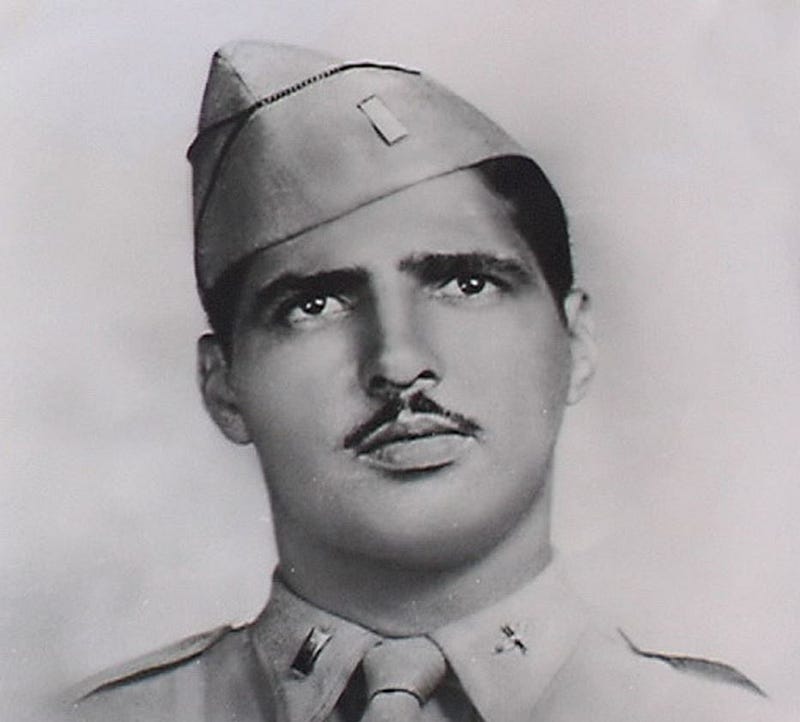
For fifty years Roger Terry lived with that stain on his record, but he didn’t let it stop him. He earned a law degree, and became an investigator with the Los Angeles County district attorney’s office. He helped to found an organization devoted to highlighting the accomplishments of the Tuskegee Airmen, and even served as a technical adviser on Red Tails, the George Lucas film about that fabled group. After his death, a square in his native Los Angeles was named for him.
Justice is finally done 50 years later
As the sequence of events continued to unfold in 1945, the AAF was forced to tacitly admit (without ever specifically saying so) that the way the officers of the 477th had been treated by their superiors was not right. Even while the court martial trials were under way, Colonel Selway was relieved of his command of the 477th and replaced by a black commanding officer, Lt. Col. (later General) Benjamin O. Davis, Jr.
But it took another half century before the Air Force was willing to explicitly admit that its treatment of Roger Terry, and the other officers of the 477th who received official reprimands, was wrong. Finally, however, the Air Force took responsibility for the mistakes it made in 1945, and began to make amends.
On August 2, 1995 Roger Terry received a full pardon for his court martial conviction. His rank was restored to him, as was the fine he had paid. His record was wiped clean. His comment about that event reveals a man free of bitterness for what was done to him:
For the first time in 50 years, I could vote, I could hold office, I was restored Second Lieutenant, and it only goes to show that we’re a nation of laws. If you wait long enough, you will be vindicated. The only thing is that they wasted so much money and so much time doing it. But we did show them that we could fly.
The other officers who had had reprimands inserted into their records were allowed, upon request, to have them removed.
In 2007 President George W. Bush presented the Tuskegee Airmen, including Roger Terry, with the Congressional Gold Medal. And two years later, in 2009, Terry was one of the Tuskegee Airmen invited to attend the inauguration of President Barack Obama. He was unable to do so because of ill health.
Roger Terry died later in that year of 2009, having lived to see the nation come to respect and even celebrate the sacrifices he and the other officers of the 477th had made to ensure that all Americans, whatever their race, would receive the respect, dignity, and equal treatment before the law that is enshrined in our Constitution.


