
A Tribute to Joanne
If not for her, you wouldn’t be reading this

I don’t want to simply call her Joanne, as that seems to diminish the respect I have for her, as well as the immense gratitude I have for her. However, for privacy’s sake, I’ll keep her surname out of the narrative.
Joanne was one of my professors in college. She was short, buxom, and exuded a very grandmotherly aura. It would be fitting to call her my writing mentor, but we didn’t have that relationship. I was just another student in her class. Her class was just another requirement that we freshmen collectively bemoaned.
I don’t even remember the exact course title. “Creative Writing 101,” maybe?
Her Magic
Before taking her class, of course, I had written numerous essays and book reports. I knew the technical aspect of writing. My grammar was on point. I knew when to use “your” and when to use “you’re.”
But I hated writing.
I dreaded being assigned yet another essay. Writing bored me. Being forced to write gave me anxiety. Essays landed at the bottom of the homework pile. If I could point to a single culprit for my developing procrastination, my finger would wag at writing assignments.
In her class, Joanne expounded on the usual advice given to aspiring writers. She suggested using more colorful words, to use synonyms to add flair. She talked about varying sentence lengths to create pauses and flows. Joanne explained how to paint a picture with words.
You’ve heard all of this before, I’m sure.
But then, Joanne whipped out her magic, her secret weapon to explain the beauty of prose.
She read to us.
Out loud. Like we were children at a sleepover.
She read to us passages from “The Grapes of Wrath,” by John Steinbeck.
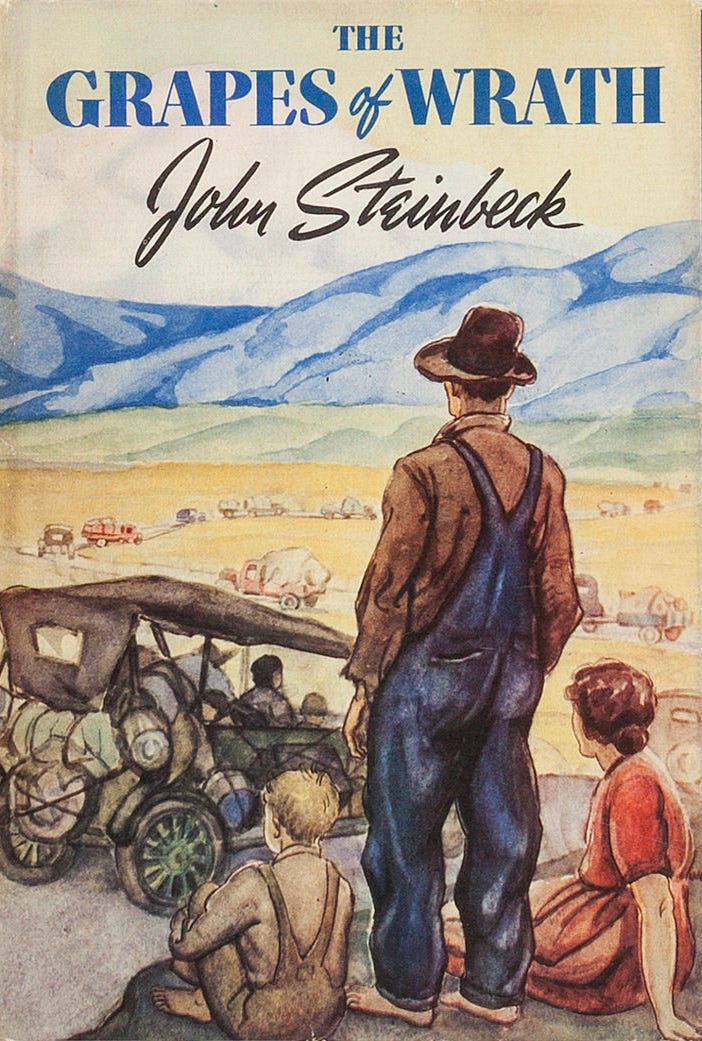
She didn’t just read the book. She gestured, moved and swayed with every line she uttered. It wasn’t sexual. It wasn’t crude. But it gave life to her words.
She would pause and look at us for dramatic effect when she delivered an emotional line. She would lower and raise her voice. She would change tempos to match the book’s heartbeats.
It was performance art. Unlike reading a bedtime story, her reading was void of changing character voices and goofy faces. She embodied each of Steinbeck’s sentences. She brought the book to life in front of the class.
If, at first, we students were cringing at her bold soliloquys, we were fully entranced within the first paragraph or two.
Then, to drive home her point, she would go back and read the same passage as if she were reading the crop report on C-SPAN. And we would laugh. Ironically, we would find her lack of movement and emotion hysterical, when just minutes before, her antics would have been much more comical.
She worked her magic, and I was caught in its spell. I don’t know if that was her intent, or that was simply how she read all her books. Maybe she gave a swaying performance reading to herself at her home or at the library.
She explained that words should not simply describe. Words don’t simply tell a story. Words should paint a picture. Words should evoke movement, emotions and reactions.
When she was done reading a passage, she didn’t curtsey or take a bow. In her mind, she wasn’t staging a performance for us. She was simply letting the words out of Steinbeck’s pages move her, much like piano players move with the music flowing from their fingers. Have you ever observed a pianist rock their whole body with each key and each chord? It was like that.
The Ox-Bow Incident
It was inevitable. We were going to be given a writing assignment. This was a writing class, after all.
For the first time in my entire academic career, I felt not a drop of dread. I was frothing at the mouth to get started on my writing task.
We were to read “The Ox-Bow Incident” by Walter Van Tilburg Clark. We were to summarize the book in about two pages.
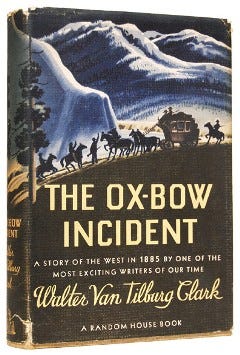
Luckily, the book was an interesting read. It wouldn’t have mattered. With Joanne’s encouraging words, I was ready to turn any old text into the most exciting summary report ever written. Readers of my report would salivate, sway and want to read the entire book.
In my mind, I killed that book report. I had produced my best work. Given that everything I had written before that was bland and unimaginative, it wasn’t a stretch. I was damn proud of that piece.
A couple of weeks later, Joanne held in her hand the stack of Ox-Bow book reports, ready to return to us. This was back in the day when reports were still submitted on actual paper, double-spaced and written in WordPerfect, the only word-processing software of the day.
She walked around the room handing back our papers. Each student lazily retrieved theirs, glanced over their papers, and unceremoniously tucked them away.
I, however, was like a dog waiting for treats.
I would perk straight up whenever she walked over to my row of desks. Then, I would slouch back down as she sauntered away to the other rows.
My paper was a long time coming. Everyone was getting theirs back, except me, it seemed. She returned to the front of the class. I didn’t receive mine. I was ready to raise my hand to question the whereabouts of my masterpiece. Surely, she didn’t lose mine!
Then, I noticed she still had one in her hand.
She finally spoke, “I enjoyed reading everyone’s work. Your reports were so fun to read. But one of you really took my suggestions to heart.”
And she shot a look in my direction.
She continued, “I really enjoyed one report in particular.”
She held up the one paper she was holding and started to read. I froze. Not because I feared that my writing was going to disappoint. I was not experiencing second-hand stage fright. I was beyond excited that she thought my piece had rocked her world.
As she read my piece to the class, she paused on a word that I had written. I still remember it.
“…tempestuous,” she said. She paused on that word, and ad-libbed, “that was a delicious word.” She even made that schlurping sound we make when we want to indicate a certain food’s tastiness.
Before that paper, I had never used that word in my life.
She read and read. And swayed and swayed. She did her performance magic on my report. Again, I was entranced. By my own writing! She brought out more meaning with her reading, than I had actually meant to express with my writing.
When her scene ended, she walked over and handed me my report. I didn’t care what grade was on the paper. It was more than enough that she performed my writing to everyone.
It was the only validation I needed.
Joanne, I know you will never read this. But, maybe, as you look down on me from up there, know that your impact on me was significant. I thank you for your teachings, your wisdom and most of all, your readings. Keep swaying for the angels who keep your company now. They are lucky to have you.


.jpg)
