
A Timeline of African American Literature.
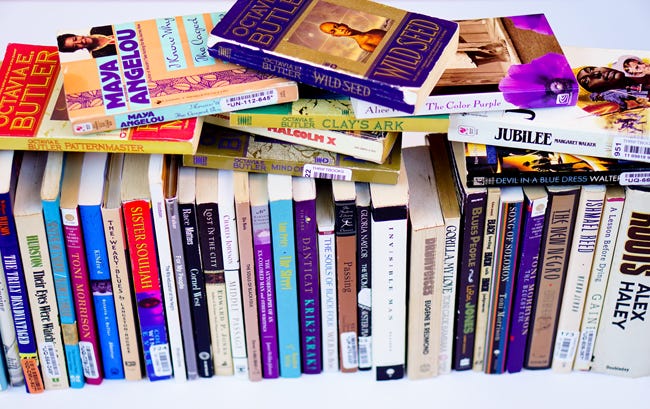
Song of Solomon by Toni Morrison was the first book I read that made my whole body react. Prior to reading that book, I was often engulfed in fantasy tales written by white writers about white kids. Song of Solomon set me on a journey through reading my favorite genre of books.
The history of African American literature is deep and wide. Our stories range from thriving of the coast of Africa to the gut-wrenching tales of street-life in Harlem and other urban cities.
The poems, short stories, novellas and novels about our struggles, our loves, our fears, and our pain is constantly changing, shedding light on the ways we have given away our power and snatched it back with vigor.
In the beginning, Phillis Wheatley, the first black woman ever published, blessed us with her poems. She spoke elegantly of imagination and praise. Even as a slave girl she had dreams that were beyond her circumstance.She unknowingly paved the way for many of our modern day poets: Nikki Giovanni, Lucille Clifton, Warsan Shire, Countee Cullen and many others.
The power of literature lies in its grasp of human emotions, but in African American literature there is a different kind of power. Its power remains in the long lost voices that were never allowed to speak of their pain and who were not viewed as human beings in a country that favored them only for their labor.
The long, dangerous and selfless journey of Harriet Tubman is told to children who would never know her personally but would have the honor of hearing her desperation to save as many black lives as she could through written word. Harriet Tubman remains the most powerful black woman to walk this Earth.
During the late 19th century the slave narrative was the most profound form of writing to be produced. The slave narrative gave rise to the voice of a people who had not been allowed a voice, whose individual lives were not their own and who had been placed in a foreign country without rights or human value.
After Phillis Wheatley, Frederick Douglass, a preeminent abolitionist, wrote eloquently about escaping slavery in The Narrative of the Life of Frederick Douglass. Douglass’ ability to write was a counter-example to the notion that slaves were all ignorant beings that could not function outside the strong hold of the slave master or overseer. Solomon Norththrop (Twelve Years a Slave) and Harriet Jacobs( Incidents in the Live of a Slave Girl) both followed suit.
The decades after the slave narratives continued to produce works by many notable authors. The era after emancipation produced works that still spoke of the ramifications of slavery and oppression, but these works were humorous and followed the path of folklore and fiction. This era was the red carpet that paved the way for The Harlem Renaissance.
The inception of The Harlem Renaissance, especially, produced the most notable fiction authors of the 19th century. Authors such as Francis Harper, Nella Larsen, Dorothy West, Langston Hughes, Richard Wright, Claude McKay, Rudolph Fisher and Zora Neal Hurston were bringing fiction to the forefront in a major way.
Hurston’s Their Eyes Were Watching God, while not as widely popular during the time of its publishing, has become a phenomenon. Hurston showed the deep struggle of black women in a time of cultural despair. Eyes was profound in its usage of dialect and showing the cycles of oppression among black people, especially of a black woman who dared to dream.
James Baldwin, another notable writer of the Harlem Renaissance, and one of the greatest writers of our time gave us so much to digest. From Notes of a Native Son to Giovanni’s Room, Baldwin wrote about the transformative power of love, race, religion and the sexuality. My favorite of Baldwin’s books is If Beale Street Could Talk. Baldwin is the writer’s writer. He is the reason we have so many black scholars, writers and activist today.
After the Harlem Renaissance we moved into the era of the Black Power Movement where literature centered the fight against white supremacy and the fight for our civil rights. Within the Black Power Movement there was the Black Arts Movement that produced works of political activism and gave voice to a generation of leaders which included Amiri Baraka, who was a founding leader within the movement.
The seminal text Black Fire: An Anthology of Afro-American Writing, was produced by Baraka and Larry Neal, a scholar of African American Theatre. The popular poet Sonia Sanchez was among the many writers and activist within Black Fire.
Another notable writer of the Black Arts Movement is my favorite black woman writer: Toni Cade Bambara. Her beautiful offering The Salt Eaters is a tale about healing, history, and community. I would venture to say it is a necessary read for any practitioners who deals in healing the black community.
The next transition of literature explored the dynamic of the black family and the absence of the black man. Terry McMillan was a heavy hitter with her debut Mama; Mama was a depiction of single motherhood and its difficulties with mothering and the children one leaves behind.
The focus on black family within African American literature gave rise to the silent but explosive reality of street life. This era of literature became know as Street Lit. Street Lit was the telescopic view of life during and after the crack epidemic. In the 1980s, Donald Goines and Iceberg Slim were pioneers of this form of writing. They respectively presented the stories of the unknown characters who suffered publicly and privately during a seemingly helpless time in black communities.
Later in 1999, Sistah Souljah published The Coldest Winter Ever, a different view of street life that showed the rise and hard fall of a family that profited from the drug trade and the screeching need to end the epidemic.
Street Lit became a highly profitable genre under the African American literature umbrella. This brought about a huge following, which included young African American readers and gave a platform to young writers who were not traditionally taught.
But as we moved deeper into the 21st Century the new wave of literature being published has fallen into the self-help category, science fiction, romance, and a greater focus on literary novels; similar to those published in the Harlem Renaissance.
Notable writers of this century include Bernice L. McFadden, Toni Morrison and Alice Walker, more of Terri McMillian, Chimanda Ngozi Adichie, Zadie Smith and many more.
It is a wide truth that reading changes lives. With African American literature we are not only changing lives, but also allowing lives to be healed and hope to be renewed through collective storytelling.
While the many great eras of African American writing produced notable works it remains to be seen how the next era will pan out.
Edit: This list of writers is of course not exhaustive. This article would be book-length had a wrote about all the prominent writers I read and who are pillars of African American Literature.