
A three-hour tour with ‘King of the Freaks’ Johnny Eck
Carnival sensation Johnny Eck’s severely truncated stature did not deter him from being crowned “The Most Remarkable Man Alive” in the 1930s by Ripley’s Believe It or Not! Prompted by a dose of eBay browsing serendipity, a twilight expedition to the retired Tarzan Escapes actor’s modest Baltimore home is fondly etched in stone by committed Three Stooges researcher Scott Reboul, incidentally a distinguished Savannah River Site radiochemist for a quarter of a century.
The Scott Reboul Interview, Part Six
In 1932 Johnny Eck was co-billed in Tod Browning’s motion picture Freaks, playing the role of himself, a circus freak known as the half-man. Eck’s Hollywood foray lasted for just three additional Johnny Weissmuller Tarzan movies [variations of a “Bird-Man” in Tarzan the Ape Man, Tarzan Escapes, and Tarzan’s Secret Treasure]. Eck was born with his body ending just below his rib cage, with no obvious waist or legs. He walked on his hands, and was an acrobat, balancing himself on one hand, while the remainder of his body stood suspended upside down. For more details on Eck, see the information provided on IMDb and/or the Johnny Eck Museum curated by Jeffrey Pratt Gordon.
As a kid growing up in the 1960s, I learned about Freaks and Eck’s role in it through Forest J. Ackerman’s Famous Monsters of Filmland magazine. Back then, there was no home video, and out of the norm films like Freaks were not broadcast on television [TCM presently airs it annually]. So reading about Freaks in Famous Monsters of Filmland was the primary means an individual could become aware of the Freaks storyline and its cast members back in the 1960s.
After several years of cogitating about Freaks, I finally had the chance to see it in the late 1970s, at college, where it was shown as an art film. Seeing the film was a bit of a letdown after thinking about it for so many years, and imagining what an extremely unusual and entertaining film it must be, given the large cast of circus freaks including the famous Hilton sisters [Siamese twins], the half man [Eck], the bearded lady, the hermaphrodite, the human skeleton, various “pinheads,” the armless and legless Prince Randian, and multiple little people. The film is unique and morbid, but given the limited acting abilities of many of the circus freaks, large sections of the film are rather monotonous and uninteresting, although the range of characters is anything but. Freaks is the longest 64 minutes ever put on film. Nonetheless, it is the motion picture Tod Browning directed immediately after directing Dracula starring Bela Lugosi.
Despite the imperfections of Freaks, it is definitely memorable and unlike any other motion picture I had ever viewed. And, of course, I was thankful to get the chance to see when I did, because it seemed to be a film that was removed from circulation, due to its somewhat disturbing content. Given the severe deformities of many of the cast members, I incorrectly assumed that none of the deformed cast members could still be alive as late as the 1970s.
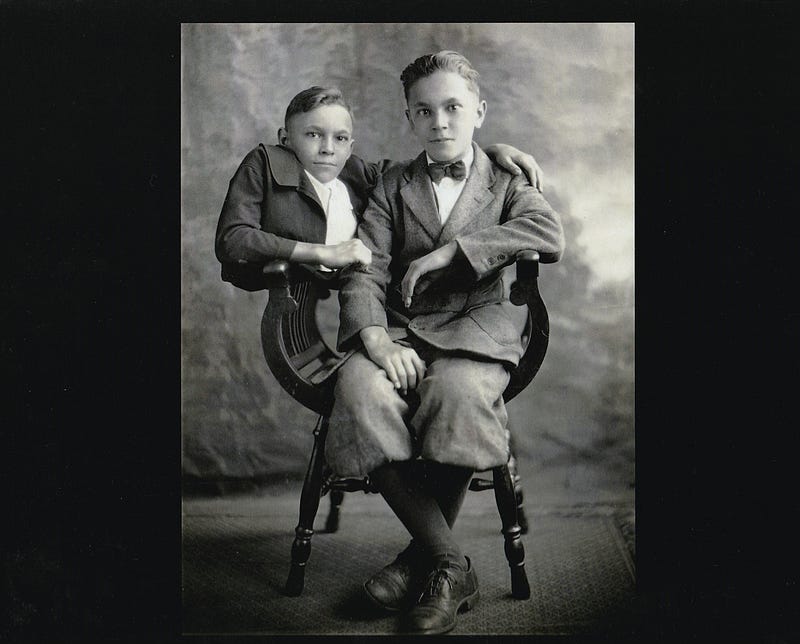
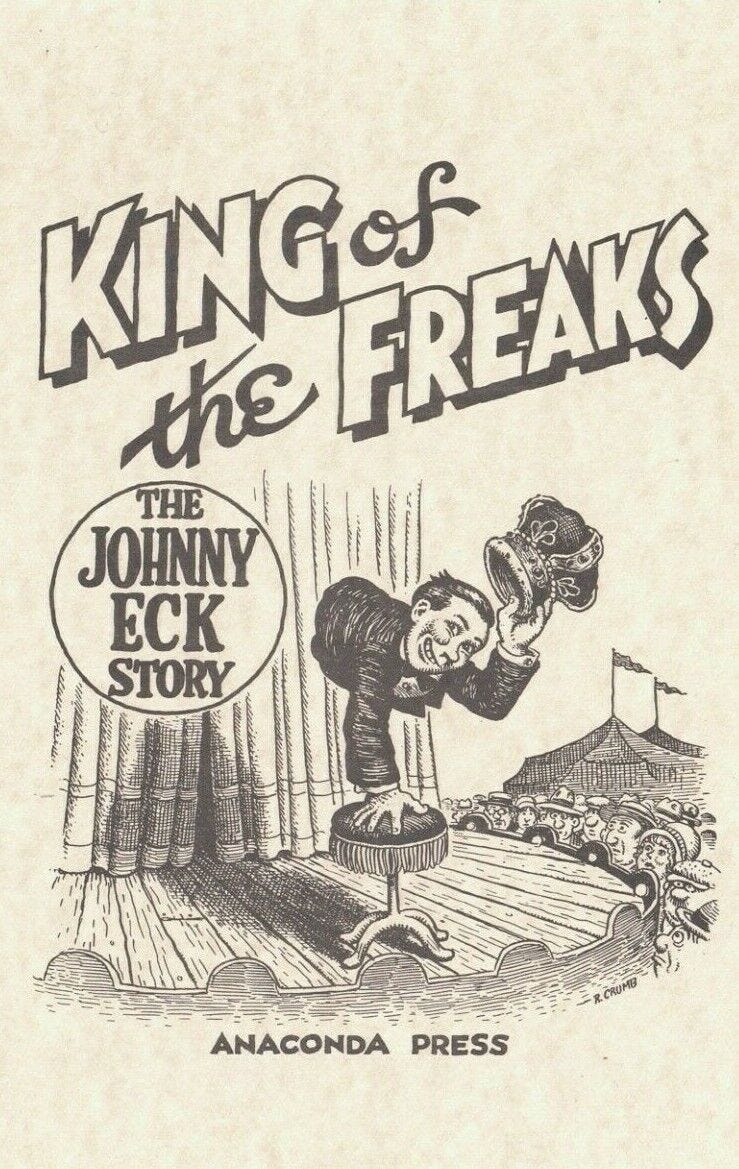
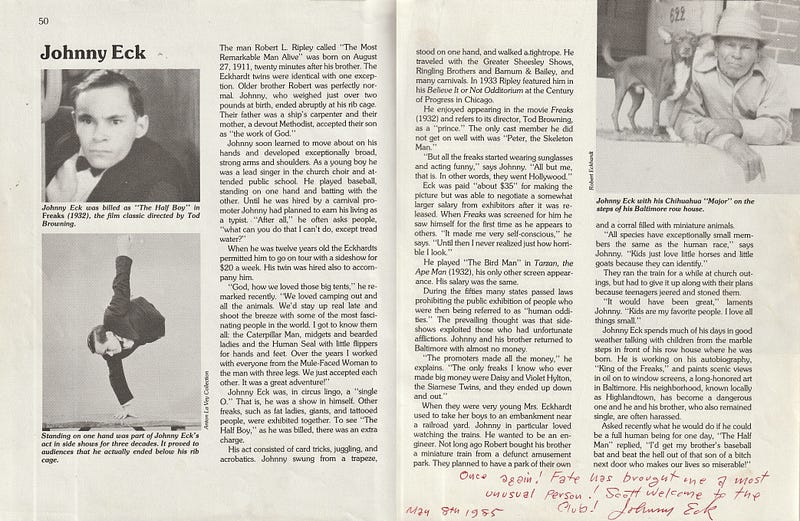
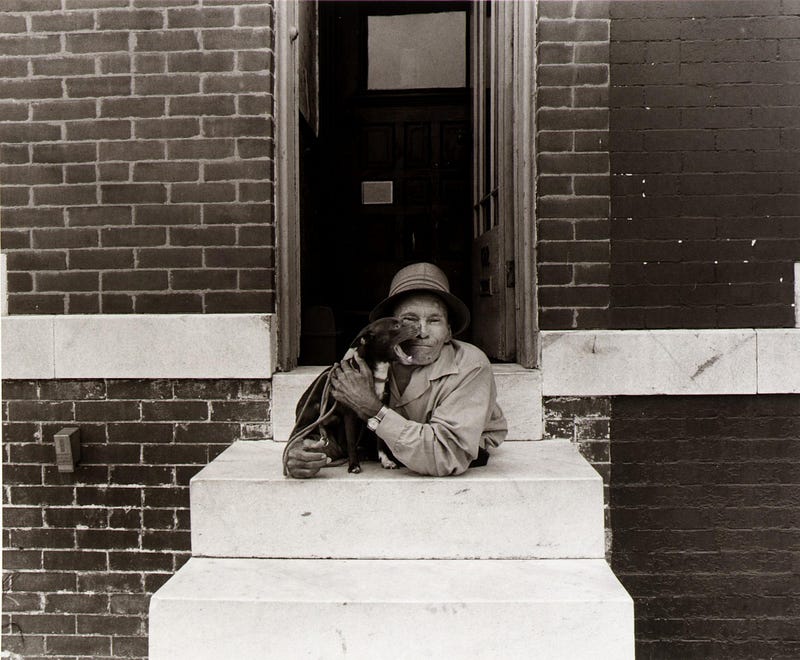
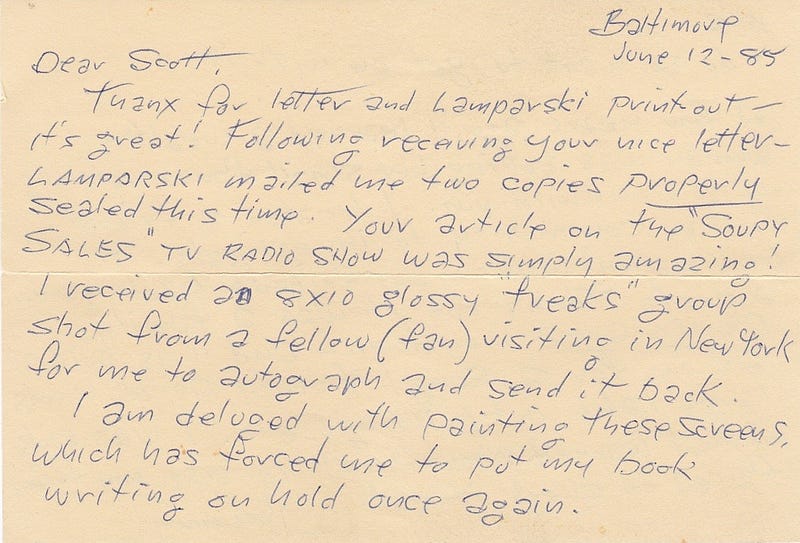
Fast forward to early 1985. I had been enjoying Richard Lamparski’s Whatever Became of…? books for the past 20 years, and I would purchase each new volume as soon as it became available. Each book would contain 100 profiles of past actors, singers, dancers, sports figures, politicians, writers, and other well-known personalities, presenting summaries of their lives focusing on their glory days and their current activities, complete with then and now pictures of each subject. Imagine my surprise when I opened Volume 9 of the series and found a profile of Johnny Eck, identifying that he still lived in the same Baltimore row house where he was born.
In 1984, I had moved from Pennsylvania to South Carolina to attend graduate school at Clemson University. My parents still lived in New Jersey, my brother still lived in New York City, and most of my friends still lived in New York, Pennsylvania, and New Jersey, so I routinely drove through the Baltimore area at that time on my trips to visit family members and my friends. Why not pay a visit to Johnny Eck on my next trip to the great northeast? All I needed to do was find his home address, which was identified in the telephone book under his twin brother’s name, Robert Eckhardt, who was identified as living with Johnny in the Whatever Became of…? profile. The address in the phone book was 622 North Milton Avenue, which was clearly the correct address, as evidenced by the “622” street number visible on the door in the current picture of Johnny included in Lamparski’s book.
My first visit with Johnny was on May 8, 1985, as I traveled from South Carolina to visit my friends in New York. With Johnny’s address in hand, I drove through center city Baltimore, looking for a street sign identifying Milton Avenue. Before long, such a street sign appeared, and when I saw it, I turned onto Milton, looking for a housing unit marked 622. As the numbers approached 622, I saw a door frame in the distance that stood out, as it was painted a bright fluorescent green color. Sure enough, the door of that unit contained the number 622, and was obviously the door in the current image of Eck included in the Lamparski book.
I parked my car on the side of the road, walked up to Johnny’s door, and knocked on the door, hoping Johnny would be home and would be open to my visit. Through the windows on the door, I could see Johnny walking on his hands to answer his door. He stopped before opening the door, with his face against one of the lower windows on the door, and loudly asked me, “What do you want?” I said I was a fan of his and just wanted to meet him. He quickly replied, “I’ll be back in just a second.”
When he returned, he had a thick scrapbook under his arm, and he joined me on his front step. He asked my name, said he was glad to meet me, and then spent the next three hours showing me his scrapbook, answering my questions, and telling me all about his life and career. During my visit, Johnny’s twin brother Bob joined us for a short while, listening to our conversation, and adding a few comments of his own. Both Johnny and Bob were as nice as they could be.
As I prepared to leave, I told Johnny that I had a copy of the Lamparski book in my car, and I asked him if he’d be willing to autograph his profile. Without hesitation, Johnny said, “Of course I will!” As I left, Johnny encouraged me to write to him, if I wanted to, and to visit him again the next time I passed through Baltimore. I told him I would do both — write to him and visit him again — and I left Johnny’s front steps extremely happy about the visit.
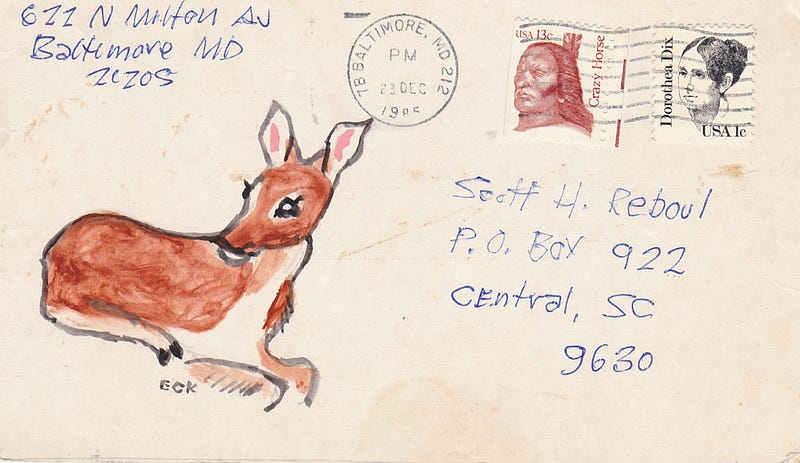
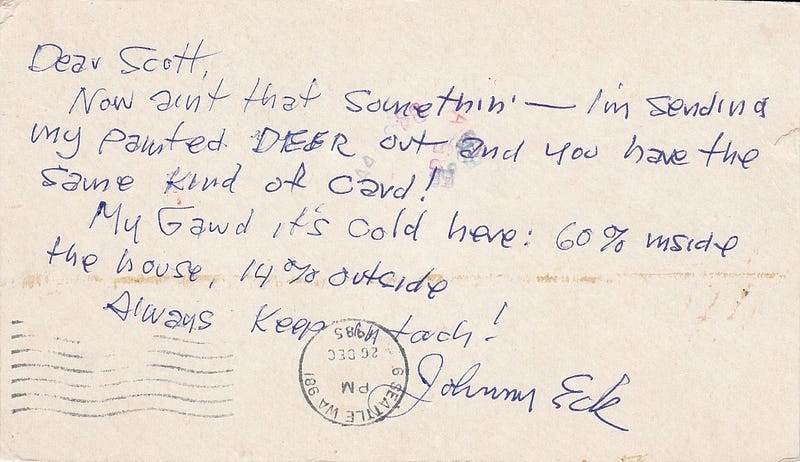
Over the next year, I wrote to Johnny twice, and I visited him two more times. Upon receiving my letters, Johnny sent back his own letters, which of course I still have. Johnny was an artist, and at Christmas time, Johnny would paint a Christmas reindeer on the front of the holiday post cards he would send.
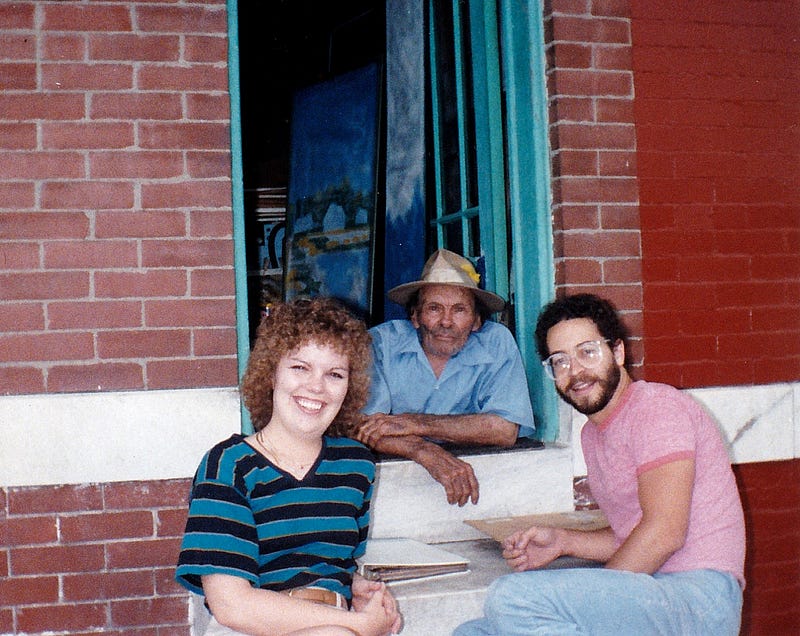
In April of 1986, I began dating a woman named Debbi Bowman, who I ultimately married. During Memorial Day weekend of 1986, Debbi and I drove up to NYC to meet a bunch of friends for a series of esoteric endeavors. Of course, I couldn’t make the South Carolina to New York road trip without stopping at 622 North Milton Avenue in Baltimore. Thankfully, Debbi had brought a cheap, 110 camera with her, which allowed us to capture one photograph of ourselves with Johnny on his front steps [seen at the top of this story].
Sadly, Johnny’s next-door neighbors harassed him and his brother from the time they moved in, including killing one of Johnny’s dogs, and then ultimately beating up and robbing Johnny in the start of 1987. From that point on, Johnny and Bob became recluses, cutting off ties with the outside world through the remainder of their lives. A very sad ending for two of the nicest, most generous gents on the planet. Meeting them was definitely one of the highlights of my life.
In 2020 I began writing an article for Gary Lassin’s Three Stooges Journal about Moe Howard’s copious 1973 Philly/South Jersey appearances. One of those appearances was a surprise cameo on a segment of The Mike Douglas Show featuring Richard Lamparski, where Lamparski answered questions from the audience about bygone personalities. I wondered if Lamparski had any recollections of Moe that I could include in my article. One of my friends who used to correspond with Lamparski informed me that Lamparski had passed away about 10 years ago. I searched online, couldn’t find an obituary for Lamparski, but found an interview with Lamparski that apparently took place within the last five years, suggesting that maybe he was still alive.
I then searched USPhoneBook.com and found an address and telephone number for Lamparski, which I realized might be obsolete. I figured I had nothing to lose by calling the number and seeing if someone answered, and if so, finding out if that person knew anything about Lamparski. When I called the number, no one answered, but there was an answering machine, so I left my message and my telephone number. The next day when my phone rang, I looked at the caller ID, and saw the name “Lamparski, Rich.”
I answered the phone, and unbelievably found myself speaking with Lamparski, more than 50 years after I first started reading his books, devouring every word on the pages. Yes, Lamparski was still alive, at age 88 or 89. When I mentioned his 1973 appearance with Moe on The Mike Douglas Show, Lamparski had a short, simple response that put everything in perspective: “That was an awfully long time ago!” [a quote I used in my two-part Moe article]. By the way, when I told retro pop culture chronicler Steve Cox [e.g. The Munchkins Remember, One Fine Stooge, and The Incredible Mr. Don Knotts] that I had just spoken with Lamparski, Steve was stunned, saying “Wow, you threw me for a loop — I had heard that Lamparski died years ago!”
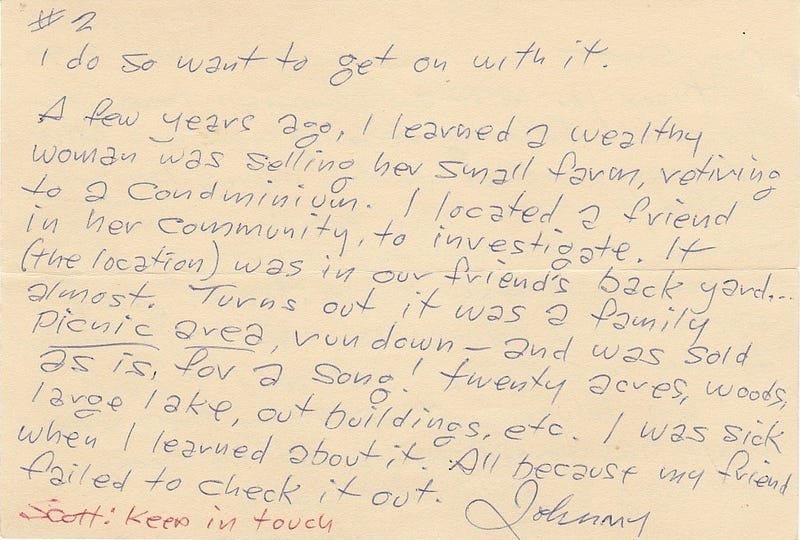
Between my long term love of the Lamparski books, my visit with Johnny Eck due to Lamparski’s coverage, and my latter day telephone conversation with Lamparski, I felt that I had come full circle regarding the Lamparski and Eck interactions. But I was wrong. Earlier this year, I found something on Ebay, 36 years after the fact, that showed there was a part of the Lamparski-Eck exchange I hadn’t been privy to, at least up until now.
It was a letter that Eck had written to Lamparski on May 11, 1985, three days after my initial visit with him. Eck was grateful to Lamparski for the coverage as well as two complimentary copies of the book Lamparski had provided him. But what caught my eye in the letter was a particular sentence Eck had written which said, “Your book is already being picked up — I had a “fan” visit from South Carolina, on his way to New York, and he showed me his copy [which I autographed].” I can’t express how amazed and surprised I was to read these words 36 years after they were written!
© Jeremy Roberts, 2022. All rights reserved. To touch base, email [email protected] and mention which story led you my way. I appreciate it sincerely.


