
Holidaying in Hungary
A Three-Day Sojourn In Sopron
A beautiful and historic medieval city in Hungary, close to the border with Austria, boasts of partially excavated open-air Roman ruins behind the main square
Vienna is one of my most favorite of cities. There is not an iota of hesitation when it comes to making a repeat visit to the Austrian capital.
That being said, those who happen to go to a particular city on multiple occasions apart from knowing that city inside out, their time also gets divided. With every subsequent visit, the general tendency is to stretch it a little further and end up exploring a bit more of the adjoining areas. In my case, it is no different either.
Having visited the countryside and little hamlets and towns surrounding Vienna, I decided to venture out further on this occasion. Since the trip was an elaborate affair, it was not only possible to space things out well but also experiment a little when it came to the intended destination. So instead of travelling within Austria, I decided to travel across the borders, to the nearby countries.
My first destination of choice was a place I hadn’t heard much about. It is right across the other side of the Austrian border and takes a little more than an hour by train from the Wien Hauptbahnhof (Vienna Main Station). It is indeed a very scenic ride through the Austrian countryside, passing through beautiful little towns like Wulkaprodersdorf, Draßburg and Baumgarten. The train then enters Hungary, has only one stop — where I eventually got down, before heading towards its final destination — an Austrian market town named Deutschkreutz.
Even though I have been to Hungary before — and explored Budapest, Debrecen and the adjoining areas, I had never been to the western part of this beautiful landlocked country. As such, I was venturing out into unchartered territory, and even as I was making arrangements for my three-day trip, I came to know more about Sopron.
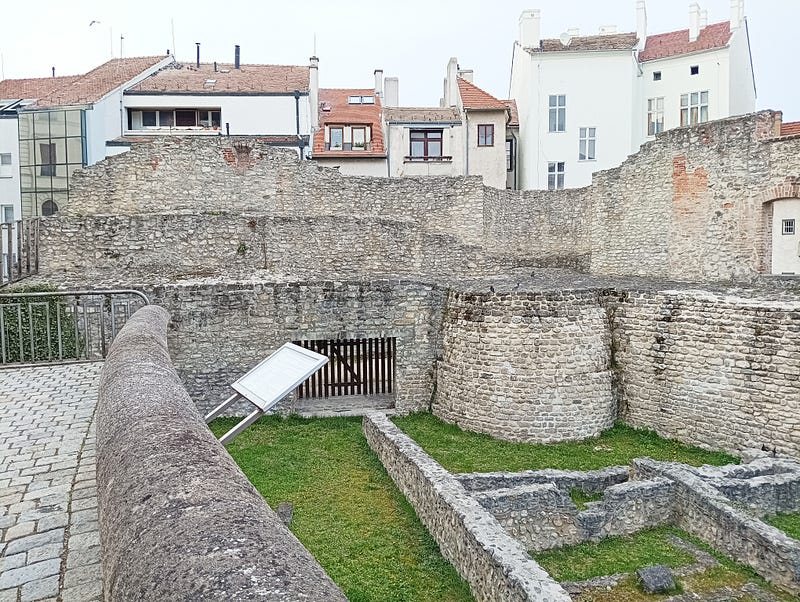
To be honest, Sopron has a fascinating history. For starters, the westernmost of the Hungarian cities stands in an area that was known as the walled city of Scarbantia, and happened to be a small outpost of the mighty Roman Empire. Like many other cities, Sopron was also destroyed to a great extent by the bombing during the Second World War.
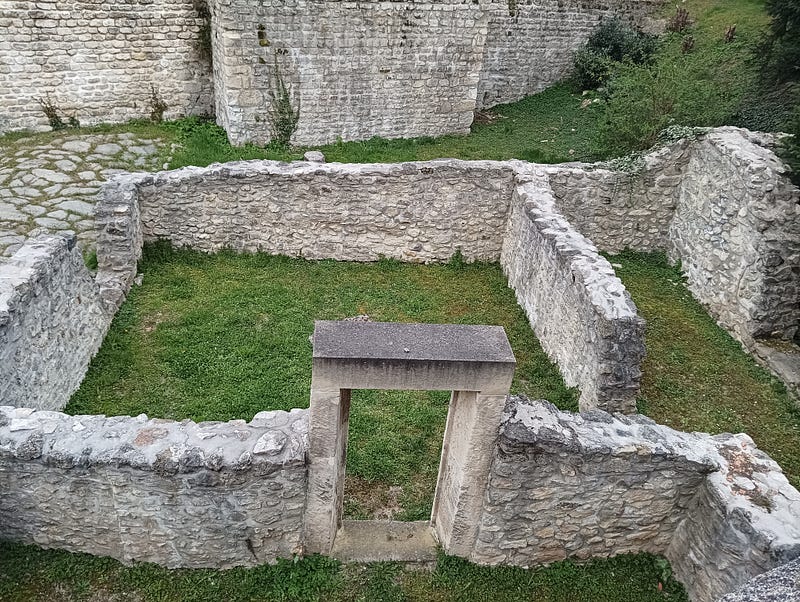
However, even as the bombs dropped damaged, many of the houses in Sopron, they also ensured the city wall (of Scarbantia) reappeared behind these ruined houses. These Roman ruins have been carefully excavated and restored right next to Fő tér — the old town main square, the place I landed up soon after checking in to the hotel.
In fact, I’d have no qualms in claiming that the glimpses of Sopron’s Roman past offer the major sightseeing highlights and the inner city castle wall is a nice area to walk around, along with what is known as the Várfalsétány (Bailey Promenade).
Also worth knowing is the fact that during the early part of the 20th century, there were many Germans who settled in what was then as part of the mighty Austro-Hungarian empire. Sopron even had a German name, and was also known as Ödenburg. Following the First World War, the Austro-Hungarian Empire was broken up, and the German-controlled areas of northwestern Hungary were palpably given to Austria.
However, the locals weren’t particularly happy about the decision. The displeasure and the ensuing unrest resulted in Italian intervention. A controversial referendum, mediated by the Italians, was held in December 1921, where the people of Sopron voted to continue with their Hungarian identity. Following this landmark occurrence, Sopron has been called A Leghűségesebb Város (The Most Loyal Town).
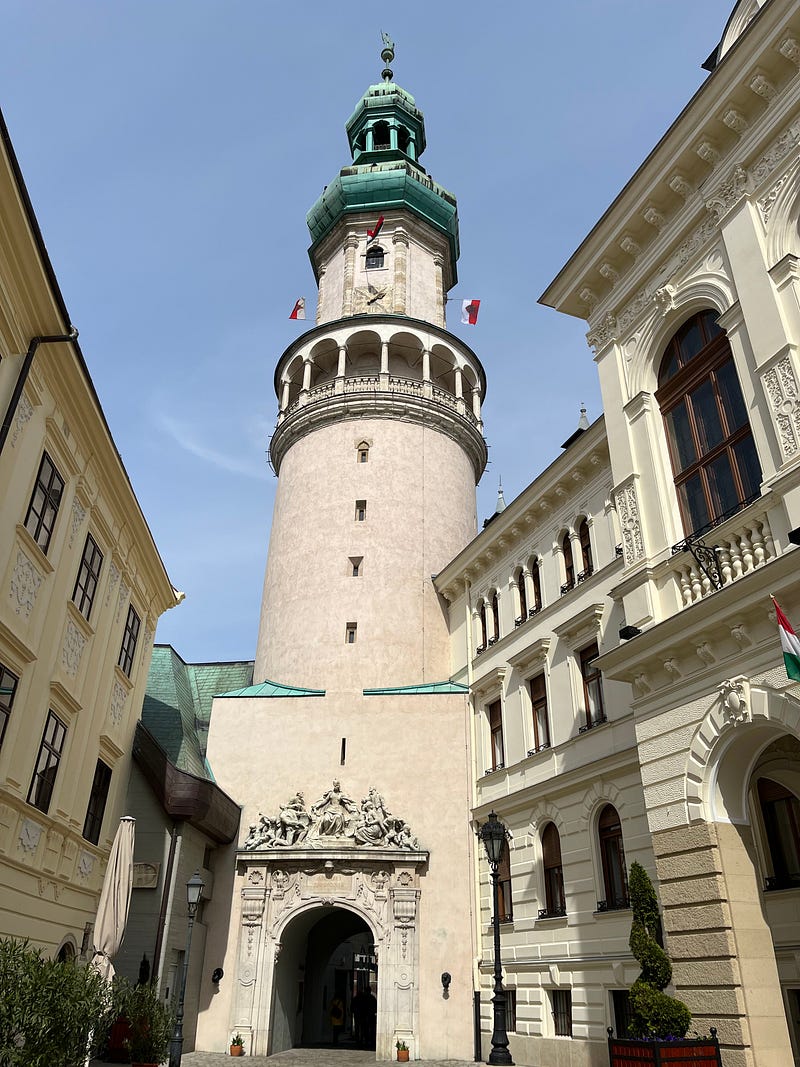
In fact, in Tűztorony (Fire Tower) — the city’s iconic landmark, is installed the Gate of Loyalty with the inscription Civitas Fidelissima (Most Loyal Citizens, as mentioned above). The historic fire tower, initially built in the 12th century as a castle gate tower, also stands on Roman foundations and consists of a medley of architectural styles.
While the main tower structure is medieval in character, its balcony and clock tower boast of a Renaissance style. Finally, its multi-storied onion dome has been constructed in Baroque architecture, the three contrasting styles clearly indicating the various periods of restoration following a fire incident of 1676 that not only burned the upper parts of the tower but also engulfed the city per se.
In fact, the catastrophic fire of 1676, coupled with the aftereffects of the two World Wars, has had a significant impact on Sopron, and explains its architectural diversity to a considerable extent.
Climbing up the 200-odd steps of Tűztorony ensured unmatched views of the town proper. Having completed a few mandatory clicks of the iconic symbol, I moved a little further to Fő tér.
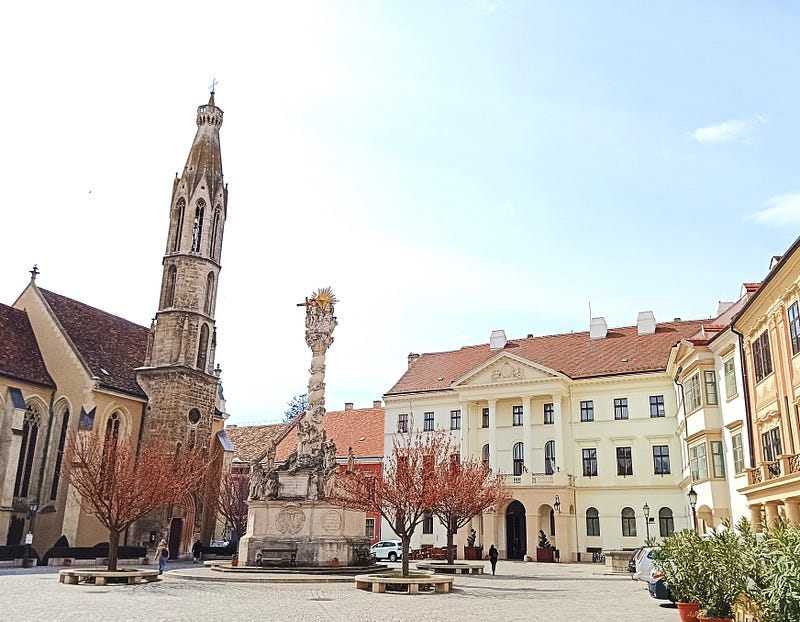
The old town main square is also home to a host of Sopron’s other main attractions including the Church of the Assumption (Goat Church), the Holy Trinity Column — a striking baroque monument commemorating the end of the Black Death (plague epidemic), the iconic Storno- ház (Storno House), the Fabricius-ház (Fabricius house) — a Baroque building with a gothic hall and the Patika- ház (Pharmacy House — Museum of Sopron).
On the second day, I spent more time walking along the Várfalsétány (Bailey Promenade), which starts from Bünker-köz street — named after the man who gave the town its name. The triple wall ring, built of elliptical blocks, contains the promenade that continues behind Színház utca 3 (Temple Street) and the Amber road leading to the ancient city and Városház Street ruins garden, which represent the remains of the Roman ruins of Scarbantia.
The Nagyrondella section of the city wall became visible during World War II bombings. These reconstructed walls and open-air ruins define Sopron’s Roman past. In fact, these Roman archaeological sites, right in the middle of Sopron, demand adequate time to be explored and cherished.
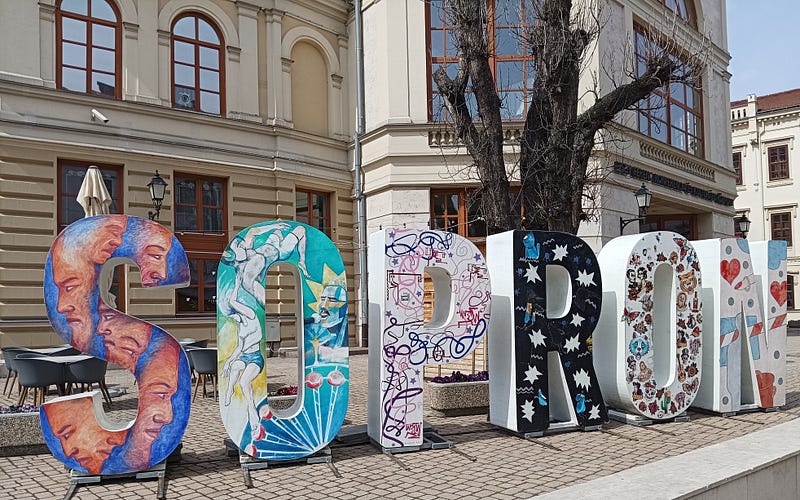
Sopron is like stepping back in time. It features heritage architecture — an eclectic combination of Baroque, Renaissance and Hungarian Gothic architecture styles and a laid-back lifestyle. In fact, Sopron is a hidden gem, a historic destination that has quite a few things going for it. It is a place that recognizes the heritage of its German-speaking culture.
As such, it is not that Sopron is not touristy at all. While not many tourists are seen on the weekdays, the weekends witness people from the neighboring countries like Austria and Slovakia arriving to relax for a couple of days.
In fact, two days are enough to explore Sopron in great detail, as also to soak in what this little city with varied history has to offer. So what did I do on the third day?
Well… Let me talk about it in my next post.