
A Tale of Two “Lion King”s: Film Review
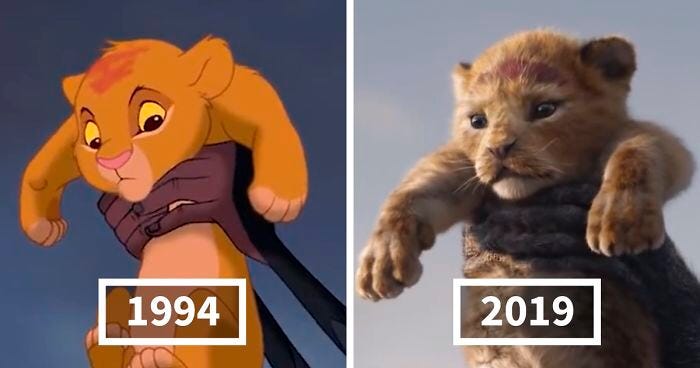
I was not quite sure what to make of the negative reviews I read of Disney’s remake of The Lion King that started popping up online after early press screenings last week. (The film currently has a truly mediocre 56% on Rotten Tomatoes and a 55/100 on Metacritic.)
I was skeptical of the reviews because most of the ones I read seemed to come from critics who resided in camps that I do not identify with in the slightest. The first camp is the “you’re ruining my childhood by remaking the classics” camp. I am a firm believer that even if the sequels, remakes, reboots, or revivals fail to live up to the original it doesn’t somehow degrade or erase the quality of the original. Just because Speed 2: Cruise Control was an epic disaster does not change the fact that Speed is the greatest action film ever made. Just because The Phantom Menace was for the most part laughably cheesy didn’t taint my love for the original Star Wars trilogy. And, no, the all-female Ghostbusters reboot did not have any adverse impact on the legacy of the original.
The second camp is the one that includes phrases like “I was ‘meh’ on the first one.” I am most certainly not “meh” on the original 1994 version and honestly have difficulty relating to anyone who is. In fact I rewatched it for the umpteenth time last week just to make sure my advancing age hadn’t changed my take on it. It turns out that it remains heartbreaking and hilarious with visuals that still stun and an original score that ranks with the all time best.
The Legacy of The Lion King (1994)
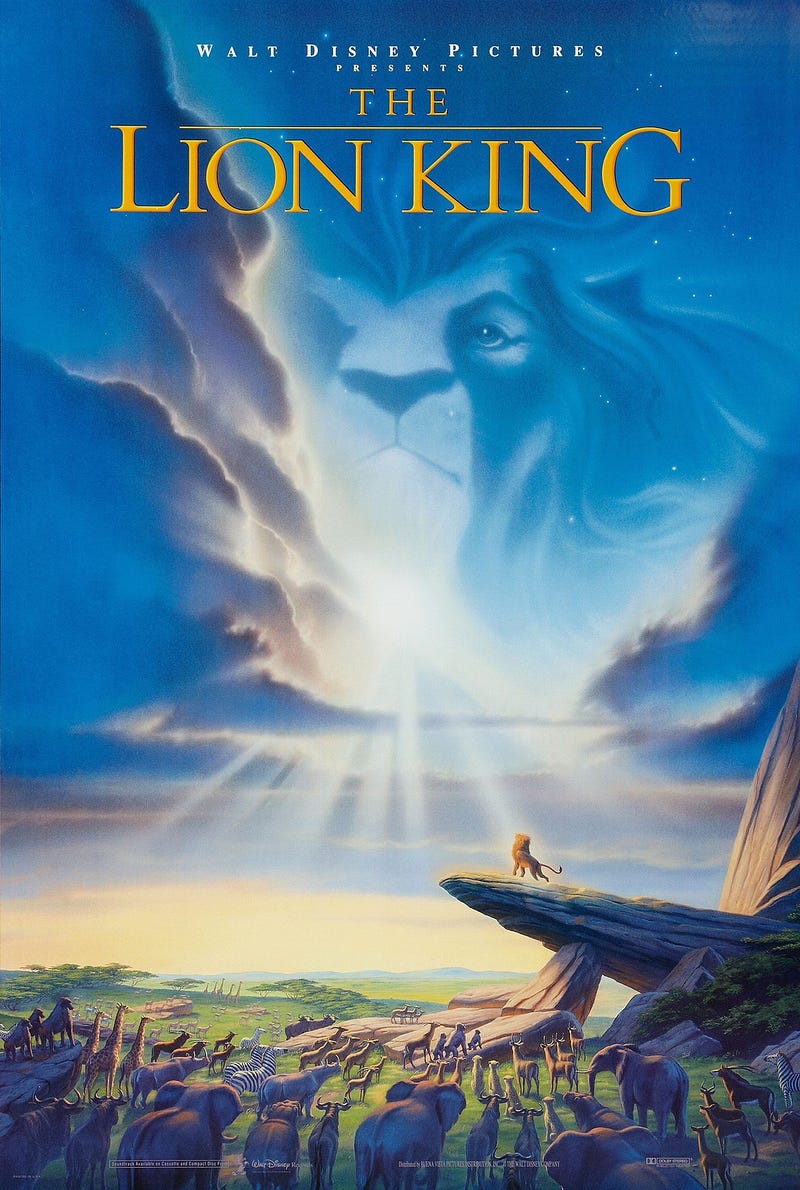
To call the initial film a phenomenon would be a gross understatement. At the end of its original run it was the second highest grossing film of all time (behind Jurassic Park, released just one year prior). When adjusting for inflation, the film ranks in the all-time top 20. It was lauded by critics and won the Golden Globe for Best Motion Picture — Musical or Comedy as well as two Oscars (Best Original Score for Hans Zimmer and Best Original Song for Tim Rice and Sir Elton John’s “Can You Feel the Love Tonight.”) The American Film Institute named it the 4th best animated film of all time, Empire magazine included it on their list of the greatest films ever made, and the Library of Congress selected it for preservation in the National Film Registry.
In addition to being a commercial blockbuster and critical hit, the original is unique for a number of other reasons. It was the fourth and arguably final film in the Disney Renaissance, in which the world’s most famous animation studio followed decades of disappointments with some of their most commercially and critically successful films ever (The Lion King was preceded by 1989’s The Little Mermaid, 1991’s Beauty and the Beast, and 1992’s Aladdin). The film was a technical marvel, with the animators capturing the film’s locale (the Serengeti plains of Tanzania) with a level of artistry and accuracy never before seen in an animated film. And the key tragedy at the center of its story (which is loosely based on William Shakespeare’s Hamlet) is the material for a generation of children’s nightmares.
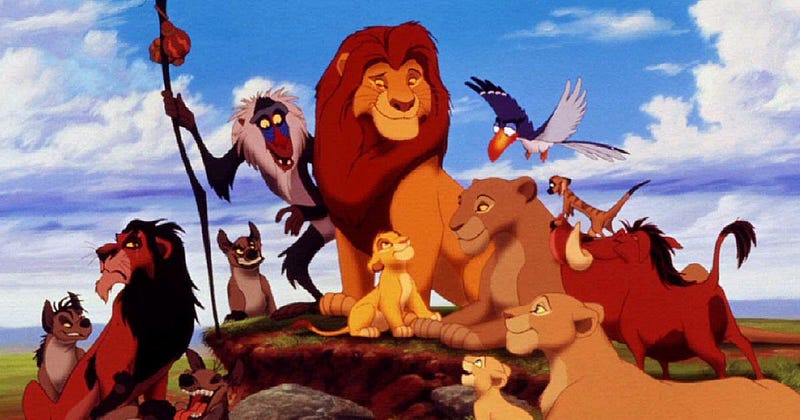
The film featured a sterling voice cast that included powerful dramatic work by Jeremy Irons, James Earl Jones, Matthew Broderick, Jonathan Taylor Thomas, Moira Kelly, Madge Sinclair, and Robert Guillaume alongside wonderful comic relief provided by Nathan Lane, Ernie Sabella, Rowan Atkinson, Whoopi Goldberg, and Cheech Marin. And then there’s the music. The film features five original songs (“The Circle of Life,” “I Just Can’t Wait to Be King,” “Be Prepared,” “Hakuna Matata,” and “Can You Feel the Love Tonight”), all of which are essential to the story and unforgettable compositions. The film spinoff direct-to-video sequels, video games, animated series, and countless toys turning it into arguably the most lucrative animated film the legendary studio had ever seen up until that point.
The Disney Classic Remake Craze
The Lion King (2019) hits theaters today, 1 month and 3 days after the 25th anniversary of the original’s release. It follows a string of live action remakes of Disney animated classics that can be traced back to the wonderfully campy Glenn Close-led remake of 101 Dalmations in 1996 and Tim Burton’s 2010 blockbuster reimagining of Alice in Wonderland. However, the trend really began in earnest with Maleficent, the 2014 remake of Sleeping Beauty headlined by Angelina Jolie, which was followed by the 2015 remake of Cinderella from Sir Kenneth Branagh, the 2016 remake of The Jungle Book from Jon Favreau, and the 2017 remake of Beauty and the Beast from Bill Condon. Each of these films was a box office sensation and most were generally well-liked by critics. They were appreciated as films that largely captured the spirit of the original while changing perspective (e.g., Maleficent), fleshing out key backstory and secondary characters (e.g., Cinderella and Beauty and the Beast), and pushing the boundaries of the medium of film (e.g., The Jungle Book’s Oscar-winning special effects).
Unfortunately, Disney got greedy in 2019 and massively overplayed their hand with three big budget remakes of animated classics being released in the span of four months — Tim Burton’s Dumbo was a critical and commercial dud upon its release in March and although Guy Ritchie’s Aladdin did swell at the box office in May, it mostly elicited groans from critics. Then two short months later, Jon Favreau’s The Lion King retread hit theaters. And while its commercial success remains to be seen, in terms of quality it fails to reverse this recent downward trend.
My Review of The Lion King (2019)
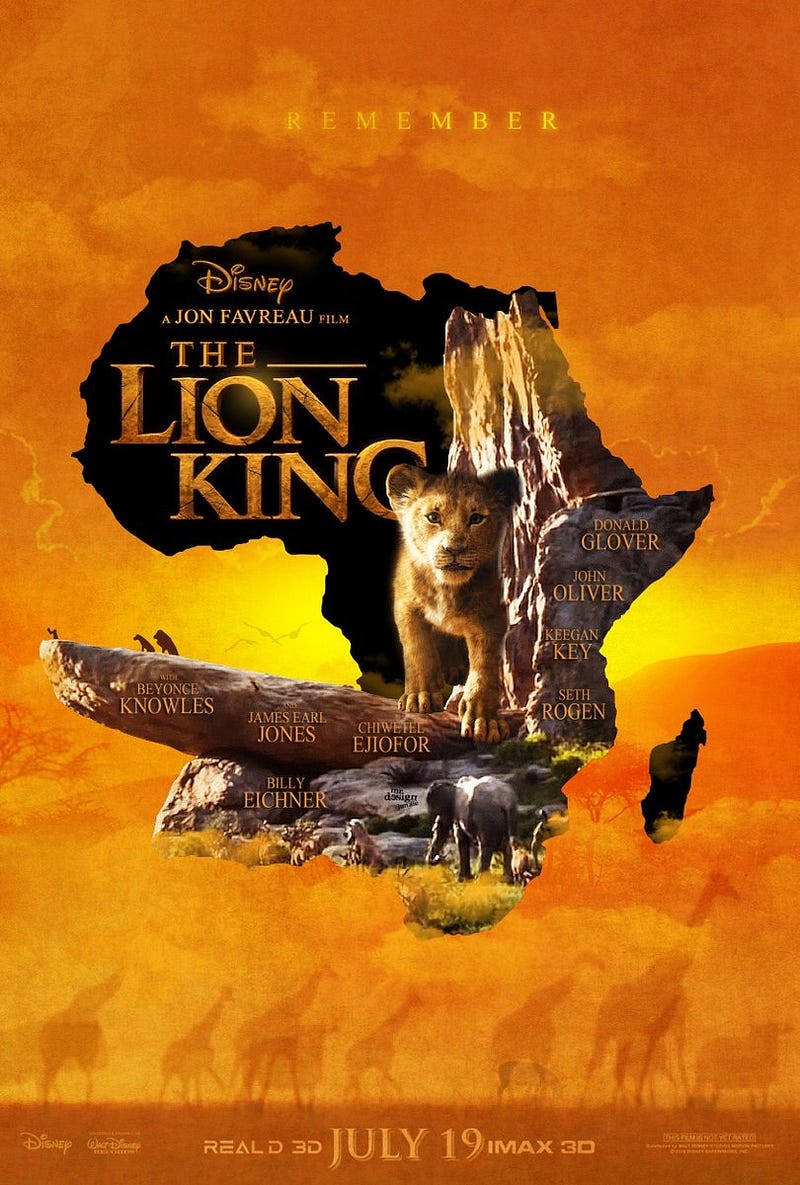
The Lion King (2019) has a tremendous amount going for it. It is directed and produced by Jon Favreau, who has given us a slew of high quality blockbusters as diverse as Elf, Iron Man, and The Jungle Book. The first film’s Oscar-winning musical trio (Hans Zimmer, Tim Rice, and Sir Elton John) all returned to score the film. A very impressive voice cast was lined up to take over the iconic roles, including Donald Glover, Chiwetel Ejiofor, Alfre Woodard, Seth Rogen, John Oliver, and the one and only Beyonce Knowles-Carter. (The lone holdover from the original film is James Earl Jones … apparently Mufasa’s regal, booming voice was too iconic to replace.) And then there’s the fact that visual effects have improved by such leaps and bounds in the past quarter century that it was almost spine-tingling for fans to imagine what modern technology could do with the dazzling set pieces.
There’s absolutely no doubt that The Lion King (2019) is a technical feat. Although it is basically an animated remake of an animated film that just uses different animation techniques, the exceedingly realistic CGI is utterly breathtaking in the film’s shot-for-shot recreation of the original’s prologue set to the stirring beat of “Circle of Life.” The film never ceases to be a wonder for the eyes, but unfortunately the film never provides much for the other senses.
Ultimately, there are three problems that derail The Lion King (2019):
- The astounding lack of originality. The decision to recreate the original film’s iconic opening sequence frame-for-frame with CGI was an inspired and effective one. Unfortunately, the film repeats this approach repeatedly throughout the film simply recreating beautiful vistas and character interactions from the original with more technical wizardry. The plot is identical, with an ever-so-slight fleshing out of the Mufasa-Scar-Serabi dynamics (although these could have been easily inferred in the original by anyone with even a rudimentary understanding of the social structure of lion prides). The dialogue is almost entirely the same. Where they did make changes they are largely unsuccessful, puzzling, or — in most cases — both. The new jokes mostly fall flat (with the exception of anything delivered by Billy Eichner’s Timon, the one character that truly comes alive in the film) and a couple of classic exchanges from the original are oddly missing. (Perhaps it was a warning sign that the screenplay was adapted by Jeff Nathanson who has given us a striking array of disappointments like the aforementioned Speed 2, Rush Hour 3, Indiana Jones 4, and Pirates of the Caribbean 5.) Save a short snippet of Beyonce’s rather uninspired original track “Spirit,” a longer version of “The Lion Sleeps Tonight” by Timon and Pumbaa, some new dialogue in “Hakuna Matata,” and a very brief foray into “Morning Report” (Zazu’s number that was cut from the original film but restored in a subsequent DVD release), the songs and score are carbon copies of the original film’s soundtrack. Even the orchestral cues in key dramatic sequences don’t seem to vary a single note from the original. There is a moment towards the film climax when Timon and Pumbaa make a clever and genuinely funny reference to “Be Our Guest” (the musical highlight of Beauty and the Beast) and it sticks out like a sore thumb — it’s one of the only original idea in the whole film and certainly the only one that works.
- The lack of emotion. One of the major criticisms that has been heaped on the film is that the animals are not expressive. And indeed this is the case, as whenever it comes to deciding between realism and expressivity the creative team goes for realism. The result is that much of the film feels more like watching Planet Earth with narration by A-listers rather than it does an actual drama playing out. One of the best things about the original was the way the animation team imbued deeply authentic human emotion into the animal characters and that is almost entirely missing here.
- The padding. The original film comes in at a nice and tight 88 minutes, whereas this one comes in at a bloated 118 minutes. It boggles the mind to figure out how they added 33% to the film’s running time with no new subplots or musical numbers, but nevertheless they did. The extra half hour appears to have mostly come from padding the existing scenes and expanding the transitions. The result is that the rhythm of key moments feels off and the film suffers from a major pacing problem in the second half that is nowhere to be found in the original.
To be fair, The Lion King 2019 is not a truly bad film. It is a technical marvel and a visual feast. It tells a compelling story with memorable characters. It features appealing voice work. But it pales massively in comparison to the original and its astounding lack of originality makes it feel hollow, like a pointless cash grab.
The Bottom Line: The Lion King 2019 is a dazzling visual spectacle, but it’s a mostly soulless and ultimately pointless remake of the far superior 1994 version.
The Lion King (1994): 5/5 stars
The Lion King (2019): 3/5 stars
Click here to follow me on Medium and Twitter.
Author’s Note: All images used in this article are promotional images owned by Disney.