
A Symbolic Understanding of Illumination
A discussion on the concept of ILLUMINATION, and its symbolic applications.
The definition of the word “Illumination” is as follows, “lighting or light.” Such a definition would be the result of a quick Google search and should easily satisfy most people who were simply looking for a quick definition. As is always the case with words, however, for many people there are numerous other contexts that accompany a word. For some people, these contexts differ depending on their experiences with certain words, and experiences with the things that certain words represent.
For those who attempt to think upon the world “illumination,” many would come to the conclusion that the word does not merely represent a concept of light, or lighting. Once we look further into this representation we begin to understand that this definition is not only representing the quality of physical light upon a three dimensional space, but also the process of “illuminating” or a bringing into the light. It is here that we begin to understand the symbolic importance of the process of Illumination.
Furthermore, we must recognize that Illumination is, in and of itself, a process. It is not a destination, and it is not a means which one could reach a destination. As humans we must humbly submit to the reality that, due to our evolutionary and biological needs, the entirety of reality is not visible to us. Each step towards illumination is a step towards that which would allow us to fully recognize the divine within ourselves, and outside of ourselves — in other words, without.
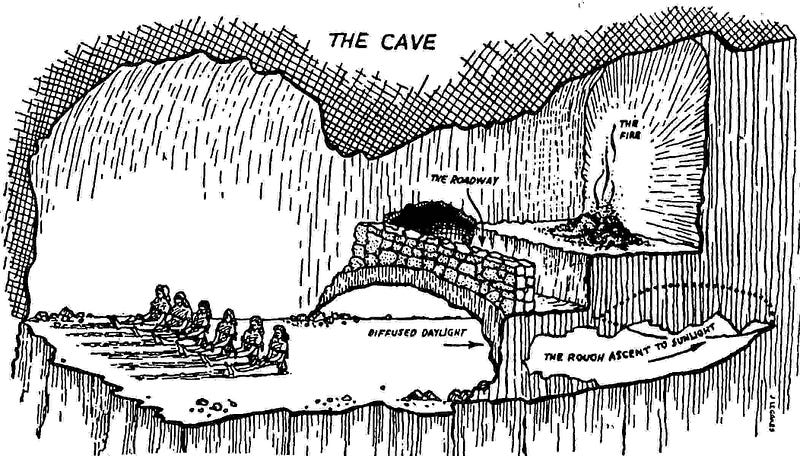
In order to fully paint the picture of what I am trying to describe, I will reference Plato’s Allegory of the Cave. For those who are unfamiliar, this story is meant to describe the act of enlightenment, and the realistic applications of one who goes through such an experience.
Imagine a cave in which people are fettered and bound by chains and forced to look upon a single wall on one side of their cave. These are people who have been chained to gaze upon this wall for their entire lives — it is all they know. Immediately behind and above these people are a road, and immediately behind the road is a roaring fire. As people and animals cross this road the fire casts shadows upon our imprisoned people’s wall. These people, never having seen the true forms of these creatures, because they have only gazed upon their shadows cast by the fire, engage in a reality that is not, to be clear, fully illuminated.
Keep in mind that the shadow forms of those who pass over the road are the only forms that the imprisoned peoples have ever gazed upon. These people would have fully formed stories and myths to accompany their experiences of these shadow creatures. For if one lived in which a reality that such would be fully accepted by all those who were a member of this society, then this would be all one would ever know.
Now imagine that, one day, one of the members of this society, perhaps by complete accident or perhaps by some other inner drive, were to break free of these chains. Confused and bewildered, this newly freed person would wander their way out of the cave and into the fully illuminated reality of the outer world. Upon reaching this “new world” this person would feel instantly blinded due to the fact that their eyes would have never gazed upon so much light. Slowly, however, their vision would adjust, and they would see the world in all of it’s true and explicit glory.
This person may be dumbfounded and shocked at the realization that their entire lives had been lived in so much ignorance. Furthermore, they are suddenly faced with the realization that they must go home — they cannot leave their loved ones behind in such dark ignorance. And so, the newly illuminated individual must journey back into the cave and rejoin their still-imprisoned neighbors and family members. This return into the darkness is symbolic in nearly every world religion, and mythology — the return of Moses back down Mt. Sinai, Nietzche’s Zarathustra journeying back into civilization from the top of a mountain, Homer’s Odysseus’ return to Ithaca — the examples are endless.
Once the illuminated has returned to their home in the cave, they must come to understand that the people who have been imprisoned their whole lives will not only disagree with the returned about the true reality of the world, but they will call them mad. They are completely ignorant of the reality which the illuminated has just seen, and, for that matter, cannot even truly fathom the concept. They have never seen anything, but their shadow-forms, cast from the light of a fire on to a cave wall. How could they fathom the nature of the true world bathed in pure sunlight when the shadows are all they’ve known?
The Illuminated must do well not to succumb to the notion that they are mad. Many find themselves lost upon their true paths in finding their purpose once they come to believe that what they have seen has driven them mad. The notion, and the true importance, of The Allegory of the Cave is in that the Illuminated must attempt to relate to their imprisoned society what they have seen, and the true reality of the world — whether this be through teaching, writing, music, the arts does not matter.
Now, when I describe the process of one of the previously-imprisoned finding their way, “into the light,” so to speak, I simply mean the process by which one finds that feeling of enlightenment, or happiness, within oneself. This could be someone becoming happier through the application of Yoga, or someone attempting to begin a writing career in order to help lead others down a path of self-fulfillment. Once again, it is important to recognize that the process of illumination, or enlightenment, is a process.
Even if we are graced with the opportunity to receive spiritual illumination, we are still human. We are tasked with the burden of living a life, at the worst of conditions, that requires a constant push towards survival. This is why such stories as those of Plato’s Allegory of the Cave recognize that illumination is not the end-all, be-all. The illuminated must still return to the cave and interact with those who are ignorant. These are the Trials of Hercules, the journey of Odysseus, etc.
All of us are, in some way, illuminated, as every person has their own unique set of skills and experiences that differ from everybody else. In all the ways we are similar, we are all also infinitely different. Some people never achieve the feeling of illumination, and others will spend their entire lives seeking to relate their message.
In whatever way you have found illumination, seek to relate your message to the world in whatever medium you can manage. This could be something as simple as living your life in the best way you see fit. It is interesting to go back and study analysis of such ideas as The Cave as we see many people who live in this way from our every day lives — it is only once we view them through the lens of symbolic interpretation that we peel back the curtain, and understand the true magnitude of a beautiful life.
As always,


