
A Story of Symbiosis
Aphids and Buchnera, a well-studied example to grasp life’s interconnectedness
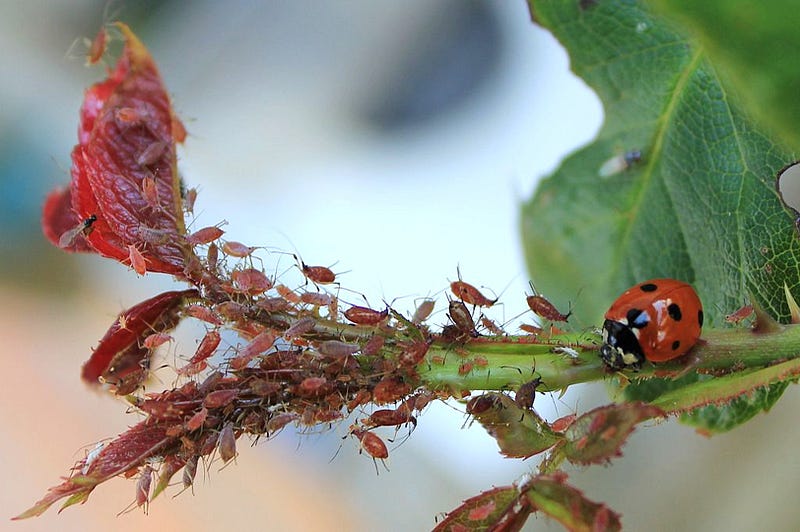
I discovered this story in Ed Yong’s I Contain Multitudes, a wonderful book about the ubiquity and variety of forms taken by symbiosis in the living realm, which I recommend to any curious mind open to the holobiont idea: that life is an interweaving of organisms nested the ones into the others.
Here is one of the clearest and most revealing examples of symbiotic co- evolution.
1910, Berlin. Zoologist Paul Buchner was studying a group of insects called hemipterans, an immensely broad group comprised of over 82 000 species, and their symbionts — organisms living in symbiosis with one another, benefitting each other. Deep diving into the biology of countless bugs and beetles as part of a grand tour of the insect world, Buchner came to realize something: the symbiosis between animals and bacteria is not the exception, but the rule.
Buchner described microbes as “a widespread device, enhancing the vital possibilities of the host animals in a multiplicity of ways.” He assembled decades of discoveries in his book Endosymbiosis of Animals with Plant Microorganisms, described as the Bible of the field by other entomologists fascinated by the interconnectedness of life, like Nancy Moran.
The mystery of aphids' survival
Nancy Moran dedicated her career to the study of symbiosis, and more specifically to aphids. Aphids are the tiny insects you can spot mainly on plant stems and buds, especially on roses, and are the reason for which we strive to attract ladybugs for pest control. They live off sap phloem, the high-sugar fluid that flows through plants' stems. Although not friends of the gardener, aphids are a wonder of biology. Let me explain why.
The sap is the ultimate plant nutrition, but it’s not a great food source for animals, because it is bitterly incomplete. It lacks ten essential amino acids that animals absolutely need in their food to survive. An animal can’t live, let alone thrive, on phloem sap alone. Unless…
Scientists conducted some experiments to understand how aphids can prosper exclusively on sap. They treated the insects with antibiotics and found that the microbe-deprived bugs died - except when supplemented with the missing amino acids. After that, the advent of new methods shed more light on the intertwined biology of the two organisms.
Finding the missing piece
Back in 1991, when genome sequencing technology was at its premises, Moran participated in the sequencing of the genes from symbionts of 11 species of aphids. She found all these symbionts were of the same bacterium species, unnamed at the time. She honored her Master by calling this mutualistic microbe Buchnera.
Reconstituting its evolutionary history, taxonomists affirm that Buchnera colonized aphids only once, 200 to 250 million years ago. At this time, the world was only starting to be populated by dinosaurs and sea monsters and had not seen the emergence of flowers or mammals. This alone says a lot about the pair’s ecological success. They have existed in this configuration for almost as long as sharks, and have become globally omnipresent.
When two organisms join and their cellular toolboxes become redundant, the expression of these genes becomes a waste of energy. By the natural rule of economy, generation after generation, they benefit from shedding unnecessary duplicates, until they lose autonomy and become imprisoned in the obligatory cooperative lifestyle.
Fitting the puzzle back together
Buchnera has a very simple genome today, with the toolkit to produce some essential amino acids, but not all. Each amino acid requires a production chain involving several enzymes.
Russell et al. described in detail the production pathways of essential amino acids, this cooperative dance between pea aphids and their inhabitants. He showed that the bacterium Buchnera alone lacks genes for the terminal reactions in the synthesis of phenylalanine and branched-chain amino acids. Only when bringing back to the test tube the aphid host fragments containing the DNA and host enzymes does he observe the release of leucine and phenylalanine. For methionine, it is the opposite: Buchnera possesses the gene for the terminal enzyme but lacks the previous steps in methionine biosynthesis — which is fine because the host provides homocysteine, the turnkey precursor ready to be transformed into methionine thanks to the bacterium’s last step.
As shown by Wilson et al., the aphid reciprocally lacks the capacity to synthesize certain amino acids such as arginine, which is produced by Buchnera. He says “the pea aphid gene inventory complements that of its symbiotic bacterium, Buchnera aphidicola”. The biosynthesis line of certain amino acids is shared between the two.
“Neither aphids nor Buchnera can build all the necessary enzyme machines on their own. Instead, they cooperate to set up the production lines, which wind in and out of 2 factories, one nested within the other. Only together can they subsist on phloem sap.” — Ed Yong, in I Contain Multitudes
Host, symbiont and organelle
According to Moran, this acquisition of the mutualist bacterium by the aphid is a key innovation in the evolution of the host, supplementing the animal in a way that must have transformed and specialized its food source.
Because of the transmission of Buchnera from generation to generation and their key role in the survival of the host, these bacteria can be viewed as organelles, in the same way that mitochondria, originally of bacterial nature, are now considered organelles of animal cells.
“Time and again, bacteria and other microbes have allowed animals to transcend their basic animalness and wheedle their way into ecological nooks and crannies that would be otherwise inaccessible” — Ed Yong, in I Contain Multitudes
Beyond aphids and the insects' realm
Hemipterans are not the only animals relying on nutritional symbionts. Jennifer Wernegreen estimates in a review about endosymbiosis that 10–15% of insects receive essential nutrients from their symbionts. Most plants also rely on fungal symbionts for their food.
Humans have more bacteria in and on their bodies than human cells (Sender, 2016). Considering our genes are outnumbered by bacterial genes by a factor of about 150, it is evident that many of our biological functions were also delegated to our symbionts through our co-evolution journey. The current loss of biodiversity first denounced by Martin Blaser of course has an impact on our health and wellbeing, spurring the research in probiotics and the microbiome.
Even more broadly, considering what climate change is exposing the living world to, and that we are living the 6th mass extinction crisis, it is important to grasp that a species barely ever disappears alone.
Biodiversity, inside and outside of ourselves, must be a priority on the personal, political, national, and global agenda, because, like aphids, we will never thrive alone.