avatarMahmoud Ezdeen

Free AI web copilot to create summaries, insights and extended knowledge, download it at here

3488

Abstract

stimated their test performance and ability. Although their test scores put them in the 12th percentile, they estimated themselves to be in the 62nd. Several analyses linked this miscalibration to deficits in metacognitive skill, or the capacity to distinguish accuracy from error. Paradoxically, improving the skills of participants, and thus increasing their metacognitive competence, helped them recognize the limitations of their abilities.</a></p><h1 id="7121">To be in mind</h1><p id="7d53">Although this phenomenon has had its roots in society since ancient times, and the observation of many philosophers, wise and thinkers to it and their expression in their writings and sayings, the psychologist David Dunning is considered the first to address the phenomenon by research, study, and experience from the perspective of psychology, in conjunction with his assistant and student Justin Kruger. This phenomenon was later called “The Dunning-Kruger Syndrom.” Let’s say (DKS) as an abbreviation.</p><p id="87d4">DKS effect, (<a href="https://rationalwiki.org/wiki/Dunning-Kruger_effect">also known as Mount Stupid or Smug Snake</a>) occurs where people fail to adequately assess their level of competence — or specifically, their incompetence — at a task and thus consider themselves much more competent than everyone else. This lack of awareness is attributed to their lower level of competence, robbing them of the ability to critically analyze their performance, leading to a significant overestimation of themselves. In simple words, it’s people who are too ignorant to know how ignorant they are.</p><h1 id="746b">The real meaning of DKS</h1><p id="faf8">The DKS is the relationship between self-confidence and the being-earned experiences. When someone has no information about some issue, he -according to the meaning of DKS- will not be able to notice his ignorant. Furthermore, his self-confidence is at its highest level, because he cannot realize how huge that issue is. A foolish mind is not an empty container, it often contains misleading or incomplete information unites with memories, pre-beliefs, theories, and life experiences that nourished this mind.</p><p id="7eb6" type="7">Charles Darwin observed that “ignorance more frequently begets confidence than does knowledge.”</p><h1 id="377e">What is happening on Social Media?</h1><p id="861e">We all see nowadays the massive amount of ignorant being spreading worldwide due to the opportunities provided by social media’s various platforms to those people with low-level experiences in subjects or issues which they are discussing. Many pioneers of social media believe that once they see a case or an accident, they will be able to give their opinions and provide advice to their followers. This increase in self-confidence makes them behave as if they were the knights of the case, but the truth is they do not go beyond being paper knights with no experience in that field, and they have no right to confuse other simple people. The problem here that they do not understand their mistake because they have that self-confidence based on nothing.</p><h1 id="321f">Cases to be analyzed</h1><p id="fb0a">For instance, despite thousands of evidences proving that Earth is spherical, many people still today defend the theory of Flat Earth, which does not conform to the standards of the 21st century on all scales. On the one hand, they do not have enough experience to support their hypothesis, and on the other ha

Options

nd, they oppose the obvious truth seen with the naked eye. Thus, they are the knights of the case trying every day to fight for what they believe. Even with provided evidences, they won’t retreat or be convinced. The lack of experience created their self-confidence and made them blind from seeing the truth.</p><p id="eb65">Another example is the grandeur that appears to those who ride the wave of making money online. Of course, I am not talking about the real knights who have knowledge, experiences, and potentials to become valuable content owners and able to earn from the internet in a socially acceptable way. But I am talking about those people who have nothing and want to take everything. I am talking about the type who sings bad, speaks terrible, produces wrong or misleading info…. etc. These also are having the delusion of grandeur, as a balloon looks full from the outside while it is only full of air and has no value to be considered.</p><h1 id="83d9">How to deal with this problem?</h1><p id="4f03" type="7">“The true knowledge is for a person to know the extent of his ignorance.” — Confucius</p><p id="2797">It is very easy to judge people by ignorance and stupidity from the outside, but it is not easy to imagine that you might be like them in some manners without feeling. Yes, we are all vulnerable to falling into the phenomenon without exception. Although we are both skilled and expert in its field or some fields, it is weak or inexperienced in many other fields and matters, so it is vulnerable to falling into the trap in one way or another. Otherwise, where does all this nonsense, ignorance, and stupidity prevail around us if we are not involved in it in varying degrees and proportions?</p><p id="e2cc">The first step to overcome the phenomenon within us and to protect ourselves from its occurrence is knowing its existence, and studying its causes, manifestations, and applications. Also, we should always assume the possibility of error in our words and actions.</p><p id="4177">In general, if you always feel that you know less than you should, and that there is still a lot to learn, then you are on the right path, keep going!</p><p id="edb2" type="7">“The wiser people know very well that they know nothing.” — Socrates</p><p id="9d5c">When we deal with such ignorant people, the best solution is to avoid their places, and not engage in discussion or argument with them. They will often drag us down to their level and defeat us with all force. We should also remember the famous wisdom that says:</p><p id="9f96" type="7">Men are four: He who knows not and knows not that he knows not is a fool; avoid him. He who knows not and knows that he knows not is a student; teach him. He who knows and knows not that he knows is asleep; wake him. He who knows and knows that he knows is a wise man; follow him.</p><p id="64f3">If that ignorant person is a friend or relative, we say to him: “You might be ignorant in this issue, and your ignorance prevents you from knowing that you are ignorant.” or we say: “You are a clear classic example of the Dunning-Kruger effect.”</p><h1 id="0b58">Summary</h1><p id="3e5c">Stupidity was not the reason to DKS effect to see lights, but the ignorant of it was. The ignorants naturally behave under the influence of not being aware of their ignorance. Some of Social Media’s pioneers are good examples of the DKS effect. Dealing with people under the DKS effect is a mission to study well.</p></article></body>

A Spotlight on Hidden Ignorance

“Dunning-Kruger” Syndrome effects on social media users

by Nevit Dilmen on Wikipedia

Abstract

Ignorant people are not only unaware of their extraordinary abilities to create stupidity, but also completely ignorant of the fact that they are ignorant of this matter. In this article, I am going to highlight a famous phenomenon analyzed by two American researchers, describing its effects on understanding the problem with some of social media’s pioneers, in creating ignorance and publishing it through the network, and of course giving examples of some cases.

The origin of the idea

As all know, falsely claiming expertise in a field reflects high self-confidence that accompanies a disease of excessive ignorance in that field. Of course, the description of this phenomenon must refer to its origin and the reasons for its emergence. The process of analyzing this issue has started after a stupid bank robbery incident in 1995.

“In 1995, McArthur Wheeler walked into two Pittsburgh banks and robbed them in broad daylight, with no visible attempt at disguise. He was arrested later that night, less than an hour after videotapes of him taken from surveillance cameras were broadcast on the 11 o’clock news. When police later showed him the surveillance tapes, Mr. Wheeler stared in incredulity. “But I wore the juice,” he mumbled. Apparently, Mr. Wheeler was under the impression that rubbing one’s face with lemon juice rendered it invisible to videotape cameras.”

This robbery made the two David Dunning and Justin Kruger set off the study, which let them win The Nobel Prize in Psychology in 2000.

They mentioned the following text at the beginning of their scientific paper named “Unskilled and Unaware of It: How Difficulties in Recognizing One’s Incompetence Lead to Inflated Self-Assessments”:
by 忍者猫 on Wikimedia

People tend to hold overly favorable views of their abilities in many social and intellectual domains. The authors suggest that this overestimation occurs, in part, because people who are unskilled in these domains suffer a dual burden: Not only do these people reach erroneous conclusions and make unfortunate choices, but their incompetence robs them of the metacognitive ability to realize it. Across 4 studies, the authors found that participants scoring in the bottom quartile on tests of humor, grammar, and logic grossly overestimated their test performance and ability. Although their test scores put them in the 12th percentile, they estimated themselves to be in the 62nd. Several analyses linked this miscalibration to deficits in metacognitive skill, or the capacity to distinguish accuracy from error. Paradoxically, improving the skills of participants, and thus increasing their metacognitive competence, helped them recognize the limitations of their abilities.

To be in mind

Although this phenomenon has had its roots in society since ancient times, and the observation of many philosophers, wise and thinkers to it and their expression in their writings and sayings, the psychologist David Dunning is considered the first to address the phenomenon by research, study, and experience from the perspective of psychology, in conjunction with his assistant and student Justin Kruger. This phenomenon was later called “The Dunning-Kruger Syndrom.” Let’s say (DKS) as an abbreviation.

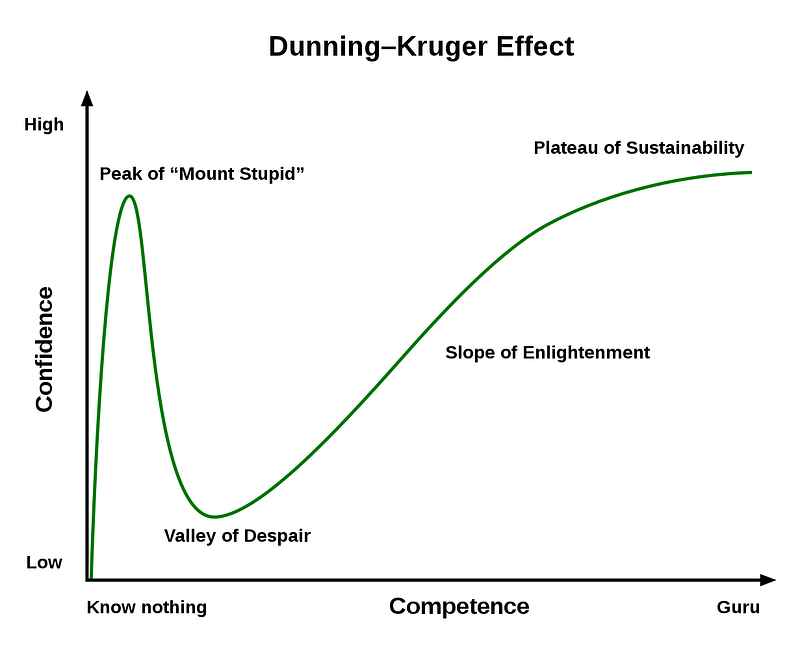
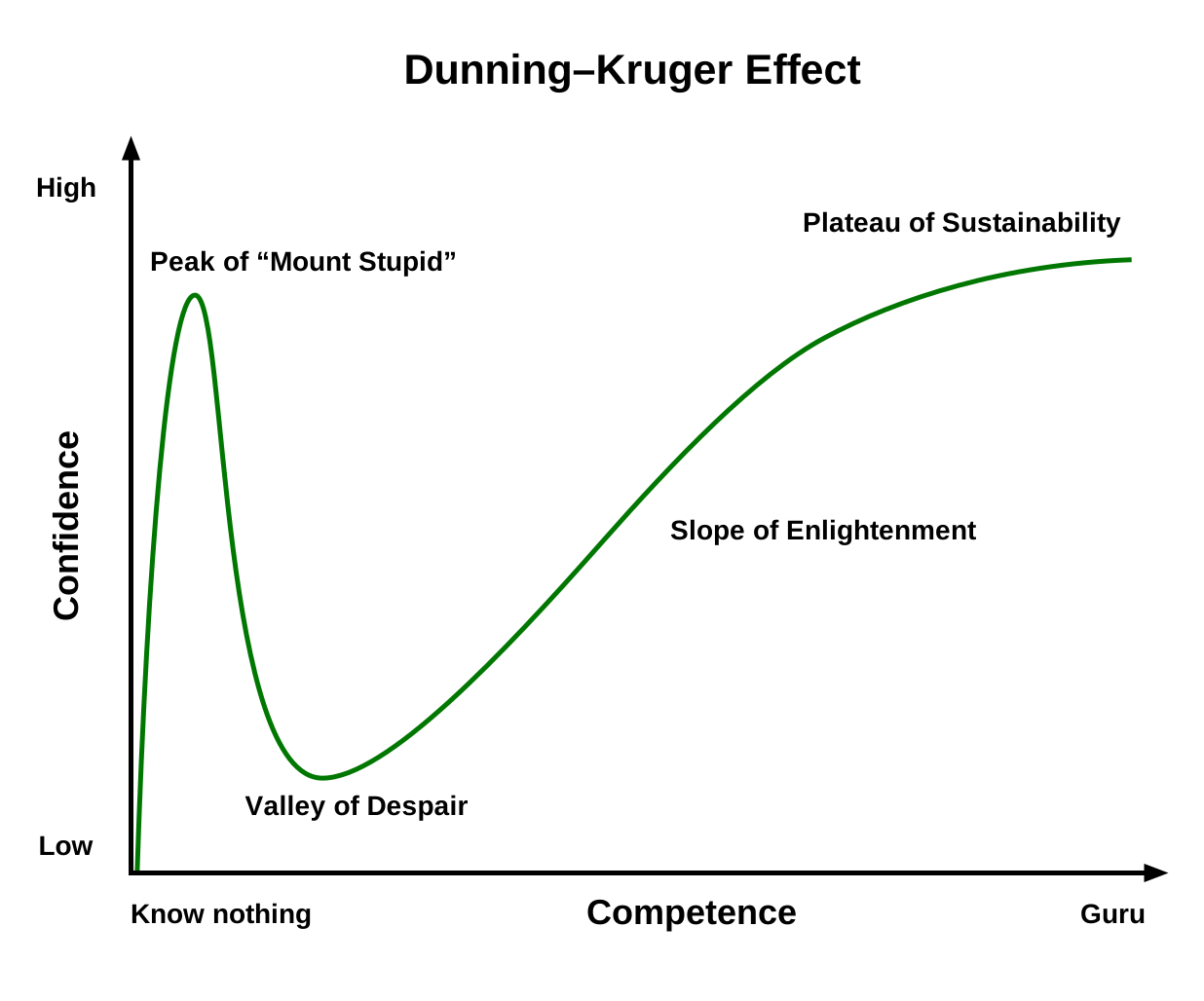
DKS effect, (also known as Mount Stupid or Smug Snake) occurs where people fail to adequately assess their level of competence — or specifically, their incompetence — at a task and thus consider themselves much more competent than everyone else. This lack of awareness is attributed to their lower level of competence, robbing them of the ability to critically analyze their performance, leading to a significant overestimation of themselves. In simple words, it’s people who are too ignorant to know how ignorant they are.

The real meaning of DKS

The DKS is the relationship between self-confidence and the being-earned experiences. When someone has no information about some issue, he -according to the meaning of DKS- will not be able to notice his ignorant. Furthermore, his self-confidence is at its highest level, because he cannot realize how huge that issue is. A foolish mind is not an empty container, it often contains misleading or incomplete information unites with memories, pre-beliefs, theories, and life experiences that nourished this mind.

Charles Darwin observed that “ignorance more frequently begets confidence than does knowledge.”

What is happening on Social Media?

We all see nowadays the massive amount of ignorant being spreading worldwide due to the opportunities provided by social media’s various platforms to those people with low-level experiences in subjects or issues which they are discussing. Many pioneers of social media believe that once they see a case or an accident, they will be able to give their opinions and provide advice to their followers. This increase in self-confidence makes them behave as if they were the knights of the case, but the truth is they do not go beyond being paper knights with no experience in that field, and they have no right to confuse other simple people. The problem here that they do not understand their mistake because they have that self-confidence based on nothing.

Cases to be analyzed

For instance, despite thousands of evidences proving that Earth is spherical, many people still today defend the theory of Flat Earth, which does not conform to the standards of the 21st century on all scales. On the one hand, they do not have enough experience to support their hypothesis, and on the other hand, they oppose the obvious truth seen with the naked eye. Thus, they are the knights of the case trying every day to fight for what they believe. Even with provided evidences, they won’t retreat or be convinced. The lack of experience created their self-confidence and made them blind from seeing the truth.

Another example is the grandeur that appears to those who ride the wave of making money online. Of course, I am not talking about the real knights who have knowledge, experiences, and potentials to become valuable content owners and able to earn from the internet in a socially acceptable way. But I am talking about those people who have nothing and want to take everything. I am talking about the type who sings bad, speaks terrible, produces wrong or misleading info…. etc. These also are having the delusion of grandeur, as a balloon looks full from the outside while it is only full of air and has no value to be considered.

How to deal with this problem?

“The true knowledge is for a person to know the extent of his ignorance.” — Confucius

It is very easy to judge people by ignorance and stupidity from the outside, but it is not easy to imagine that you might be like them in some manners without feeling. Yes, we are all vulnerable to falling into the phenomenon without exception. Although we are both skilled and expert in its field or some fields, it is weak or inexperienced in many other fields and matters, so it is vulnerable to falling into the trap in one way or another. Otherwise, where does all this nonsense, ignorance, and stupidity prevail around us if we are not involved in it in varying degrees and proportions?

The first step to overcome the phenomenon within us and to protect ourselves from its occurrence is knowing its existence, and studying its causes, manifestations, and applications. Also, we should always assume the possibility of error in our words and actions.

In general, if you always feel that you know less than you should, and that there is still a lot to learn, then you are on the right path, keep going!

“The wiser people know very well that they know nothing.” — Socrates

When we deal with such ignorant people, the best solution is to avoid their places, and not engage in discussion or argument with them. They will often drag us down to their level and defeat us with all force. We should also remember the famous wisdom that says:

Men are four: He who knows not and knows not that he knows not is a fool; avoid him. He who knows not and knows that he knows not is a student; teach him. He who knows and knows not that he knows is asleep; wake him. He who knows and knows that he knows is a wise man; follow him.

If that ignorant person is a friend or relative, we say to him: “You might be ignorant in this issue, and your ignorance prevents you from knowing that you are ignorant.” or we say: “You are a clear classic example of the Dunning-Kruger effect.”

Summary

Stupidity was not the reason to DKS effect to see lights, but the ignorant of it was. The ignorants naturally behave under the influence of not being aware of their ignorance. Some of Social Media’s pioneers are good examples of the DKS effect. Dealing with people under the DKS effect is a mission to study well.

Dunning Kruger
Social Media
Ignorance
Spotlight
Study
Recommended from ReadMedium