
A Solution to the Problem of Deepfakes
A patent from 1998 offers a solution to the expanding epidemic of disinformation and outright fakery.
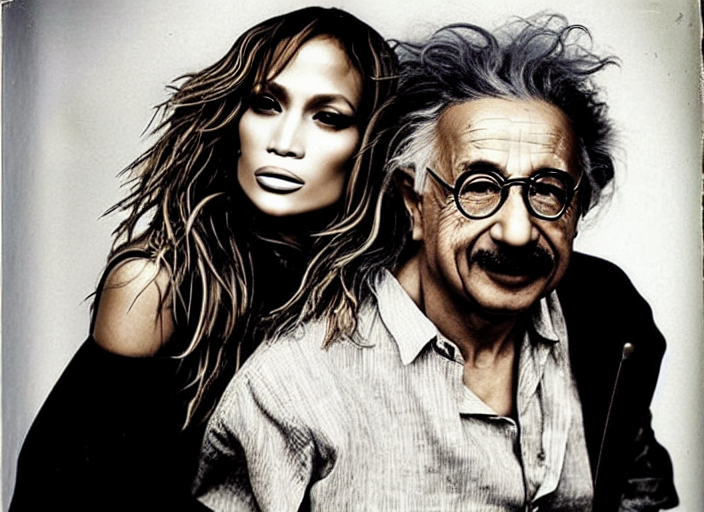
It’s a maxim from a bygone era — “Seeing is believing.” From government propaganda to unconfirmed war footage, from fake social media accounts to fake celebrity porn, the ability of artificial intelligence to generate credible-looking images, video, and text has fundamentally undermined our political discourse and the public’s faith in any sense of objective truth.
Compounding the problem is something called the “liar’s dividend” which refers to way that politicians and their followers can profit from an informational environment rife with misinformation. This often takes the form of inconvenient, yet demonstrable truths being dismissed as “fake” or “fake news.” A recent example is a video of the serial liar and fabulist George Santos in drag in Rio. While it’s arguably the most innocent thing he’s tried to deny or hide, it took no time at all for his supporters to suggest that the video is a fake.
Generally speaking, efforts at addressing this monumental challenge are centered on detection and legal remedies. This is from a recent New York Times article about the world’s response to ubiquity of deepfakes:
In most of the world, the authorities can’t do much about it. Even as the software grows more sophisticated and accessible, few laws exist to manage its spread.
China hopes to be the exception. This month, the country adopted expansive rules requiring that manipulated material have the subject’s consent and bear digital signatures or watermarks, and that deepfake service providers offer ways to “refute rumors.”
According to one estimate, by 2026 up to 90% of online video content might be synthetically generated.¹ Even without concerns for how new laws might potentially threaten legitimate and helpful free speech, attempting to contain deepfakes is ultimately a game of whack-a-mole. The technology advances far more quickly than laws can adapt and it is alway the most destructive and malicious players who are the most difficult to identify and contain.
A popular example of AI-generated fakery is Jordan Peele’s entertaining production of a Barack Obama PSA:
An example with more ominous implications is a deepfake of Ukrainian President Volodymyr Zelensky surrendering to Russia:
A Change in Perspective
One thing is clear — if we are to effectively deal with a world in which the provenance of virtually all media is suspect, then we will need a paradigm shift. Rather than simply attempting the difficult task of detecting fakes, it would help to simultaneously approach the problem from the opposite perspective by employing the easier task of proving that a video is authentic.
In 1998, working with friend and software engineer Christopher Genly, we patented a design for an Event Verification System (EVS). EVS uses public key encryption along with a tamperproof enclosure to insure that any recorded video can be authenticated.
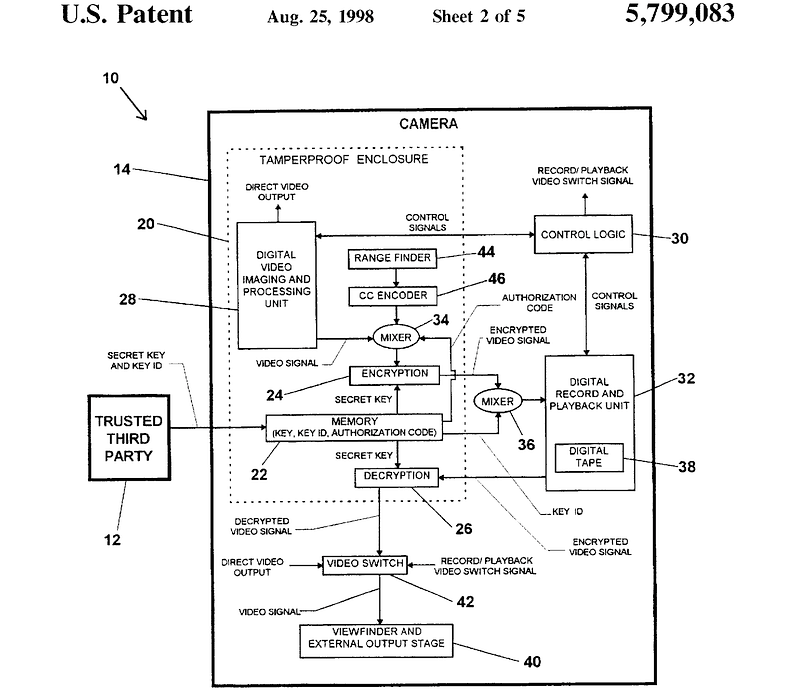
Public key cryptography employs a public/private key pair. Using their private key, a person can encrypt data that can only be unencrypted by someone holding the corresponding public key. In short, EVS stores the private key in a tamperproof enclosure. Breaching the enclosure erases the key. Therefore, any recording that can be successfully decrypted by the published public key can be deemed authentic. For details, see U.S. Patent 5,799,083.
The good news is that this idea of establishing provenance is finally catching on with Big Tech. Adobe’s Content Authenticity Initiative uses cryptographic protocols to authenticate digital content across platforms:
The Content Authenticity Initiative is a group working together to fight misinformation and add a layer of verifiable trust to all types of digital content, starting with photo and video, through provenance and attribution solutions. We’re creating a secure end-to-end system for digital content provenance through open-source development, cross-industry collaboration, and interoperability of tools.
There is also Apple’s Secure Enclave:
The Secure Enclave is a dedicated secure subsystem integrated into Apple systems on chip (SoCs). The Secure Enclave is isolated from the main processor to provide an extra layer of security and is designed to keep sensitive user data secure even when the Application Processor kernel becomes compromised.
While the primary goal of Secure Enclave is to protect user data, by securing internal communication pathways, this type of system also prevents the introduction of manipulated data into the authentic data stream.
It seems reasonably clear that in the not-too-distant future, it will be essential for news organizations, journalists, armed forces, police, and surveillance services to use EVS-type recording devices if they are to provide convincing evidence of events, whether it be in the service of the news or the court system.
We have the technology that would allow us to re-assert a sense of objective reality over the rampant flood of bald-faced deception in which we are currently drowning. The longer we wait, the worse the damage will be.
Indeed, we’ve just seen a disturbing example of how an AI-generated image can be used to move the stock market.
Fortunately, there is now the C2PA initiative, which uses EVS-like techniques to establish the provenance of digital media:
C2PA unifies the efforts of the Adobe-led Content Authenticity Initiative (CAI) which focuses on systems to provide context and history for digital media, and Project Origin, a Microsoft- and BBC-led initiative that tackles disinformation in the digital news ecosystem.
My guess is that significant change won’t happen until news content providers and digital recording device manufacturers decide it’s in their economic interest to team up on the side democracy and justice.
Let’s hope they don’t wait too long…
¹Nina Schick, Deep Fakes and the Infocalypse: What You Urgently Need To Know, Hachette UK, 2020.
Thank you for reading! If you enjoyed this piece, please don’t forget to hit the “Applause” icon on the left-hand side below as many times as you want. You can also subscribe to get my latest content straight to your inbox.
You might also want to consider becoming a Medium member to get unlimited access to all of the wonderful articles on Medium. If you register using this link, you can help support my work as a writer, researcher, and creator.


