
A Simple Technique To Give Feedback
SBI: situation, behaviour, impact model

“We all need people who will give us feedback. That’s how we improve.” – Bill Gates
I always recommend my team members to give constructive feedback to each other — both at individual and the team level as it helps us grow and improve continuously. Sometimes it is easy to give feedback while at other occasions, it could be a daunting task. “Is there any simple yet effective method which we could use for giving feedback without hurting the other person’s feelings?” is a question which often comes up. “Yes, there are many, but the one I always use is the SBI model.” is always my answer.
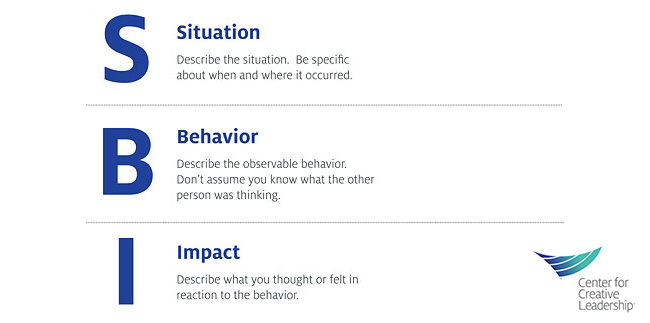
Developed by the Center for Creative Leadership, SBI stands for Situation, Behaviour, Impact. This technique helps separate your emotions from the message, and you can use simple facts to explain what and when something happened, how someone behaved, and what reaction it generated.
“True intuitive expertise is learned from prolonged experience with good feedback on mistakes.” — Daniel Kahneman
Before you start offering feedback to a person, it is a good practice to ask for permission. If the person is happy for you to go ahead, start with things done well. Appreciate them for the work they have done recently and give examples of how they have helped the team succeed.
Let’s have a look at the SBI model in details.
Situation
When and where a specific behaviour occurred. Be as accurate as you can.
Vague: Last week at the office Specific: In our Friday’s team planning meeting in the library area
Behavior
Don’t assume or judge. Be very specific in stating what behavior you observed.
Vague: What was wrong with you Specific: You became angry when Helen asked you a few questions
Impact
What happened as a result of that behavior. What was the reaction.
Vague: You hurt your team Specific: It shocked Helen and the team. Helen personally felt hurt and may never ask you any question in the upcoming team meetings.
Offer specific actions
Once you’ve given the feedback, you can suggest some ideas/actions to John to improve.
Suggestions for John: So John, to clear the air, I reckon you could go on a coffee with Helen. And, if you feel comfortable, maybe in tomorrow’s stand-up meeting, talk to the team. We all are here to support you.
So if we sum up the above example, the two versions of the feedback you provided to John, are as follows.
Vague: John, last week at the office, what was wrong with you, your behavior hurt the team Specific: John, in our Friday’s team planning meeting in the library area, you became angry when Helen asked you a few questions. It shocked her and the team. Helen personally felt hurt and may never ask you any question in the upcoming team meetings. So John, to clear the air, I reckon you could go on a coffee with Helen. And, if you feel comfortable, maybe in tomorrow’s stand-up meeting, talk to the team. We all are here to support you.
“Feedback is a gift. Ideas are the currency of our next success. Let people see you value both feedback and ideas.” – Jim Trinka and Les Wallace
About the Author Salam is a polyglot poet by Passion and an Agile Coach and Delivery Consultant by profession. You can learn more about him by reading his introduction article, shared below.