
Simple Math Explains How to Effectively Step up Your Content Production
Big players are ramping-up their writing game.
People might say that writing is outdated, and in many ways, it’s an ancient form of communication. And speaking is an even older communication form than writing in that sense.
I’m producing content daily while juggling a set of other projects, relationships, and travel destinations. Medium has rewarded me with a top badge in writing, and I’m often curated in the same topic.
Simple math can show you how to effectively maximize your online content game. My mother hates it, but the world is starting to use voice apps and messages. You can send a large message with less trouble if you just speak instead of type. If you’re a content creator, you can 10x your output by re-arranging your writing tools.
Content factory
We live in a world of hyper-information and hyper-content. Media blogs are posting 30 or more stories each day. Top-performing writers, influencers, and Youtube celebrities are present at all times, somehow, always delivering valuable content. You can jump into that game too.
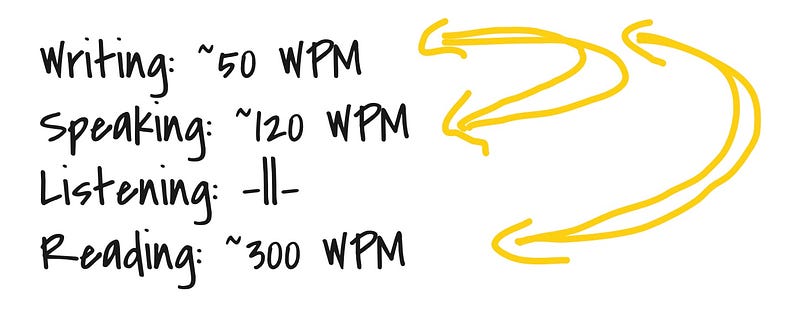
The general speed of writing is 50 words per minute. If you’re a professional typist you can bump it up to 80 or 90 words per minute, and in some instances, you can reach 120 words per minute. Stela Pajuns holds the world record for the fastest typist with 216 words per minute.
If you’re typing inhumanly fast, you can theoretically churn out a 1500 word story in 15minutes. In that case, you might wonder why is this story important.
Health is another reason for re-thinking the way you produce content. Unnatural and Prolonged static-hand movement like tying is associated with a number of health concerns. You might suffer carpal tunnel or repetitive stress injuries that are reportedly affecting the writing communities.
Speaking generally offers a speed of 120 words per minute, you don’t have to be anything special or super talented to speak at that pace. Speaking is less tiring, more natural (humans have been doing it since forever), and easier on your wrists and limbs.
Speaking with an intend to record your message in a written form is called dictation. You can dictate in a variety of different situations where you just can’t type or write.
You can dictate to your headset microphone while walking your dog. You can dictate while running in the gym. You can dictate on a hike or a stroll around the neighborhood, and you can dictate in your bathtub while being completely relaxed and underwater.
You can dictate more than 1000 words in less than 10 minutes. Individuals like Eminem and Busta Rhymes can speak way faster than the common people, but they’re the exception. You don’t have to be an exception to produce great and fast content. Public debaters like Ben Shapiro can speak up to 500 words per minute.
Of course, you still have to create the premise, develop your story, and do the research. You can’t just speak at the maximum speed all the time. You might stop and think and find out the best way to express yourself.
Stories take mental work, and 10 minutes can’t translate to 1200 words every time. Yet, dictating is still 10 times faster because you have to do all the mental work with writing too.
Then we come to listen. you can generally listen at the same speed somebody is talking, you can’t listen faster than the message. Listening has the same speed as speaking, roughly 120 Words per minute. You can only absorb the message by the pace it’s being sent.
That leads us to reading speed. The average reading speed is 250 words per minute. Average readers can absorb 4–5 syllables per second, and each word is 2 to 3 syllable long, which gives us a ballpark number of around 250 words per minute. Biologically, women tend to read faster than men due to optics and more developed peripheral sight.
The Guinness World Record for reading might climb as high as 25.000 words per minute, which is crazy. You can’t listen faster than somebody speaks but you can read way faster than somebody dictates, as it’s already on paper/screen.
To maximize your content pace, translate speaking to reading through dictation.
Dictating
Dictating is not everyone's cup of tea. Some just love to type in peace with classical music. But others want to be time-effective and squeeze more quality moments with their family, spouse, and kids.
Neither is wrong, or right. You should do whatever you feel like it. Your content is your content.
My personal experience with dictating is wonderful. You have to say punctuations out loud, making you sound like an idiot at times. But once you’re into it, the text sounds way more conversational and you can record stuff while you research or move.
By dictating you can produce more content in a shorter time span. You can upload more stories on Medium. You can finish a novel while walking your dog or driving to work. Dictation takes a few days or weeks to get used to, but the technology is so advanced that it’s way less frustrating than it sounds.
You don’t want to be in a room with other people when you first start dictating, but once you get a hold of it, you can produce content everywhere. Apple products have an in-house dictate feature, which I’m using right now.
Software like Dragon is pricey, but professional writers swear by the speech recognition program that goes for $300. If it’s out of your budget, you can also hop to your app store and pick one of many free dictate apps.
Your accent won’t get in the way as long as you pronounce words clearly. Dictate can help you double down on your speaking skills too, as you’re learning how to express yourself with clarity.
The final words
Dictating can help you write faster, and ramp up your content production game. Instead of publishing just one article today, you can publish two or three. And two or three hold a better chance of success and going viral, than just one story.


