
A Simple Framework for Capturing and Organizing Your Blog Post Ideas
The PSST Framework will revolutionize the way you work if you find yourself struggling to write as much as you want to.

Several times a week, I run writing workshops. This morning one of my students mentioned that she wished she had some sort of a framework for capturing and organizing her blog post ideas.
At first I thought she meant just making a list of them, but it turned out what she really wanted a was a framework — a way of quickly taking down the bones of blog post idea so that she doesn’t lose it, in a way that would make writing it later easier.
Oh, I told her, I actually have one of those.
My students were excited — to the point of taking me by surprise. And I was super excited, because I’ve always struggled with how to help my students who want to write more blog posts, but just aren’t.
I realized all of a sudden that I was missing what the real problem was.
They needed a way to wrap their heads around what they want to write so that they can A) keep track of their ideas as they get them and B) write them quickly and efficiently.
The PSST Framework
The PSST Framework is something I just do it without really thinking too much about it. A mentor told me once that’s the kind of thing that needs to be taught the most. As soon as you think something’s too basic to teach, you know you’re on to something that’s right in your wheelhouse.
Because if it feels easy to you, then you’ve got a good enough handle on it to teach it to someone else. And trust me, there is always someone else who wants to know how to do what’s easy for you because it isn’t easy for them.
So, I impromptu spent an hour teaching my PSST Framework to my students this morning.
There are four parts. Once you get the hang of it, you can build a PSST Framework around any idea in a few minutes. Today, during our workshop, we organized a blog post for four different writers in an hour, so it took about fifteen minutes each and that included a lot of teaching and workshopping that you wouldn’t have if you were doing this on your own.
Each of my students came away with an idea that was both well-documented and organized so that they’ll be able to easily write it when they’re ready.
I can do this in five or ten minute with even a complicated idea. I don’t think it would take long for anyone to get to where they can do it as quickly.
The four parts include: Premise, Story, Subheads, Takeaway. (Hence, PSST.)
Let’s take a look at each one.
Premise
This is just a sentence that states your idea. I think about it as a working title.
You want your working title, or premise, to be a sentence that you’ll understand when you come back to it even weeks later, when the idea isn’t in the forefront of your mind.
In other words, don’t be clever here. You can rework the title later. This is a great exercise though, because your final title actually should be this clear and concise.
Ask yourself this question: If I read this sentence to a friend, would they know what I was writing about, without any more information?
Here’s an example of a premise that doesn’t really work: What kind of writer are you?
That doesn’t really mean anything. I would have known just what I meant by it the day I came up with it and forgotten my intent entirely when I came back to it.
Here’s a revised premise for the same post: How to figure out what kind of writing career you want to have and make a plan to make it happen.
As far as post titles go, it’s too long. But if I read that to someone, they would know what I was talking about without any other information from me. And I’ll remember what I wanted to write, even weeks or months later if it comes to that.
Story
Every blog post should start with a story. I firmly believe that.
So, the second part of the PSST Framework involves making a note to yourself about what story you’re going to tell. Your story should be personal and specifically related to your post.
Think about it as an invitation to your reader into your story. It’s their assurance that you’re someone they can trust. And your story hooks them and keeps them reading.
For the post I mentioned above, my story note was about a Facebook post that came across my feed that asked the question what kind of reader are you? and how that question had stuck with me all day. It’s a small story, but knew the post would run long, so I didn’t want a long, in depth opening.
Subheads
Once you have your premise and your story, now you can just make a list of your possible subheads. This is a bullet list of points you want to make in your post.
Don’t worry about writing the actual subheads that you’re use in your post. You’ll rewrite them later. For now, just list the points you want to hit.
For the post I wrote this morning, my subheads included:
- What kind of writers are there?
- How to use your notebook to figure out what kind of writer you are.
- Your past experience.
- Your current writing life.
- Your future writing plans.
- The gaps.
When I come back to a list like that later, I can very easily see exactly what I what I was thinking of when I had this idea. I have an outline for my post that only took me a few minutes to write down.
Can you see how writing this post will be easier than it would be without the Framework? I just have to go from subhead to subhead. But it isn’t written in stone. I might come up with other ideas as I’m writing and that’s okay, too.
This is a framework, not a steel cage.
Takeaway
Every blog post ends with a takeaway for the reader. Some reason why you’ve told them the story you’ve just told them or given them the information you’ve just given them.
Even very personal essays end with some kind of take away. What do you want readers to do with what they’ve just learned? What do you want them to think about or know or understand?
Sometimes your takeaway is very clear. A specific call to action — directions or instructions for how to do something very specific. The take away for the post you’re reading now will be to go forth and create a PSST Framework for your own blog post ideas.
Sometimes it will be a little more esoteric. If you were writing a personal essay, your takeaway might be more along the lines of a reminder that something you’re talking about is worth doing or learning. Or that your reader isn’t alone in whatever they might be suffering.
The takeaway for the post I wrote this morning was a list of possible kinds of writers and examples of plans those writers might use to bridge the gap between where they are and where they want to be. The hope being that those examples would help readers understand how to do the same planning for their own specific situations.
Putting the PSST Framework All Together
I have a Google Doc with a simple table where I can record my ideas in the PSST Framework format.
It looks like this when I’m done.
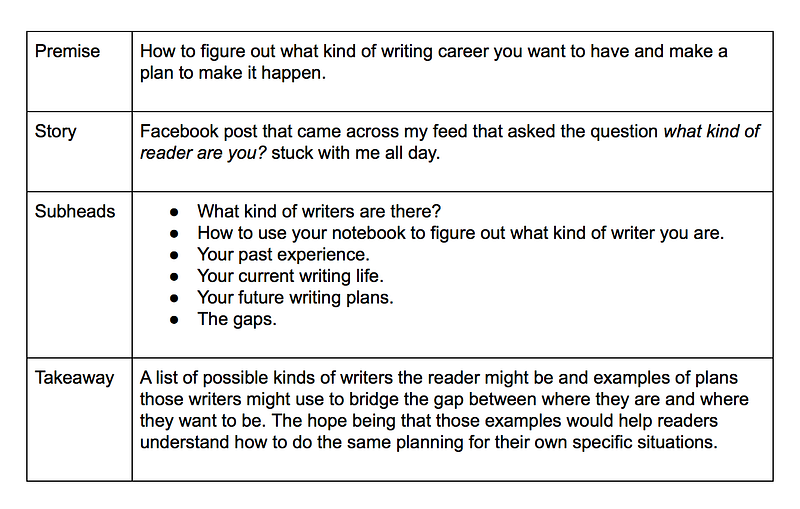
If you’d like a copy of the Google Doc that I use, click here.
I also just use my notebook, if I’m out and about and get an idea. Usually, I just make a note of the first part of the framework — the premise — and then wait until I’m on my computer to fill out the rest. But if I’m feeling inspired, it’s super easy to remember just the four questions sections of the framework, especially with the acronym.
Challenge yourself to work through the PSST Framework on one new idea every day and see what happens.
Here’s my secret weapon for sticking with whatever your thing is.
Shaunta Grimes is a writer and teacher. She is an out-of-place Nevadan living in Northwestern PA with her husband, three superstar kids, two dementia patients, a good friend, Alfred the cat, and a yellow rescue dog named Maybelline Scout. She’s on Twitter @shauntagrimes and is the author of Viral Nation and Rebel Nation and the upcoming novel The Astonishing Maybe. She is the original Ninja Writer.


