
A QUINTESSENTIALS QUEER TRANS BOOK REVIEW
A Sensual Queer Trans Experience Through the Poetry of La Espiritista
Poems affirming the spiritual and sexual power of our love as a people
As I sat in a darkened room, watching La Espiritista, a queer, trans, non-binary Latinx poet speak passionately about love, I was still processing my own grief in losing the support of so many family members in response to having shared my own queer transness.
In an attempt to bring us all forward from the dark into a common love story that was flowing through each of us, they asked us to chant, not mindlessly, but with our own personal responses to end their sentence: “Love is…”
I felt indicted by my own silence. I couldn’t think of a response, still lost in that grief, despite sitting next to someone I love deeply. Finally, after several missed chants, I whispered one of their words back to them: paciencia (English translation: Patience). That felt like the only word I could use to describe the pain of a kind of love I was feeling in that moment. It’s a love I’ll have to feel alone across years, maybe even a lifetime. Their words cut through that grief, sharing a common thread between us all as humans.
“Amor es paciencia. Love is kind. Amor es amiable. Love is vulnerability. Amor es humano. Love is feeling through the pain. Amor es aparecer. Love is layers. Amor es entero…love is free love is joy love is grief love is essence. Love is spirit…Love is the universal heartbeat that unites us all; the calling that beckons to create una nueva familia., Una communidad en unidad. Love is our PULSE.” (La Espiritista, Butterfly: Una Transformación, p. 79)
This love that characterizes us all unravels briefly in the middle, becoming fluid, quiet, unpunctuated, yet with a smooth rhythm, flowing beneath and between the lines to exist. Like the life of every queer trans person I’ve had the pleasure to know long enough, this love reforms into something stronger, united, whole, beautiful, and connected by symbols of equity in experience: semicolons. It is loud in stating with finality that we’re alive as a people. We express this through love and community, through the connection felt even between strangers with a common experience.
“My sexuality is my spirituality,” (p. x).
These words are written in the first couple of pages of their poetry book, Butterfly: Una Transformación. They are written by an author who is on the ace spectrum and they are a reminder that our people have been considered holy across many cultures throughout history. It is life-affirming to see one of our people embracing sexuality in this way, elevating our experience as not merely beautiful, but spiritual. This theme will reappear in many poems.
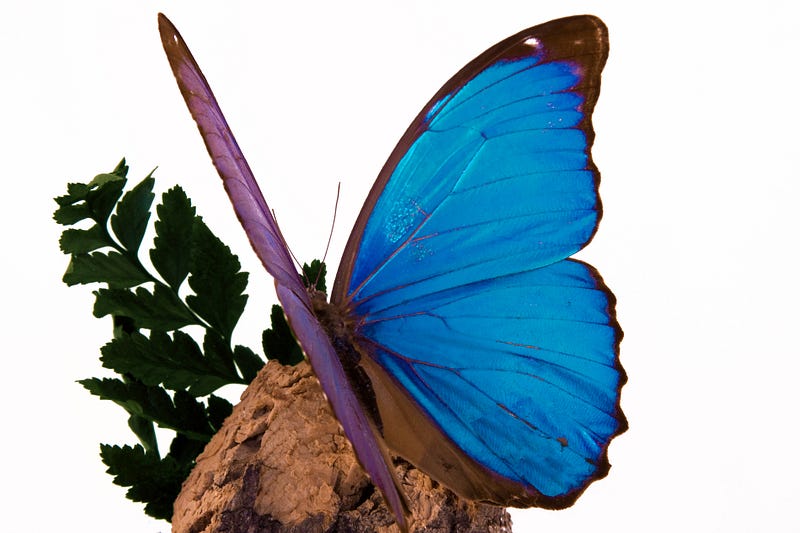
The architecture of this poetry book creates a structure for a wide range of common experiences among us, categorizing them into a pattern of life not unlike what a butterfly lives through. La Espiritista creates a map for a continuous circular path through creation, destruction, and rebirth that is part of the transformation I’ve witnessed and felt in our communities.
The phases are release, renewal, retreat, and rebirth. These chapters demarcate the cartography of an individual and collective queer trans experience, while forming solid pillars holding each of the poems in their place, connecting them to each other as part of something larger.
Release
“The forest is a watercolor painting floating in mid-air…It is where fairies and human gather and don’t always see each other…You can be an exception./You see they rarely like your kind, but I kind of like you./Let me be your guide,” (p. 16).
These words touched me, as circumstances have forced me to let go of people who I love, for now at least. This reclaims a slur that has been used against our people, focusing instead on the beauty of the word. Yes, we are fairies. We are mythical creatures who can’t always be seen, but who are magical by definition. We deserve to hold the full power of that word that has harmed us across history; we deserve to keep that magic inside of us and cultivate it into art. These words are a road map, a “guide”, to self-love in the context of all that we have lived through as a people.
Renewal
“Yo resido entre el reflujo y el flujo./Mediar el ascenso y la caida./Soy el susurro en el silencio./Soy el movimiento dentro de la quietud,” (p. 43).
The speaker here, like all of us, stands at a tipping point between rising and falling, making a life for themself in the constant movement of the tides. I remember once being told (while being trained to teach) that there is no voice more powerful than the one that whispers into the silence of students leaning forward to catch your words. This is a trick of the trade. One doesn’t need to speak loudly to be heard in such a circumstance.
These few words splash lightly across a mostly blank page, but reach me with the quiet strength of each syllable. We can rebuild ourselves. We can take this time for renewal in the silence between the regular tides and the sweeping currents brought by storms. Little movements in this sort of space and time will have substantial impacts. There is wisdom in acknowledging this.
Retreat
“I am worthy of life for my existence,/not for what I produce./I am worthy for my ability to see/beneath the surface from which others overlook./I am worthy for providing gentle grounding space,/even when one picks off my petals./Worthy of life because I am.” (p. 70)
I know these words will resonate with so many of us who have struggled throughout the Pandemic to make sense of our worth in a society that defined it in terms of productivity or in terms of billable hours in places that so many of us could not safely be. These words fight against the toxic ableism that permeates the societies we live in, ableism that has resulted in so much death over these past couple of years.
Our worth is not a product with a price tag. It is not devalued by the harm that others may cause us. We are each inherently valuable, priceless, because we exist and see the world through a perspective that belongs to us alone. I wanted to highlight this poem because I believe so many of us need to read and reread these words right now.
Rebirth
“My favorite pastime is making love to colors./Infusing essence and elements.,/combining water and earth,/transforming air to fire,/creating consensual circles/around your back,” (p. 89).
You can see how through these words, love becomes an artistic performance, a painting happening across the back of a willing participant. It’s a circle mirroring the cycle portrayed throughout this book. Each word is carefully placed as a piece of a larger mosaic, adding colors to share a larger picture of our existence.
“Fluid and fuck are my favorite words./Fuck for fuck your binary ideology./Fluid as in I will be the ebb which trickles right through your constraints…Te rezo a ti todos los dias,” (p. 90).
Once again, there is a connection between spirituality, prayer, and our sexuality as a people. There is anger for the way that our bodies have been disrespected by binary enforcement, and a dismissal of that imprisonment as fluidity leads the speaker gradually to freedom.
La Espiritista’s words radiate the beauty of what I’ve come to recognize as the queer voice. It flows seamlessly between grief and grace, laughter and tears, shock and power, sex and spirituality, generational trauma and healing, life in every form it can take from birth to rebirth to death. Above all, each word is drenched in the many forms that love can take: love of self, love of others, love that continues through loss, grief, healing, and renewal, love that permeates each word and flows into the reader.
Each of their words are life-affirming to read. They tell us that we are not only worthy of love, but imbued with it. Though I’ve selected a handful of my favorite quotes here, I have not begun to scratch the surface of the power that can be found in this book of poetry. You’ll have to read more for yourself to take in all that they have to offer. It’s well worth your time to travel across these words wound in cycles again and again.
Butterfly: Una Transformación, can be found here (external link):
Here is a link to a beautiful song I was listening to while reading this poetry:
This writing is in response to The Quintessential’s call for reviews of our favorite queer trans representation in literature and media.
Interested in joining Medium for $5/month? You can support me at no additional cost by joining through this link: