A Senseless Tragedy - Part 2
Is Guam a Safe Place to Visit?
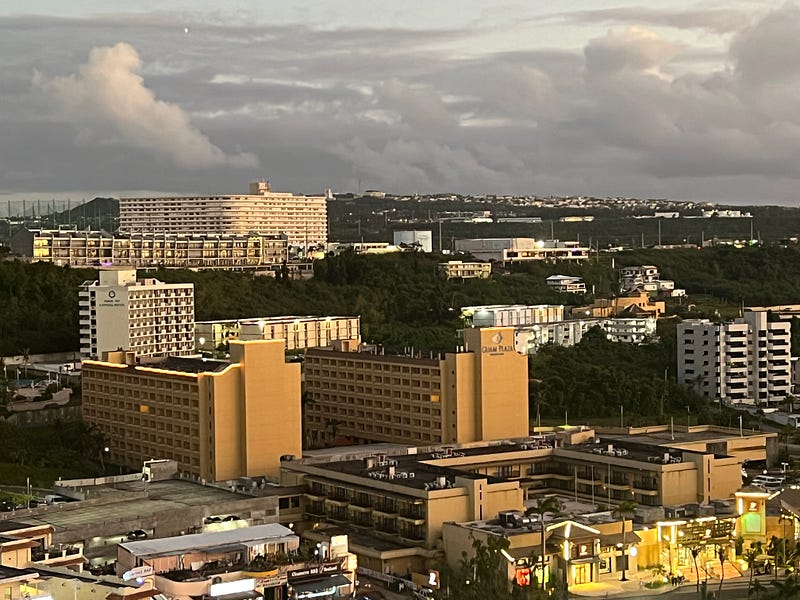
Despite the recent ‘purse snatching’ murder, all the official sources, including the government, police, hotel management, and tour operators, insist that Guam is a safe place to visit. But is it really?
That’s what I set out to find out right after I found out about this murder. As the murder happened less than 200 yards from my hotel the night after I arrived in Guam, this crime hit very close to home. In fact, that same night, I went out to a 24-hour convenience store near where the crime occurred. I thought, “That could have been me!”
The recent ‘purse snatching’ murder of a Korean citizen raised all kinds of red flags within the Asian tour industry. The incident made national headlines in South Korea. Almost immediately, all the hotels in the Tumon tourist district (where the murder occurred) saw a dramatic increase in room cancellations. While the Guam tourist industry members haven’t hit the panic button (not yet, anyway), they are all very concerned.
But is all of this concern (and even panic) justified? In light of all the hype surrounding this senseless killing, the answer might surprise you. After conducting about three days of research, looking at all the official crime statistics for Guam, and scouring the archives of both major newspapers on the island, my conclusion is ….
YES — at least for now. Guam is still a safe place to visit despite this murder (which could have been avoided, in my opinion). But there are some troubling signs on the horizon, which, if not dealt with, could change that.
Let me explain why I think Guam is still a safe place to visit.
First is the official UN World Bank statistics on worldwide crime data. According to the World Bank statistics, the murder rate in Guam is 4 people per 100,000. With only about 160,000 people on the entire island, that comes out to about 7 murders per year.
Digging in further, almost all of the murders have been the result of local-on-local crime, with most of these murders being drug-related. Digging in even further, before this murder, the last tourist murder was in 2014 (three tourists were stabbed to death), and I found an incident in 2013 where a local drove his car into a crowd of tourists — killing two people.
So, over the last 10+ years, there have been a total of 6 tourist murders. Except for the COVID years of 2020 and 2021, Guam has been receiving about 1 million — yes, that’s one million — visitors to the island per year. To put this in perspective, your chances of being murdered in Guam are on par with your chances of ever getting into a plane crash. Your chances of dying in a car crash or even walking by a busy street are higher than getting killed while being a tourist in Guam.
In fact, it may have been the rarity of violent crime in Guam’s Tumon tourist district that may have led to Mr. Hwang’s death in the first place.
While the murder rate of 4 per 100,000 people seems low, it is similar to the overall rate of the entire US at large and much higher than the rates for Asian countries like Korea and Japan, which only have murder rates of .51 per 100,000 (South Korea) and .23 per 100,000 (Japan), respectively. As a result, the citizens of both these countries freely roam around their countries day and night and don’t worry about traveling alone, even in the worst parts of their countries.
So, when Asian tourists come to Guam (and even other parts of the US) to travel, many of them don’t even think to take the types of precautions that Americans consider a normal part of protecting themselves from violent crime, such as avoiding poorly lit areas after dark.
Unfortunately, the Asian tour and local hotel operators unintentionally aggravate this situation. I don’t know if the tour operators provide information on keeping yourself safe, but I highly doubt it. I have been living in the tourist zone for over a week and haven’t heard or seen any warnings about risks of theft, except the usual “put your valuables in the safe” warnings. I understand that these business people don’t want to unduly alarm their guests, but the simple fact is that while violent crimes on the island are rare, property theft is a fairly common occurrence on the island.
Tourists from the visiting countries should be given some basic safety instructions that Americans and other Westerners almost take for granted. These include “don’t walk in dark or poorly lit areas.” The Hwangs were robbed in an area that had no street lights — I drove past that area at night, and I thought to myself, “Yep, this is a prime area for a criminal to strike.”
Second, tourists should be told not to put up a fight if they ever find themselves in a robbery situation. When Santos grabbed Ms. Hwang’s Lacoste purse (a designer brand), rather than just surrendering it, Mrs. Hwang struggled and fought with Santos over the purse and its contents. That most surely led to Santos shooting Mr. Hwang.
In Korea, the thieves still might have gotten the purse, but as there are no guns available for thieves to commit crimes, in all probability, the Hwangs would have escaped with only a beating. Who knows? In Korea, Mrs. Hwang might have struggled long enough for the police to arrive.
This leads me to my third comment. In the eight days I have been on the island, I have rarely seen any Guam police patrol cars, no matter where I have been. I have NEVER seen them in the tourist zone. The fact that there is so little police presence in the Tumon tourist district may have certainly been a factor in this crime, as the thieves in question intentionally went to the Tumon tourist district, searching for ‘easy marks’ (this according to the confession accounts of Stefan Camacho, the SUV driver in this crime).
So, even though this murder was a senseless tragedy, Guam is still a safe place to visit. Furthermore, this tragedy could have been avoided. Not excusing the acts of the thieves, Mr. and Mr. Hwang could have taken steps to prevent the robbery itself if they had been just a little more aware of their surroundings. They should have never left their group and walked alone up the dark hill to their hotel.
The city and government of Guam are not entirely guiltless here, however. With the advent of super reliable and cheap industrial LEDs, NO excuse exists for any tourist area to be ‘in the dark.’ Additionally, I strongly agree with the sentiments of local citizens who argued for more police presence in the tourist area and all over Guam.
So, despite this senseless crime, I’ve concluded that Guam is still a relatively safe place to relax, shop, play, and have a good time. But Guam is not without its criminal element, so it pays to be vigilant, travel in groups, and avoid dark areas if possible. If you find yourself face to face with a thief, the very WORST thing you can do is struggle with him. You can replace your things, but not your life.
However, the city and territorial government of Guam also need to step in and provide some support to ensure this type of crime remains rare in Guam. The city needs to step up and work on replacing all its city lights with cheaper and more reliable LED lights. The Guam Police need to increase their presence in the city, especially in Tumon, Guam’s tourist district. This will not discourage tourism; on the contrary, it will give tourists a greater sense of safety.
Finally, Guam needs to address two chronic long-term problems in its society that threaten Guam’s status as a safe place to visit. Guam has a very high unemployment rate, and meaningful work is tough to find in Guam. Additionally, as with many other parts of America, Guam is battling an ever-increasing drug problem that threatens the very fabric of Guam’s culture and society. Both of these issues are very problematic and difficult to address. Still, if you look at the crime statistics ‘below the surface’ among the local population, you will find rising violent crime rates that are linked to these two chronic problems of drug addiction and unemployment. Left unchecked, the crime caused by these two problems will spill over into the Tumon tourist district.
If that happens, Guam, an economy dependent on tourism, will no longer be considered safe. In fact, the unemployment and drug problems, left unchecked, will create long-term difficulties for the island from which it may never recover.


