
LAST MINUTE CHAUFFEUR
A Road Trip to Remember: The Time I Drove R & B Rocker Bo Diddley to His Mississippi Gig
His wife stole his car and he needed to hitch a ride
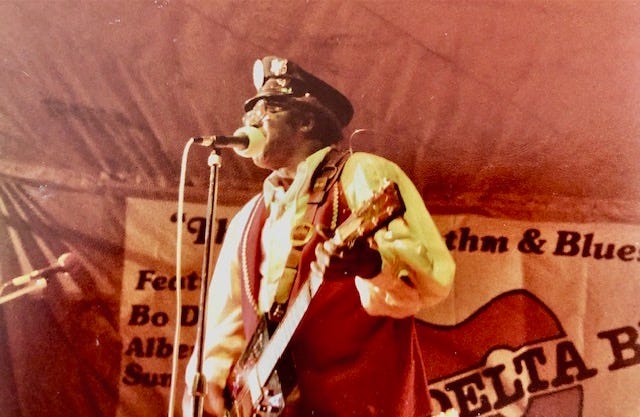
My phone rang early Saturday morning as I leisurely sipped a second cup of coffee. I wondered who would be calling me at this hour on the weekend.
I was recovering from a long Friday night at the Peabody Hotel, where I worked as director of event marketing. My job included booking talent for the hotel’s Peabody Alley, a hip venue for music events featuring artists like the Neville Brothers, Michael Damian, Rodney Crowell, Tav Falco’s Panther Burns, and many others.
Blues rocker Bo Diddley entertained a house of over four hundred fans the previous evening. By 11:30, the audience was still demanding encores.
Bo Diddley’s contract was for only three hours—from 8:00 to 11:00—but the middle-aged artist continued to perform tirelessly until well past midnight.
The room reverberated with his hits, including “Not Fade Away” and “Who Do You Love” — songs that were covered and popularized by The Rolling Stones.
His contract differed from most entertainers who played at this venue. It stipulated that I arrange for his drummer, keyboardist, and bass guitarist.
When he arrived in Memphis that Friday, he had with him nothing more than a suitcase and his custom Jupiter Thunderbird guitar.
But with my contacts in the local music industry, putting together his backup band would be easy.
I asked Marvell, son of Rufus “Funky Chicken” Thomas, to provide keyboards and to round up the other musicians — preferably people he regularly played and recorded with.
It was understood that R&B players in Memphis would be familiar with Bo Diddley’s work. It wouldn’t be a stretch to pull together players who knew most of his playlist, even if they’d never performed with him.
“We’ll have a little time to run through the songs real quick, won’t we?” asked Marvell when he called back to report the names of the backup musicians.
“Oh sure,” I replied. “He says he’ll be at the Alley at five. He’ll eat at Chez Philip first and then join you around six. No problem.”
This sounded reasonable to me—and to Marvell, who teased that he and the guys should also be treated to dinner at the ultra-exclusive hotel restaurant.
“Not in your contract, dude,” I joked back.
Bo Diddley had chosen to stay at the Marriott a few blocks from The Peabody. He didn’t offer a reason, but of course, his contract stipulated we would pay for his lodging.
The night of the event, I arrived at 5:00 to make sure there were no banquet issues and that the dressing rooms contained water, sodas, beer, and munchies for the backup guys.
I had a copy of his contract with me, along with checks for Bo Diddley and the backup musicians.
Six o’clock came and went, as did seven. By 7:30, the venue was almost full, but there was no sign of Bo Diddley.
A local deejay from a popular radio station would be introducing the act at 8:00 and seemed pissed that I didn’t have him backstage, ready to go.
Marvell and the guys had set up their instruments and mics and were getting nervous about the performance.
So was I. There was no chance of a quick rehearsal.
“Damn, we don’t even have his playlist,” Marvell complained. “What’s up with this guy?”
I was used to dealing with absurd requests from prima donna entertainers, but I’d never been stood up by one.
At five minutes till 8:00, Bo Diddley strode in, smiling and shaking hands.
“Okay,” he said. “Y’all know what to do. Just follow my lead.” He mimed holding his Thunderbird as he stomped on the floor, singing in a low voice, “Hey, Bo Diddley,” his signature tune.
Few musicians didn’t know his trademark beat — a five accent hambone “hoodoo” rhythm (three strokes/rest/two strokes) which became the cornerstone of much of the rock, hip-hop and pop music we listen to today.
The “Bo Diddley beat” can be heard in music by Bruce Springsteen, U2, Buddy Holly, The Byrds, Elvis, and The Pretenders, to name a few.
He’s also credited with helping to transition from traditional blues and R&B to blues rock & roll. Numerous music historians claim Bo Diddley—not Elvis—is the actual uncrowned King of rock & roll.
See if you recognize this beat in the short clip below.
At five minutes past 8:00, the curtain rose on Bob Diddley and his newly formed backup band. I stood near the bar and watched him open with “Who Do You Love,” followed seamlessly by “I’m a Man.”
I doubt anyone in the audience knew these musicians were playing together for the first time in their lives.
After two or three numbers I relaxed. A rehearsal wouldn’t have made them any more polished than they already were.
Bo started each song by twanging the first lines, stomping his feet, and twirling around to face the musicians and then the audience. The group knew every song he played and performed them note for note.
As Marvell and the band warmed up, they began throwing in appropriate back-ground vocals.
The audience was ecstatic, and I went home happy.
When I answered the phone the next morning, it was Bo Diddly.
“Miss Deborah, I was wondering if you could give me a lift to the Delta Blues Festival today?”
Bo explained that when he’d gotten in Friday night, his wife accused him of flirting with someone in the audience. A huge fight erupted, and around 6:00 AM, she took off in his car.
They had driven to Memphis from St. Louis, where they had visited with her family. They’d planned on driving to his gig in Mississippi the next day, but she returned to St. Louis without him.
Bo Diddly sounded desperate.
I told him I’d pick him up at noon. The all-day festival had already started but he was scheduled for 6:00, so we had plenty of time.
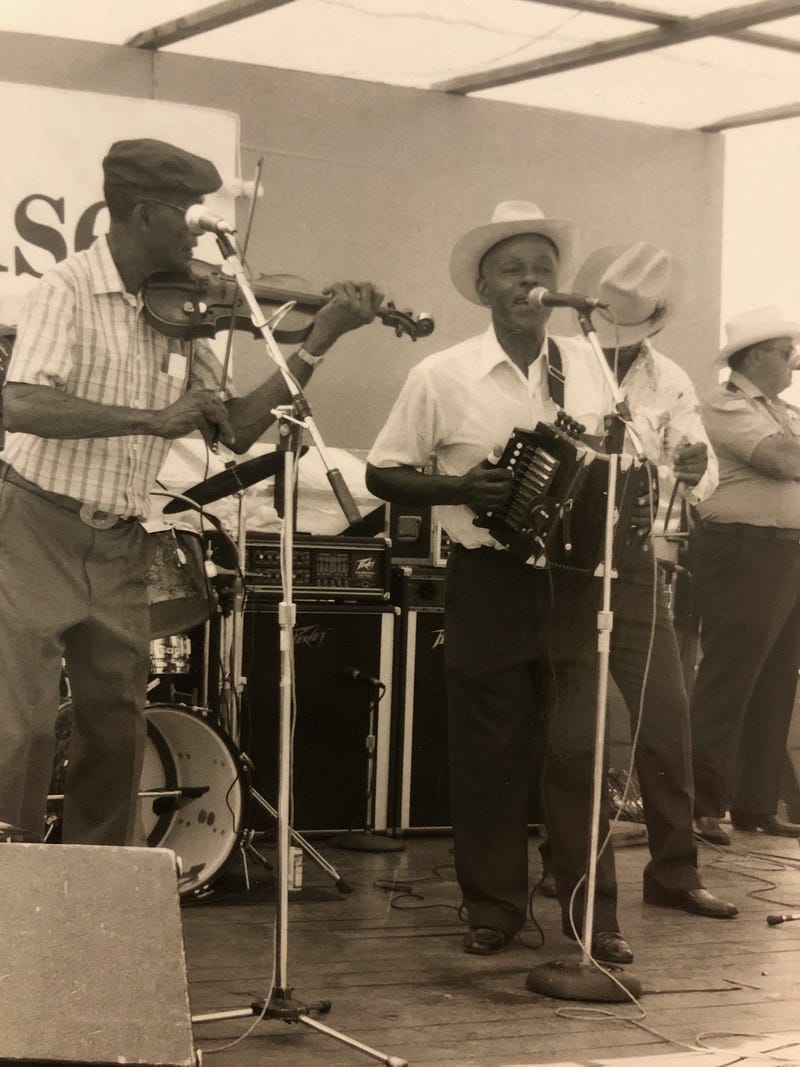
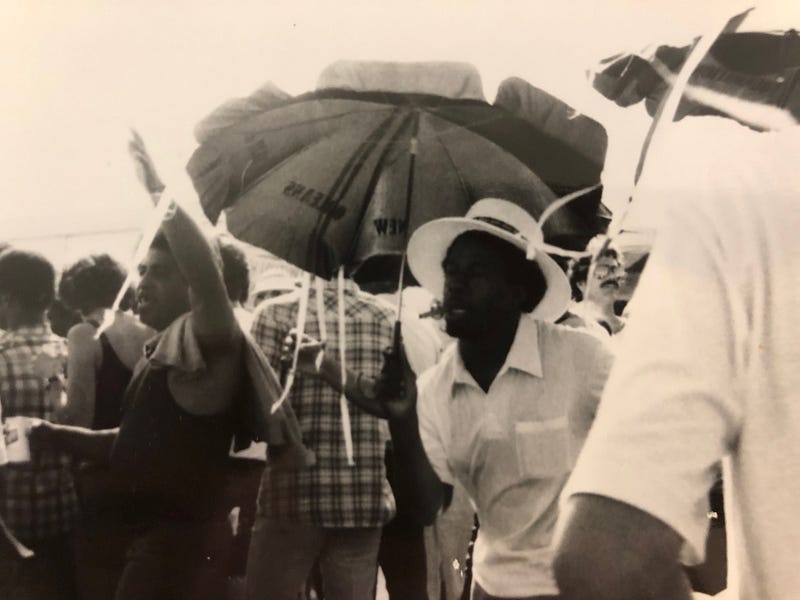
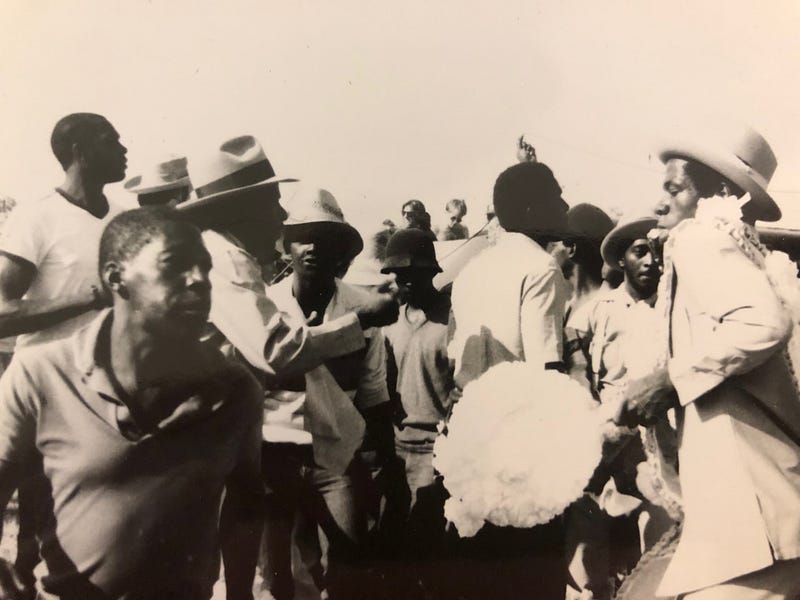
The Delta Blues Festival is an annual event, and in the late 1980s, it was held in Freedom Village, Mississippi, a rural community just south of Greenville.
It was a three-hour drive on Highway 61, also known as the “blues highway.” The road has been the subject of numerous musical works, including Bob Dylan’s album Highway 61 Revisited.
When I got off the phone, I called Rob Bowman, a Canadian friend finishing his Ph.D. in ethnomusicology at the University of Memphis. I knew he’d want to come along.
After picking up Rob and his wife Sue, we spotted Bo outside the Marriott. I handed my keys to Rob and scrambled into the back seat with Bo and his guitar. Rob placed his case and suit bag in the trunk.
For the next three hours, we all chatted like old pals. Bo was friendly, witty, and easy to talk to. Rob and I pelted him with questions, which he answered good-naturedly.
Rob was curious about particular songs — where he got his ideas and why he’d written this or that one. Bo was generous with his details and frequently stopped mid-sentence to finger-pick the song in question.
The man seemed to have unlimited energy. I suspected he’d gotten very little sleep, and looking back, I realize we should have kept our damn mouths closed and let him snooze.
Cars began to lock up like Tetris blocks as we approached the concert grounds. It looked like thousands of people were searching for a parking spot.
I fretted about Bo walking at least a mile to the staging area, but Rob had another idea.
He cut boldly through the jammed-up traffic and drove on the shoulder of the road. When people hollered and honked their horns Rob yelled out the window: “Bo Diddley coming through, make way for Bo Diddley!”
Surprisingly, people did. Some threw peace signs, and others called out his name.
Rob maneuvered up to the security gate, and when the guard saw who was in the back seat, he pointed to a roped-off section where cars and touring buses were parked.
Sweet. No walking — and we were right where Bo needed to be. Dressing rooms were set up where security guards patrolled, guiding performers to areas where they could change clothes and leave valuables.
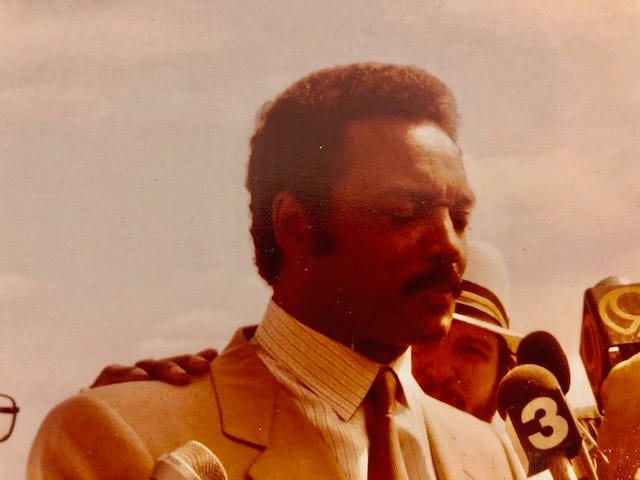
Almost immediately, civil rights activist Rev. Jesse Jackson spotted Bo and came over to greet him. He was surrounded by his staff and personal security and trailed by a TV reporter.
“My man!” Jackson exclaimed.
The three of us hung back, watching Bo interact with Jackson and fellow performers.
Onstage Vivian “Sam” Chatmon finished his set and wandered over to where we were standing, catching shade under a tree. It was hot and Mississippi humid.
The ancient blues guitarist seemed exhausted, and I noted he was wearing a wool jacket.
Rob purloined a lawn chair while I brought him water in a Styrofoam cup. I wondered where “his people” were.
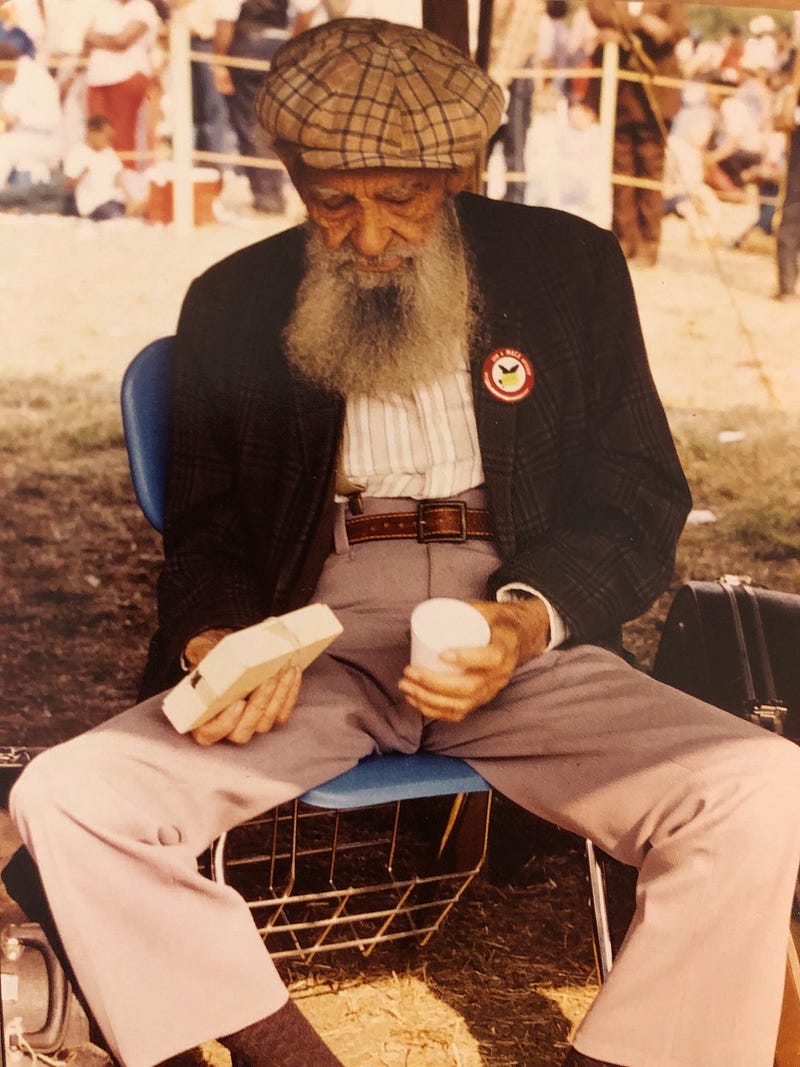
Chatmon was born on a plantation in 1897 and passed away in 1983.
Moments later, Bo came up to ask if we could fetch his guitar case and suit bag from the car.
“Y’all don’t have to worry about me,” he smiled. “I’m staying with some folks tonight, and I gotta ride back to Memphis.”
“Will you fly back to St. Louis?” I asked.
He chortled. “That ho never even left. She’s still there running up my credit cards at The Peabody.”
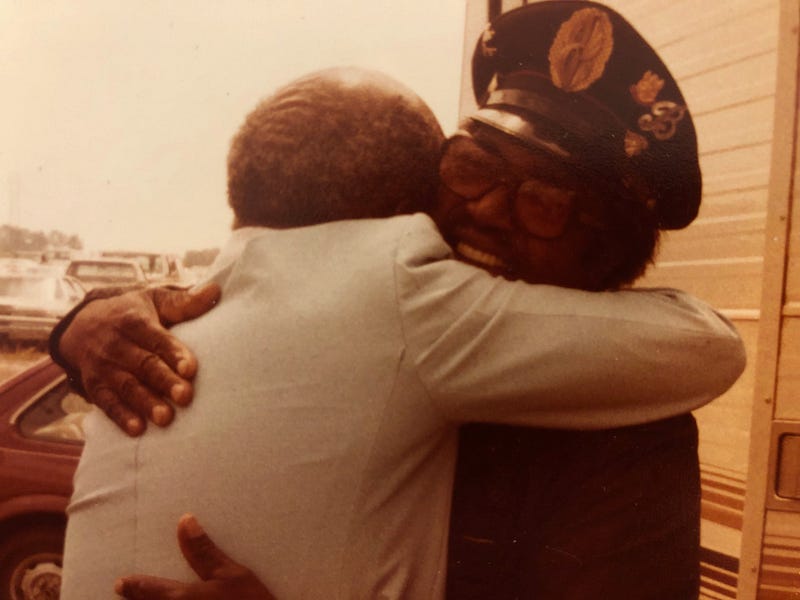
Suddenly, I heard the booming voice of Rufus Thomas — who was also performing that evening.
I told him his son Marvell had backed up Bo the previous night.
“Ain’t nobody better in town to backup this man,” he laughed as he gave Bo Diddley a bear hug.
For the rest of the afternoon, we walked from one stage to the other, catching performances by Muddy Waters, Robert Clay, the Fieldstones, Otha Turner’s fife and drum band, and other legendary blues artists.
Joining Turner was blues guitarist Jesse Mae Hemphill, an early pioneer of the North Mississippi Hill Country Blues tradition.
Below: Jesse Mae Hemphill’s “Run Get My Shotgun (and a box of shells).”
As afternoon turned into evening, the mosquitos became brutal. Sue stepped on an ant mound and couldn’t locate anything to relieve the stings.
A concert-goer offered his dew-rag doused in warm beer, but it didn’t help much.
Although it was only 9:00 — and the music would continue late into the night — we decided it was time to make the long drive home. I hated missing Bobby Rush, “Son” Thomas, and a few artists I’d never heard perform live, but I was bushed.
Unlike most people, we forgot to bring blankets or lawn chairs, which are comfort essentials for all-day outdoor music festivals.
We left to the trailing sounds of R. L. Burnside singing Robert Johnson’s “Crossroads Blues.” You could almost feel the spirit of Johnson, who said he sold his soul to the devil at a crossroads in exchange for his musical talent.
I offered to drive, but Rob said he’d do it. He popped in a tape of blues recordings, and we headed back on Highway 61.
Eerily, we drove long stretches without seeing headlights in either direction. It was almost like we were the only ones on the road.
Finally, a sign indicated that Tunica was just 30 miles away. We’d be back in Memphis before too long.
As we slowed down to enter the small rural community, Rob said, “Look over there!”
A single street lamp dimly illuminated an area not far from the railroad crossing. Lying beneath the street lamp was a large black dog.
The song playing on Rob’s tape was “Black Dog Blues” by Blind Blake. I wondered if Robert Johnson was looking down on us from Heaven’s Blues Highway.
© 2024 Deborah Camp. All rights reserved.
Thank you for your time and attention.


