
A Ridiculous Challenge — Gameful Writing (A Parable), Chapter 3 (of 7), Section 2 (of 3)
To celebrate the launch of my new book Gameful Writing, I am sharing it with you here, one section of each chapter at a time. Each of the seven chapters is a separate story, but they are interconnected. I hope you enjoy reading this little parable.
Chapter 3: Toni
Section **
There were a couple of e-mails in his mailbox. One of them was a notification about the third blog post by gamefulwriting.com.
Toni wasn’t sure why he was reading this blog, having thoroughly checked the credibility of the site.
The idea of combining something he hated with games, which he enjoyed but no longer had much time for, seemed in itself ridiculous. Why would anyone want to do it?
Nowadays, he was passionate about graphic design and could research different techniques for hours, trying them all out.
Passion made sense. “Gameful Writing” sounded like someone trying to force fun onto something tedious. Toni glanced at his unfinished pizza and smirked. This Gameful Writing idea was like trying to turn a pizza into a French dish by adding Herbs de Provence.
Maybe he should write that down. But no. Laura wanted him to write about global warming.
OK, it wouldn’t hurt to read this little blog. Who knew what could come of it.
Welcome back to the Gameful Writing blog. It is blog post three or Level Three of your writing game. Today we will talk about how to turn the third type of writing, of the five I outlined in my first blog post (click here), into fun games. And this third type is about pieces we have committed to but which we either don’t want to write, or consider unnecessary. We’ve all had those bits of writing. Just think of all those exams and graduation papers!
“Now, you’re talking!” Toni said out loud, and leaned back with satisfaction. The first two blog posts were amusing and something had compelled him to read them. In fact, he only meant to skim through them but found himself going back and re-reading them in full.
But this one promised to be what he needed. He was skeptical that it would do any good, but at least it directly addressed his particular challenge. “OK, surprise me,” he said to his laptop, straightened his back, and continued to read.
If you hate to do the writing that has been asked of you, or any task for that matter, you probably resent other aspects of your life as well.
Toni grunted, “You bet I do.”
You wouldn’t be the first, nor the last, in this situation, although you might feel like nobody could match the depths of your misery. And if you try to convince someone of your misery, they will only try to illustrate their suffering and probably try to prove that they are more miserable. We, humans, are competitive this way. If there’s nothing else to compete about, then we will compete about misery.
Trust me, I did that too and sometimes even today I catch myself trying to. How shall I put it? Well, I have some issues with my health.
Ah, screw it! I have cancer, and the doctors can’t agree on how long I have left to live. When you get such a diagnosis, it strikes you full in the stomach, even if the cancer is growing somewhere else. It is for me.
What I see now but didn’t see when my family, friends, and I found out that I had cancer, is that we all competed to show how sad and miserable we were about it. Only when I turned the figurative “spotlight” away from myself and from how I thought I felt, and just listened to my loved ones, only then did I see that they were scared of what it would be like to lose me.
I am not losing anyone. On the contrary, I’ve got more support and love than ever. From people I knew from my childhood, those I met throughout my life and now complemented with several doctors and plentiful nurses. But they don’t have this richness of help. Wittingly and unwittingly, I have become an integral part of their lives, and now for them there is a real danger of losing that part.
I am getting a ton of painkillers to make my time as comfortable as chemo, and other such things can be (which they are not; they suck, to be honest; sorry I can’t find a better word to describe what I feel about chemo). But those around me don’t get any painkillers for their heartache.
Yes, you guessed right. I started this project for those dear to me. But maybe not quite or not only as you think. It is not only to help them to go through this. But it is also for me to learn how to experience fully and without grudge what is asked of me, including that damn chemo. (Well, I do sometimes swear when I play games, so don’t judge me for swearing about the chemotherapy.)
So yes, you guessed right again, I give myself points and badges for each chemo session, and for each time I take my medicine. You are the first to learn about me doing it, and my loved ones will know it when they find out that I wrote this, but for now, this is your and my secret. And I love secrets. As long as they are kind, empowering, uplifting, and fun to find out, remember?
There is something else I found out about chemo and all those meds with side effects that I have to take. I realized that even if I thought I hated getting the shots and taking the meds, I had to admit that taking them was a part of the bigger dream. The dream is to prolong my time on earth as much as possible, so that I can spend it with my family and friends and gather a few more moments with them. So, for now, my part of the game is to take all the power-ups I need to gain more life power. I can’t believe how direct the analogy is between video games and my situation!
You might wonder what that has to do with your hated work or the thesis you have to write. Well, I have news for you. If you haven’t ripped the page (even if only figuratively) with the assignment into small pieces and thrown it into your supervisor’s or boss’s face, then you also want to write it.
There is some part of you that sees the truth about the assignment, that there is value in it, for you and others. And you hate yourself for seeing it.
You don’t have to hate yourself anymore. You are not alone in beating yourself up. We all do this, at least once in a while. Let’s do a test. Refresh your browser page and see if anyone wrote “I am” to the following question. “Are you ever hard on yourself and think that you or what you do is not good enough?” Feel free to answer it yourself, but you don’t have to. Just refresh and see what happens.
Toni scrolled down and discovered there were three “I am” answers before the other two “I am” answers mixed with reports on earning both reading and writing badges. He refreshed and saw how the side marker on his browser moved from the bottom to the half of the page. He scrolled down and discovered tens of “I am” and reports and words of gratitude.
Toni drew a couple of deep breaths. He scrolled back up to where he stopped reading, framed his face with his hands, and continued reading.
Shocking, right? I love those commercials that put people in the position of seeing how hard they are on themselves. And it’s tempting to judge ourselves for judging ourselves, however ridiculous that sounds when you write and read it. Judging for judging for judging for complaining about complaining and about judging again.
So where do we go from here? Well, let’s see what we do when we get stuck in games? We see where we are (for example, in a hole we fell into in a video game), then we double-check where the finish line is, or the “win-state” as game designers call it. Then we jump or crawl out of the hole and proceed one step at a time, double-checking all the time where the win-state is and continuing to make steps and beneficial detours (like gathering power-ups), but in the end bringing us to the win-state.
You can do the same with the writing piece you think you hate, but which we’ve established deep inside you need and want to do because, in truth, it is the power-up that will boost you toward the win-state, which you want beyond many other things, if not everything.
Toni sighed. “OK, OK, I see that now. You got me here. But how do I write the damn thing? I still haven’t got a clue.”
If you still resist putting your timer on for five minutes or even thirty seconds and just writing, then I am here to help.
Do you know how game designers get people to play their games? By introducing ridiculous rules. Often the more ridiculous the rules are, the more people play those games.
I bet you know more than one person who plays either badminton, hockey, tennis, ping-pong, baseball, cricket, or golf. And yet, in all these games, none of the players who want to win the game would do the straightforward and most logical thing, which is to go and grab that little object they all hunt for or throw around, and put it in the goal net, small hole, or onto the opponent’s field. Instead, every one of them willingly and dutifully takes a hockey stick, a bat, a club, or a racket and hits or hunts for that little, tiny object with all their might and skill. They do all that to win that match of their favorite game, regardless of how small or big the prize might be.
So, if you want to win this round of the writing game, then here’s the ridiculous rule for you.
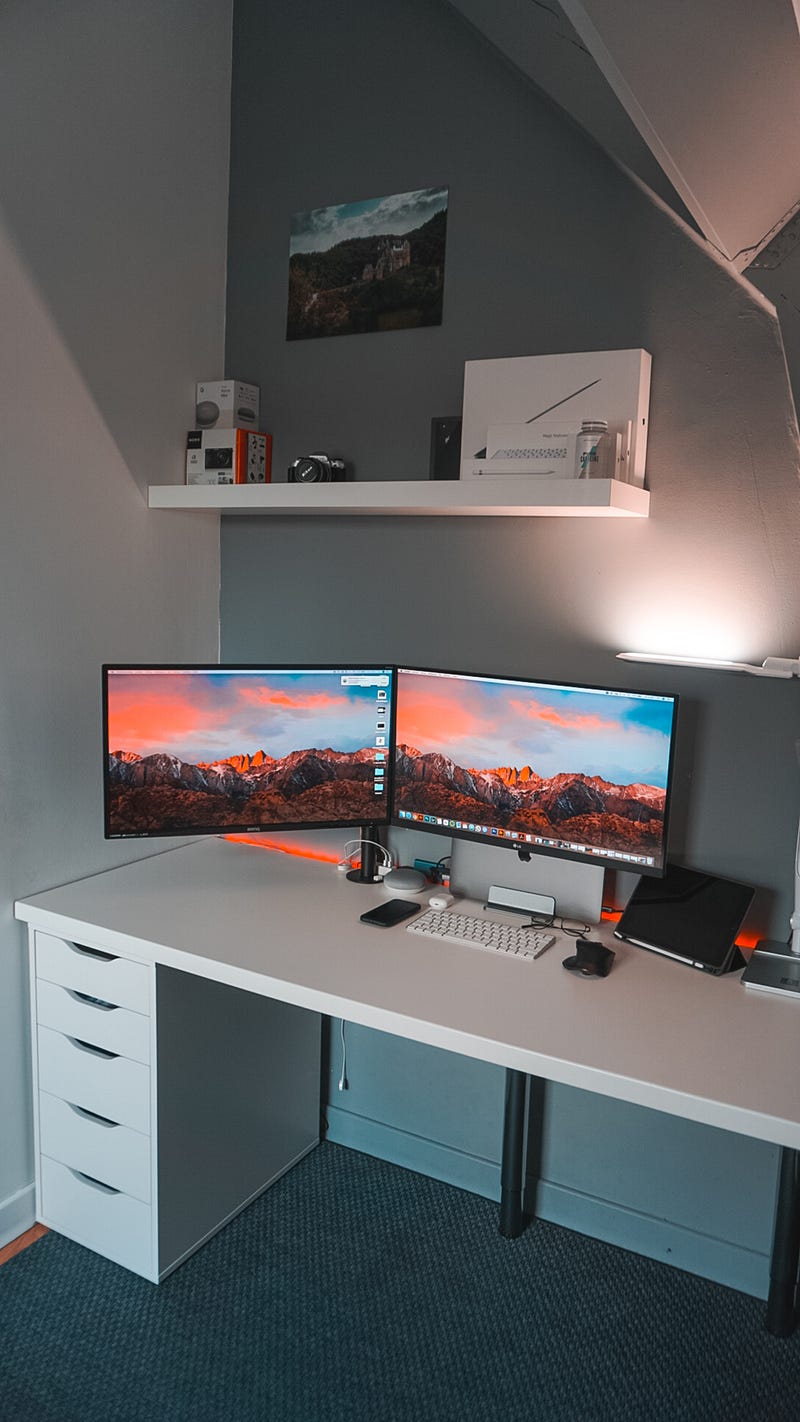
Get all the gadgets, take all of them under your desk or table, and write.
“What?” Toni took his hands away from his face and put them between himself and his computer on the desk. He leaned a bit closer to make sure he’d read it right.
Yes, you read that right. I suggest, no, in fact, I insist that you write under your desk or table. Otherwise, no writing badge for you today.
“Seriously? You got to be kidding me!”
Yes, I am serious. The only variant I will allow here is if you choose to write in a place that is as or even more ridiculous than sitting under a table. Like sitting in the kitchen sink, for example.
Toni grunted. “No, thank you. Under the table is ridiculous enough.”
He went and checked that his apartment door was locked, which he rarely did. He couldn’t believe what he was about to do, but he wanted to make sure that no one caught him actually doing this stupid challenge.
“What was your gadget list again?” He clicked back to the first blog post and got his computer, his mobile with the timer app open, and a cup of espresso along with a glass of water, which he set a little outside. He didn’t want to risk a flood on his floor or, heaven forbid, his computer. Then he would be completely screwed tomorrow.
Toni tried to make himself comfortable, but it was so damn hard sitting on the floor. Why did the Danes love wood for their floors? He had no idea. Since, as this damn blogger had helpfully pointed out, judging and complaining didn’t help, Toni put his laptop aside, got the blanket from his sofa, folded it, spread it under his desk, and sat on it. Better. Not much, but better.
I’ve got another helpful tip for you.
“You call making people write their graduate papers under the table helpful? If you expect me to do anything else like this, then I am out of here, I’m telling you!” He hoped that the blogger could feel his outrage.
Before you start the timer, go on and write the following sentence, “I write this while sitting under my desk (in the kitchen sink, or under the kitchen, dinner, hopefully not a coffee table — you’d need to lie down under it, and that would slow your writing speed ;D ).”
So, did you write that down?
“OK, OK, I can do that.” Toni typed:
I write this while sitting under my desk. I have no idea why I’m doing that, and please don’t ask me the details, but here I am sitting under my desk and writing an article on global warming.
Toni stopped himself. “Whoa! What was that?! I forgot to start the timer.” He narrowed his eyes, leaned forward, and looked around his room. Everything looked the same as always, or slightly different from the perspective of being under his desk. He shook his head and briefly checked the end of the third blog post, which he recalled he’d not yet finished reading. He saw that there were just wishes of fun (”Yeah, really? Well, OK.”) and the usual countdown, “Ready, set, go!”, which looked ridiculous being on a screen, as opposed to shouted out by someone at a kids sporting event. Now under his desk, Toni had no words for the stupidity of all this.
With another grunt of disdain, he set the timer to thirty minutes (“five minutes are for sissies”) and went back to the paragraph he just wrote.
The End of Chapter 3, Section **
Credits:
This is a work of fiction, but like any other, it was inspired by a myriad of creations and ideas I’ve had the honor of reading, seeing, and experiencing.
To share them all would be impossible, but I would like to credit several that I can “tackle.”
The Spotlight
The figurative “spotlight” in the third blog post (chapter 3: Toni, section **) was inspired by a story told by Ariel & Shya Kane in their acclaimed book Practical Enlightenment.
Here is the extract from the third blog post:
What I see now but didn’t see when my family, friends, and I found out that I had cancer, is that we all competed to show how sad and miserable we were about it. Only when I turned the figurative “spotlight” away from myself and from how I thought I felt, and just listened to my loved ones, only then did I see that they were scared of what it would be like to lose me.
And here is Ariel’s memorable account of wearing a headlamp, from Practical Enlightenment:
Whatever direction I turned my gaze, the headlamp automatically followed since it was strapped to my head and wherever I turned my attention, the view was illuminated. Then the light accidentally slipped, pivoted down into my eyes and I was blinded. It was a simple matter of readjusting the direction of the beam so I could go about packing my things.
… I realized that it is as if we have each been equipped with a personal headlamp that illuminates things. We see whatever we direct our attention to, allowing us to take care of the things and the people in the world around us. However, if our “light” slips and we focus on ourselves and how we’re doing, we become virtually blind and lose our way. With awareness, it’s a simple matter of readjusting the direction of the beam away from our complaints, worries or thinking about ourselves and bringing it back to this moment of now and the world around us. — Ariel and Shya Kane, Practical Enlightenment
Golf as an Example of Unnecessary and Voluntary Obstacles in Games
The more I read about games and gamification, the more I encounter golf being used as an example of how rules contribute to the engagement and fun factor of the whole process. I used this example, extending it to other games, in chapter 3: Toni, section **.
Here is the excerpt from the third blog post:
I bet you know more than one person who plays either badminton, hockey, tennis, ping-pong, baseball, cricket, or golf. And yet, in all these games, none of the players who want to win the game would do the straightforward and most logical thing, which is to go and grab that little object they all hunt for or throw around, and put it in the goal net, small hole, or onto the opponent’s field. Instead, every one of them willingly and dutifully takes a hockey stick, a bat, a club, or a racket and hits or hunts for that little, tiny object with all their might and skill. They do all that to win that match of their favorite game, regardless of how small or big the prize might be.
And the following quote inspired it:
As a golfer, you have a clear goal: to get a ball in a series of very small holes, with fewer tries than anyone else. If you weren’t playing a game, you’d achieve this goal the most efficient way possible: you’d walk right up to each hole and drop the ball in with your hand. What makes golf a game is that you willingly agree to stand really far away from each hole and swing at the ball with a club. Golf is engaging exactly because you, along with all the other players, have agreed to make the work more challenging than it has any reasonable right to be. — Jane McGonigal, Reality Is Broken
The Ridiculous Challenge
Here is my inspiration for the additional “ridiculous” challenge in chapter 3: Toni, section **. That is, the suggestion of writing under a table or in the kitchen sink.
Here are the two suggestions from the third blog post:
So, if you want to win this round of the writing game, then here’s the ridiculous rule for you.
Get all the gadgets, take all of them under your desk or table, and write.
…
The only variant I will allow here is if you choose to write in a place that is as or even more ridiculous than sitting under a table. Like sitting in the kitchen sink, for example.
The first, writing under a table, was inspired by a challenge my son got in school, to promote daily reading and make it more fun. This scheme included various ideas for where or how the pupils should read, including under a table, sitting outside, in the dark, under a duvet, and many others.
In 2016, I taught a seminar with the title “Exploring the meaning of Write-What-You-know in Fiction” at a Creative Writers Camp organized by the South Gate School of Creative Writing in Aalborg. At one point in this seminar, I gave all participants a prompt to write freely for five minutes. I joined the challenge. Before the workshop, I searched for fun first sentences online and found a website listing the first lines of one hundred novels. There, one caught my attention immediately. It was “I write this sitting in the kitchen sink” by Dodie Smith from I Capture the Castle (1948). It sounded utterly unusual and fun.
The reaction from the twenty-five participants of the workshop was colorful; many were surprised, amused, some skeptical. But the results were fantastic. We all read our pieces aloud. None of them was lacking. All contained terrific ideas, some reflective and some humorous, but all brilliant. That was an unforgettable experience for me as an instructor, and I often share the story of this free-writing exercise. I’m glad I got to use it here in this book as well.
From Gameful Writing: Seven People, Seven Stories, Seven Lessons Learned.
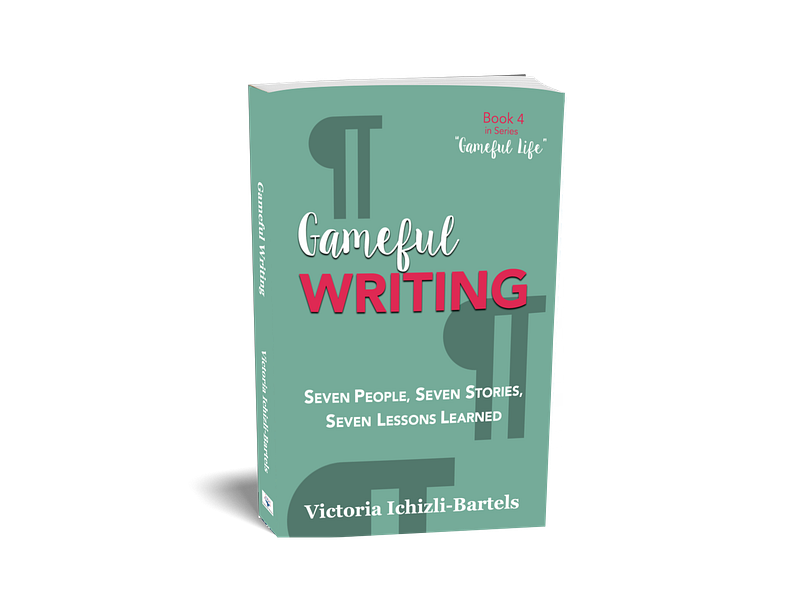
We are all required to write something at some point in our lives. For some, writing is a great passion, while others do it only under duress. Even the same person will enjoy writing some assignments while subconsciously resenting others. The writing “game” will unfold differently, in each case, for all of us.
In this little parable, several people receive a mysterious email from an anonymous blogger, challenging them to play the “Gameful Writing” game. Each of them has been struggling with writer’s block, or to deal with something in their lives, and this game just might hold the key to unlocking their potential.
Join Miriam, Will, Toni, Sofie, Torben, Lily, and Karina as they experience the healing and empowering nature of gameful writing.
And discover these forces for yourself.
P.S. To stay in touch, join my e-mail list, Optimist Writer.
About the author:
Victoria is a writer, instructor, and consultant with a background in semiconductor physics, electronic engineering (with a Ph.D.), information technology, and business development. While being a non-gamer, Victoria came up with the term Self-Gamification, a gameful and playful self-help approach bringing anthropology, kaizen, and gamification-based methods together to increase the quality of life. She approaches all areas of her life this way. Due to the fun she has, while turning everything in her life into games, she intends never to stop designing and playing them.