
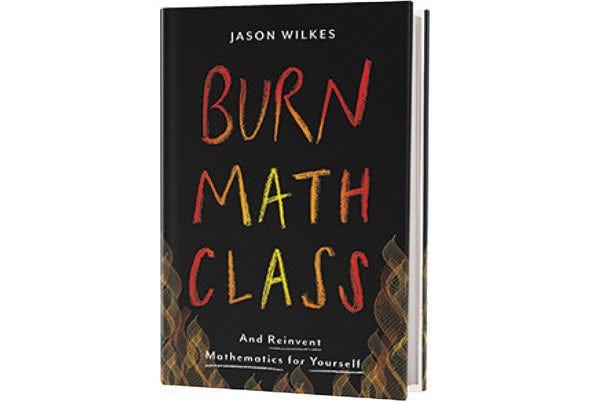
A Review of Burn Math Class: And Reinvent Mathematics for Yourself by Jason Wilkes
In 2014, I wrote an article entitled “Math Anxiety and the Quest for an MBA”. In this article, I chronicled my struggles with mathematics. I was taking graduate-level business finance and was way over my head. I didn’t understand any of the mathematics. I was struggling badly.
“After three weeks in class I was petrified. The word problems the teacher handed out were in the English language, and the words were familiar, but I had no idea how to find the solutions. There was math I had to do, I knew that. I also knew I couldn’t skip the math and rely on my strengths in writing to get me through. There was no writing to do.”
It is interesting to read that post now. These days, I understand my weakness in right-brain logical thinking. I can see programming and mathematics, and I kinda understand the process, but I am very weak at performing it.
I would need a lot more practice before I get confident in actually doing mathematics.
Although my job is only tangentially related to programming, and I probably won’t do math beyond the 6th grade level anytime soon, in an effort to better understand the concepts of mathematics, I read a math book.
Not an ordinary math book, of course. I haven’t had success with those.
I read Burn Math Class: And Reinvent Mathematics for Yourself by Jason Wilkes, probably the most creative and unorthodox math book I have ever seen. If you read to the bottom, I compare it to two of my favorite cartoons.
Amazon link here.
Burn Math Class was amazing. It is easily the most difficult book I have ever read and also one of the most creative. Easily the most challenging I read for fun. Yes, I said I just read a math book for fun. Does that mean I now think Math is fun?
I can see the fun in math. I have always been good at basic statistics and data, especially in regards to fields I enjoy, such as conflict studies and baseball. I have always been decent at playing with spreadsheets and finding anomalies in data.
But data manipulation is not mathematics. Mathematics is much more like a logic puzzle. Most mathematics doesn’t even have numbers. In Chapter 1 on page 19, Wilkes states that “mathematicians don’t like to deal with numbers”. That took me a few moments to wrap my head around.
I had to pause a lot reading Burn Math Class. I rarely read more than 20 pages in any sitting. I read it slowly and sometimes twice. If he was offering to teach me math in a new way, I wanted to understand what Wilkes was doing. With nearly 400 pages, reading Burn Math Class took me almost six months to read.
Wilkes takes the reader through a slow building process starting with the basics of addition and multiplication. By the end of the book, the reader has been exposed to Infinite-Dimensional Calculus. I am not saying I could write anything about Infinite-Dimensional Calculus, but I will tell you Wilkes’s discussion about the subject was much easier to understand than other google results on the subject.
For example, none of this makes sense to me:
This book treats the theory and applications of analysis and functional analysis in infinite dimensions based on white noise. By white noise we mean the generalized Gaussian process which is (informally) given by the time derivative of the Wiener process, i.e., by the velocity of Brownian mdtion. Therefore, in essence we present analysis on a Gaussian space, and applications to various areas of sClence. Calculus, analysis, and functional analysis in infinite dimensions (or dimension-free formulations of these parts of classical mathematics) have a long history. Early examples can be found in the works of Dirichlet, Euler, Hamilton, Lagrange, and Riemann on variational problems. At the beginning of this century, Frechet, Gateaux and Volterra made essential contributions to the calculus of functions over infinite dimensional spaces. The important and inspiring work of Wiener and Levy followed during the first half of this century. Moreover, the articles and books of Wiener and Levy had a view towards probability theory.
I am not trying to throw Takeyuki Hida, Hui-Hsiung Kuo, Jürgen Potthoff, and L. Streit under the bus, but I bet they are used to talking mathematics to mathematicians. And try to follow this video:
Again, I am not an expert on Infinite-Dimensional Calculus or anything else beyond Chapter 3 in Burn Math Class. I still have never taken a Calculus class. But at least now I think I know something about it.
The experience of reading Burn Math Class was a lot like being Donald Duck in the classic cartoon Donald Duck in Mathmagic Land.
There needs to be something said about Wilkes’s writing style. There are several chapters in which characters enter the book. These characters are Author, Reader, and Mathematics, with guest appearances by other minor characters, to include Meta-Author. Having these characters helps the actual reader throughout the journey. Many of the concepts are repeated or their dilemmas re-evaluated from a philosophical perspective by Author, Reader, and Mathematics. The characters also allow Wilkes to stretch out creativity, re-emphasis key points, and provide bits of levity during the journey through mathematics.
Wilkes’s meta-writing style, especially in the end of the book, reminded me of another classic cartoon, Duck Amuck starring Daffy Duck.
Time for me to get meta. On page 383, Wilkes’s Meta-Author character thanks the reader for reading and tells the Reader to go create their own thing: a book, “a painting, an email, or a big pile of sand”. Wilkes calls it the reader’s “homework assignment”. As I was reading Burn Math Class, I was editing and preparing my first novel, Curveball at the Crossroads, for publishing. It was published in early November 2020.
Book Review Meta-Author: Jason, if you want to read Curveball at the Crossroads, the link is right there. Check it out. That’s my creative magnum opus. For now, until my next one.
Overall, I really enjoyed Burn Math Class. As mentioned, it was one of the most challenging but rewarding books I have ever read. Recommended, even if you aren’t a “math person”. Recommended especially if you aren’t a “math person”.


