
A Review of Bruce Springsteen’s ‘Born in the U.S.A’ Album Forty Years in the Making
You can’t start a fire without a spark
Earlier this week I wrote a track-by-track review of Bruce Springsteen’s latest album, Letter to You. Over nearly forty previous Bruce-centric articles, I had never reviewed an album this way and I discovered I like it, which made me wonder which one I should tackle next. Back in August I did a monthlong series on Born to Run, so as tempting as that one is, it can wait. I’ve also done more general reviews of Tunnel of Love and Magic, so those go on the backburner too. It soon became clear that for several reasons my next review would be the very one I was in no hurry to do: Born in the U.S.A.
If you’ve read any of my Springsteen articles, you may have the impression that I dislike this album; nothing could be further from the truth. The album was released a few weeks after I graduated high school in 1984 and is thus inextricably linked with a formative period of my life. Just as important, it introduced millions of people to the man they had only vaguely known before as that guy who sang “Born to Run.’’ It may not be my favorite record of his, but I love anything that spreads the Gospel of Bruce and swells the congregation of The Fellowship of the E Street Band.
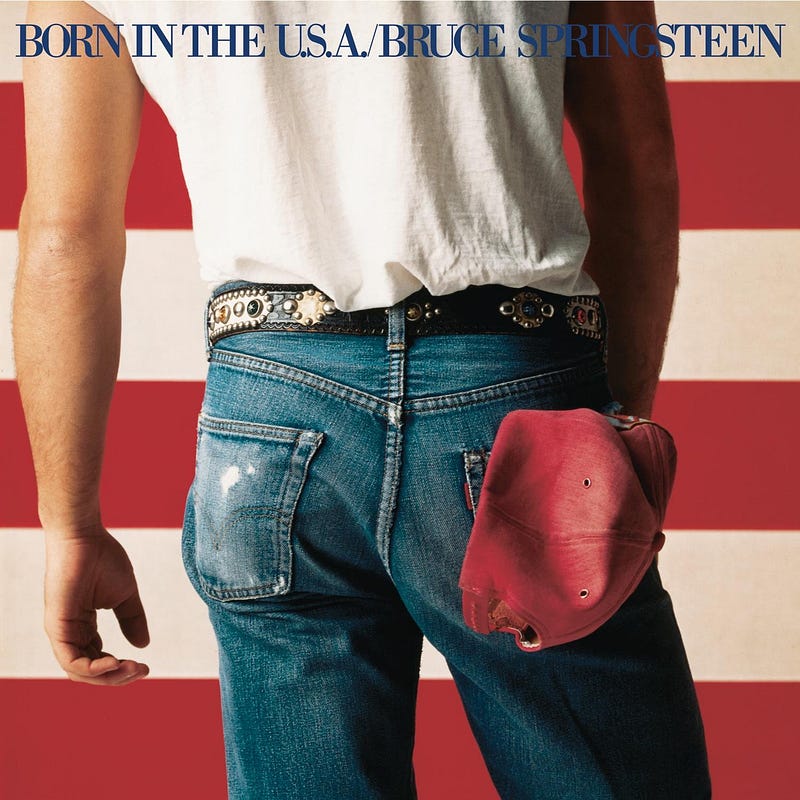
Born in the U.S.A. is Springsteen’s seventh studio album and remains by far his most commercially successful. It has sold over 30 million copies to date worldwide, produced seven Top 10 singles (“Dancing in the Dark,” “Cover Me,” “Born in the USA,” “I’m on Fire,” “Glory Days,” “I’m Going Down,” and “My Hometown”), and was supported by a massive world tour, his first to feature huge stadiums. It is also his second-most recognizable album cover, and thank God the cover of Born to Run with the iconic photo of him leaning on the Big Man’s shoulder will always be more famous; no one wants a picture of their backside to be the one they’re best known for. (My daughter just told me I’m wrong about this; she is 23, married, and now grounded).
Below is a brief track-by-track look at Born in the U.S.A., along with a playlist of the entire album at the end. You will see that it’s an album I love far more than I let on, except for one particular song (see if you can figure out which one).
“Born in the U.S.A.” A great song that everyone from President Ronald Reagan to your wingnut uncle completely misinterpreted (both when it was released and still today), as I wrote about in detail here. In a nutshell, the song is not the flag-waving, jingoistic, America-first anthem so many think it is. It was originally written and recorded during the Nebraska sessions, and to me that version is the superior one.
“Cover Me.” A catchy tune that can easily become an ear worm. It is, however, probably the least Springsteen-like song on the album, a fact brought home to me when I heard the “dance mix version” one night at a club in Dallas. No, really.
“Darlington County.” Both this track and the one that follows could just as easily have fit on The River album. It’s got something of a “Cadillac Ranch” vibe, though it’s not quite as good as that classic jam.
“Working on the Highway.” This is another song that, like “Born in the U.S.A.,” was originally recorded with the tracks that would end up as the Nebraska album. This version is certainly more rockin’ than it would have been on that record, and certainly more fun. It’s even better when they play it live because of an added sax solo at the end.
“Downbound Train.” An overlooked gem that brings back two distinctly different memories almost 40 years later. It was my go-to song as my high school girlfriend and I were breaking up and, on a less morose note, also the song Bruce forgot the opening lines to when I saw him at the Cotton Bowl in 1985. Even legends stumble sometimes.
“I’m on Fire.” Only rarely does Bruce write what would be called traditional love songs; “My Love Will Not Let You Down” and “I Wanna Marry You” are two that come immediately to mind. More often he writes love songs with a hint of pain, like “Tougher Than the Rest,” “I’ll Work for Your Love,” and this track, which I can only describe as “smoldering.” That heat came across on the video, which won Best Male Video at the 1985 MTV Video Music Awards.
“No Surrender.” This just might be the best song on the album; it certainly has the best line of any song on the record: “we learned more from a three-minute record than we ever learned in school.” How it was not among the seven singles released between 1984 and 1985 is a mystery that may never be solved.
“Bobby Jean.” Bruce wrote this musical goodbye letter to E Street Band guitarist and lifelong friend Steve Van Zandt, who left the band after the album was recorded for a solo career; it is easily one of the most personal Bruce has ever written, at least until the Letter to You album. It is also my oldest daughter’s favorite Bruce song that’s not “Born to Run.” He forever endeared himself to her by saving it for last when we saw him during The River anniversary tour in 2016.
“I’m Goin’ Down.” Of all the songs on Born in the U.S.A., this is the one I am most likely to turn up loud enough for the neighbors to call the cops (especially during Clarence’s sax solo). Often overlooked among the many hits from the album, this rocker peaked at #9 in August of 1985. It deserved better.
“Glory Days.” My utter disdain for this song is well known, even to my subconscious; when I first typed out all the song titles for this article, I “inadvertently” left this one off. If only Bruce had done the same thing, replacing it with songs he chose not to include like “None but the Brave,” “This Hard Land,” or “Janey Don’t You Lose Heart.” It’s just a bad song with an even worse video, and the fact that the greatest lyricist of his generation allowed himself to use the word “speedball” rather than “fastball” is surely one of his greatest regrets. It reached #5 on the Billboard charts in 1985, eighteen spots higher than “Born to Run” a decade earlier; I personally consider that the moment America as a nation lost its way.
“Dancing in the Dark.” One of the best songs on the album was recorded last, and only after producer Jon Landau told Bruce the album didn’t have a hit single in the mold of “Hungry Heart.” Bruce gave in, and “Dancing in the Dark” spent four weeks at #2 on the Billboard singles chart in June and July of 1984, blocked from reaching #1 by first (I kid you not) Duran Duran’s “The Reflex” and then by the Prince classic “When Doves Cry.” The music video for the song became famous for introducing us to actress Courteney Cox (who dances with Bruce at the end of the video) a full decade before she became famous on the show Friends.
“My Hometown.” A fine song to close out a fine album. The first verses tell the story of his youth (both the good and the bad) in Freehold, New Jersey; the latter verses perfectly mirror what he sang about in the title track that opened the album. What no one knew at the time was that in many ways this was a short preview of his incredible autobiography Born to Run that would arrive three decades later.
That’s my look at the one Springsteen album I know everyone’s at least heard of. Here’s the full album and, as always, tramps like us…


