
A Remembering in the Streets of Guwahati
On my re-discovery of the city
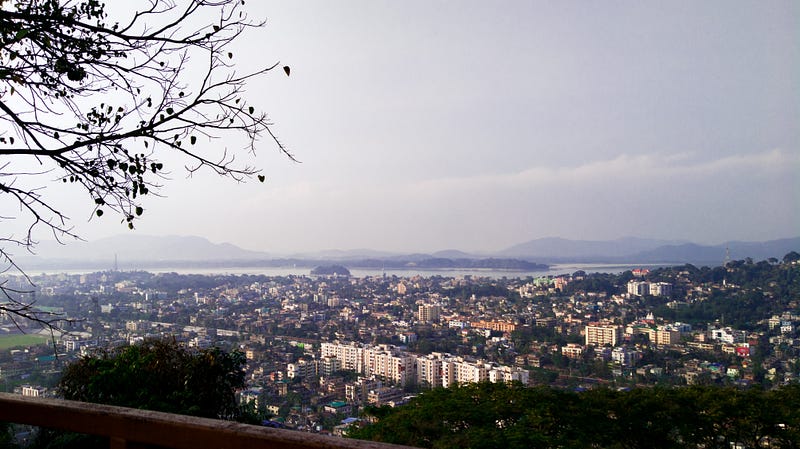
When I was tasked with bringing back a vial of Guwahati’s¹ essence, I hadn’t given it much thought. I had done stranger things before, more dangerous, more peculiar. And I had once reigned over her anyway. I was sure it would be a walk in the park for me.
And so, I ventured out, excited and eager, like an animal that had been caged for far too long. I had been given a legitimate excuse to venture out of this corral and prowl the city and haunt my old haunts. Determined to be as authentic as possible, in the experiencing of this adventure, I left behind my red mahogany door, pushing forth into a world that had better not forgotten me.
But I wasn’t to be indulged. I was no longer my city’s favourite. I couldn’t recognize her anymore. Making my way down the hill I had made my home on, I was confronted by a lush green. It was everywhere and I had to admire the pace at which Nature had birthed and proliferated. The old government quarter I had to pass by, was now over-run with the vines. Small shrubs had made their way out of the cracks on its facade. Kids outside threw stones at this mausoleum of the dead. I smirk at their faux bravery. Come sunset, they will carry dried red chillies and mustard seeds as talismans against the ghosts² that prey on wayfarers in this stretch of the road.
I hasten my steps and make my way down to the main road. There are a few vehicles, not as many as during the heyday of Guwahati, but still, enough to make me feel the grime on my face. A pack of dogs make their way by me, saliva dripping from their mouth as they search for their next meal. One trails behind, on its side a vicious bite, probably from the gang wars that have become so common these days — it’s a harsh world, and even dogs have to fight for their meals.
The road seems to blur in the distance. A watery shine reflects on my eyes as cars pass by, at furious speed because no one is there to check them. I ignore this blurring and walk on. It is the heat making me see mirages but this is the summer we native Guwahatians are used to. But all cooped up in our air-conditioned homes, we had forgotten this truth.
I know I need to find some shade soon and desperate, I make my way into a once-swanky cafe on the side of the Dighalipukhuri³. The floors, the glass, have all lost their shine and I make my way to the window front so I can watch the people passing by. It is a revelation for me — seeing people after so long, even with faces and emotions hidden behind masks. Creep⁴ plays in the background and I am chastened. Almost. I have been deprived of human interaction for far too long and I drink in every sliver of skin I see — the lovers braving the heat as they lounge on the benches by the lake, the people walking by on the footpath, and of course, the ones in the cafe with me.
Guwahati feels alien today. Once, I ruled her streets and I knew her like the back of my hand. But I cannot make my way to some areas now, my rights over my kingdom curtailed. I gulp down my masala cola and ask for another while I devour the large pizza I had ordered. My appetite to reacquaint myself with Guwahati is just as ravenous and I must make my way out soon.
I walk and walk and lose myself in the serenity of this now ghost city. Before this pandemic came down on us like the vengeance of a waking Kalki⁵, Guwahati was home to thousands. Hundreds of thousands of souls just like me, who lived and worshipped her. But now, so many have gone back to their ancestral lands, leaving behind a skeleton of a once plump and luscious beauty.
But never you mind because one look and I am ready to prostrate myself at her feet every day.
I walk by the Brahmaputra⁶, a river who will soon turn on us. He is just waiting for the dense rains to start when he will gleefully spill over the frail edges and drown us again. I enjoy this temporary peace, this small respite, and the calm at Bellevue⁷, the scenic hilly path to the Governor’s estate. Lovers and families are here, silently listening to the whisper of the wind. They had been deprived too of their mother’s touch for far too long, but now, as they gaze below at the river and into the distance, they are reinvigorated. I am too. And after a short-lived appeasement that this view of Guwahati offers to my deprived soul, I am back again in the present.
And I compel myself to turn back before the clock strikes five when we need to be inside our houses. I silently fume over this curfew and damn everyone who still won’t take proper precautions. At five, Guwahati turns back into her lonely self and I am angry for myself and for her too.
I decide to venture through Pan Bazar⁸ on my way back. Trapped outside the shutters of bookstores, I feel bereft and at a loss. How long has it been since I was physically enclosed in one? How long has it been since I had willingly let myself be unmoored in a space that steadied me? Too long, I whisper, but soldier on, the ticking of my watch an audible warning. It is not an easy task, to turn my back on that which my eyes had cried to see again.
But I must go on. I make my way back and try to console myself with the view of the people closing the shutters of Guwahati Bakery⁹, the lack of traffic at Silpukhuri¹⁰, the empty mast at Gandhi Mandap¹¹. For a second, I can almost swear that I see the Tricolour waving in the wind, high up above any of us on that little hilltop nestled in this valley, but it is an illusion — my memory and my love play tricks on my dejected soul.
Pretty soon, I am making my way up to my house anyway, my hand gripping my worn cotton-wrapped talisman, my mind in disarray. Very soon, I promise Guwahati, I will venture down again from my hilltop to explore her again. To breathe her air, to feel her rolling hips as she lay curled on the banks of the Brahmaputra.
Note:
- Guwahati — The biggest city in Assam (a NorthEastern state in India) and my birthplace. It is also called the Gateway to North-East India.
- Ghosts — This is a real belief and a talisman is an actual object we are told to carry around when we pass this area. There have been many suicides and so elders in the community make the younger kids have it on them always.
- Dighalipukhuri — Legend says that King Bhagadatta, who led the Kauravas in the Mahabharat war, built this man-made lake so that all the 100 Kaurava brothers could bathe in it when they were visiting the swayamvar (a ceremony where the bride picks a husband of her choice from a group of eligible men) of his daughter. Today, it is a pleasant park people can visit.
- Creep — A song by Radiohead.
- Kalki — The tenth avatar of Lord Vishnu who is said will end the Kali Yuga, an epoch of lawlessness and crime.
- Brahmaputra — The only ‘male’ river in India, Brahmaputra literally means ‘Son of Brahma’.
- Bellevue — Named after the hotel situated on the banks of the river, Bellevue is a pleasant riverfront area that people often visit. Located on a hill, it offers a beautiful scenic vista of the Brahmaputra.
- Pan Bazar — This is the book market in Guwahati. On normal weekdays, it is chock full of academics and students.
- Guwahati Bakery — One of the oldest and most popular bakeries in Guwahati.
- Silpukhuri — A neighbourhood located in the midst of Guwahati. There is also a small park with a ‘pukhuri’ (pond) inside it.
- Gandhi Mandap — A museum dedicated to Mahatma Gandhi, it is situated atop a hill in the midst of Guwahati city. There is also a huge flag (9,600 sq ft) hosted atop a 319.5 ft flag pole at the Gandhi Mandap. Because of its position on top of a hill, it is the ‘tallest’ national flag in India.
Nayanika Saikia graduated summa cum laude with a Bachelor’s degree in English Literature and was also a Dean’s List student. She is currently pursuing her Master’s degree and is also a Booktuber and Bookstagrammer. She can often be found on her Instagram account Pretty Little Bibliophile. You can support me by Buying Me a Coffee. To get regular updates and amazing content, sign up for my newsletter!