
RELATIONSHIPS
A Relationship Lesson for “Fixers” — You Know Who You Are
Set yourself free from fixing other people’s behavior
My client has double-spaced after every single sentence in their 50K-word manuscript, and as their editor, I have to fix every instance of this. An editor friend of mine explained that I can use “Find and Replace” even for blank spaces. Who knew?
And this got me to thinking.
Find. And. Replace. Click. Click. Done. Easy. Peasy.
And then, as any chronic overthinker would do, I made it a thing.
You see, I am like that — I overthink, overanalyze, and when I am dating someone, I do this to them. Have you ever done this? Overanalyze your partner to the point of stressing yourself, them, and your relationship?
You are not alone.
Mental Wellness Check Do you do this to people you love? Search through them like you are the editorial team hired to rewrite their life into perfection? How about shelving the red pen for a moment and thinking about this from a general “life journey” perspective.
🌟 Each person is given a life journey. This is very personal to each of us, and though we may converge with other life paths, our own path — birth to death — is inherently personal to us. If someone chooses to share their journey with yours…this does not mean they want you to redefine them or reshape them or their journey. Allow them to approach, face, and rise to the challenges they encounter because these learning experiences shape us and help us to grow.
I look for flaws. Any little thing (or God forbid, big thing) that needs to be corrected, polished, worked on, fixed, repaired, or eliminated in order for my partner to be a better person, a healed person, or in some cases, a more presentable person.
It’s wrapped up in this kindness and smile rhetoric, but really it’s just picking them apart one tiny unpalatable portion at a time. Sometimes, when you can’t find anything wrong, your mind goes into a tailspin — perhaps they are hiding those things from you.
Then comes the suspicion, the snooping, the watchful eye, and mistrust.
All because you need someone to fix.
MentalHelp.Net reports that not only is this behavior unhealthy for your relationship, it can also doom your relationship to fail:
“An unhealthy wish to fix others is to get into relationships where the partner is seen as someone who needs fixing. One problem with this is that the other person may not want fixing and may not even see a need to be fixed. The other problem is that any relationship based on one person trying to fix the other is doomed to failure.”— MentalHelp.Net
Find and Replace
Find and Replace — The act of searching your partner for flaws and then set out to shape them into something more pleasing.
What’s been called Fixer Syndrome may run deeper, psychologically speaking, than you may think. It’s more than just being an empathetic and helpful person. What feels like “loving” someone can actually subvert their own decision-making and self-empowerment, lessening their own experience with personal growth and making it actually more about you.
This isn’t “helping” but can be detrimental to your partner’s growth. When you think about it, that’s pretty icky. And so easy to get into the bad habit of doing.
Writer J. M. Siebens explains in her article How to Stop Being the Fixer in Relationships that we may do these things in order to make ourselves feel better. We become the “savior” to our partner, and on some level, this makes us feel they need us more.
Think of the underlying feelings, here.
- Fear of abandonment?
- Fear of not being “enough” for our partner? (Without being their “savior.”)
- Fear of what other people make think of us, our relationship, and our choice to stay with a flawed individual?
(Note: We are ALL flawed individuals.)
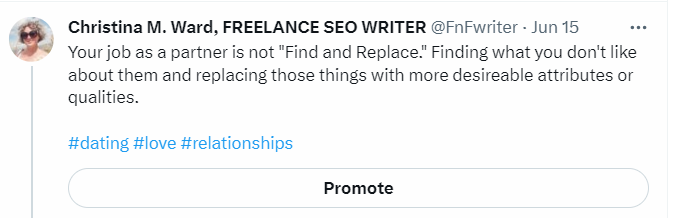
There are some underlying fears we must personally deal with in order to let go of what we see as our partner’s “potential” and simply accept and love them for who they are — flaws and all. It’s our “job” as their partner to give them the safe and supported space they need to grow — as they see fit. We do not get to be (nor should we be) the navigator of their life choices.
Perhaps when we begin interfering in our partner’s life under the guise of “helping” our partner to grow…it is really we who need to do some growing.
Mental Wellness Check
Are you considering how a “Find and Replace”partner would make you feel?
🌟How would this scrutiny make you feel about yourself? 🌟Would you be more or less confident? 🌟More or less secure in the relationship? 🌟Would you feel more or less loved and supported?
Think of it from their perspective. You would not want another person dictating your steps or behaviors or lessons or what-have-you on your own life path, right?
I am not a completely rehabilitated fixer. In fact, I am working very hard to be more of a supporter in my current relationship — allowing my partner the space for growth, the safe space for good communication, and the love they need when they are at their best and at their worst.
After all, this is what I would want from them, right? To feel loved and supported even when I am not at my best? To feel they see my flaws but do not pick me apart for them or try to “splain” me into better emotional expression or behavior.
I try to think of this as an equal-opportunity-for-growth relationship. And our separate journeys, each very individual and personal experiences, are made better for the love and support (and acceptance) we provide each other.
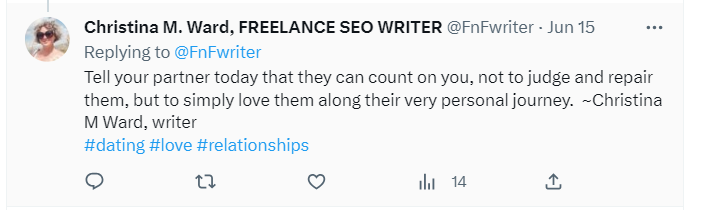
If you’re “fixing” your partner, you are missing out on the freedom and inner peace of letting all that go. Let go and let them be. Focus more on loving communication and supporting your partner in ways they need.

Christina M. Ward is a freelance writer in cannabis, wellness, and clean beauty. Christina’s professional work has been featured in Today’s Health Science, LA Weekly, Village Voice, Men’s Health, and OK! Magazine, among others.
Christina also writes on personal journey, productivity, and relationship topics for Medium publications like this one. If you want to read more of her work on Medium use this join link for unlimited access. A portion of your small monthly dues will go to support the work of the writers and poets that you read.
Books: Amazon. Newsletter: Fiddleheads & Floss Newsletter.


