
A Recollection of My 4-Year Journey as a PhD Student.
The ups and downs, good and bad, exciting and boring.
On 28 Feb 2021, I’ve submitted my doctoral thesis entitled “Weight Management and the Prevention of Obesity — The Role of Dietary Protein in the Regulation of Appetite and Body Weight” for examination, to the University of Auckland, New Zealand. It’s a milestone after four years of hard work, while waiting for my oral defence, it’s time to remind myself of what’s like as a PhD student. If you are a current PhD student or considering to do a PhD, I hope this article can provide you with some insight.
The Interview
It all started back in 2016 when I completed my BSc (Hons) Nutrition. I was certain that I love research and human nutrition, hence would like to pursue a career in nutrition research. Upon browsing www.findaphd.com, I found this funded PhD studentship position at the University of Auckland.
The interview comprised two rounds, both were conducted online by the prospective supervisor, which is my current PhD supervisor. The first interview was to understand each other. In this first interview, we had a chat about my personal and professional background, whereas the supervisor informed me about the project details and the skills required. After passing the first interview, the second interview occurred one week later. In this second interview, I presented my Research Project for the Hons program I was qualified for. This interview also allowed the supervisor to gauge my research skills and critical thinking. I passed both, owing to my familiarity with the basics of clinical work required for the PhD research project, having authored a scientific publication, as well as having the ability to speak Mandarin Chinese. For your information, about 11% of the population in Auckland, New Zealand are Chinese.
An Eventful Year 1
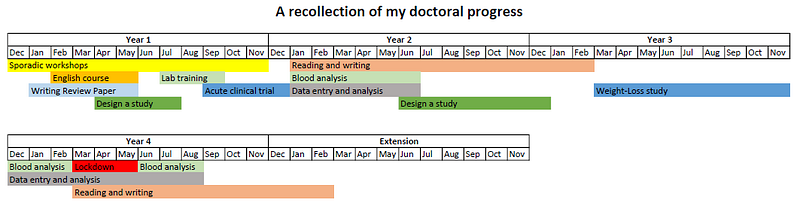
I successfully enrolled as a PhD student on 1 Dec 2016. As part of the university requirement for all international PhD students, I was required to take an English language test designed by the university, called the Diagnostic English Language Needs Assessment (DELNA). It is very similar to any other English language test for non-native speakers, such as the IELTS, except DELNA had no speaking test. Although I understood I never excelled in the English language, it came as a surprise that I failed the test, twice! Having failed the test twice, I was required to take an academic English language course, which ironically, I passed with an A…
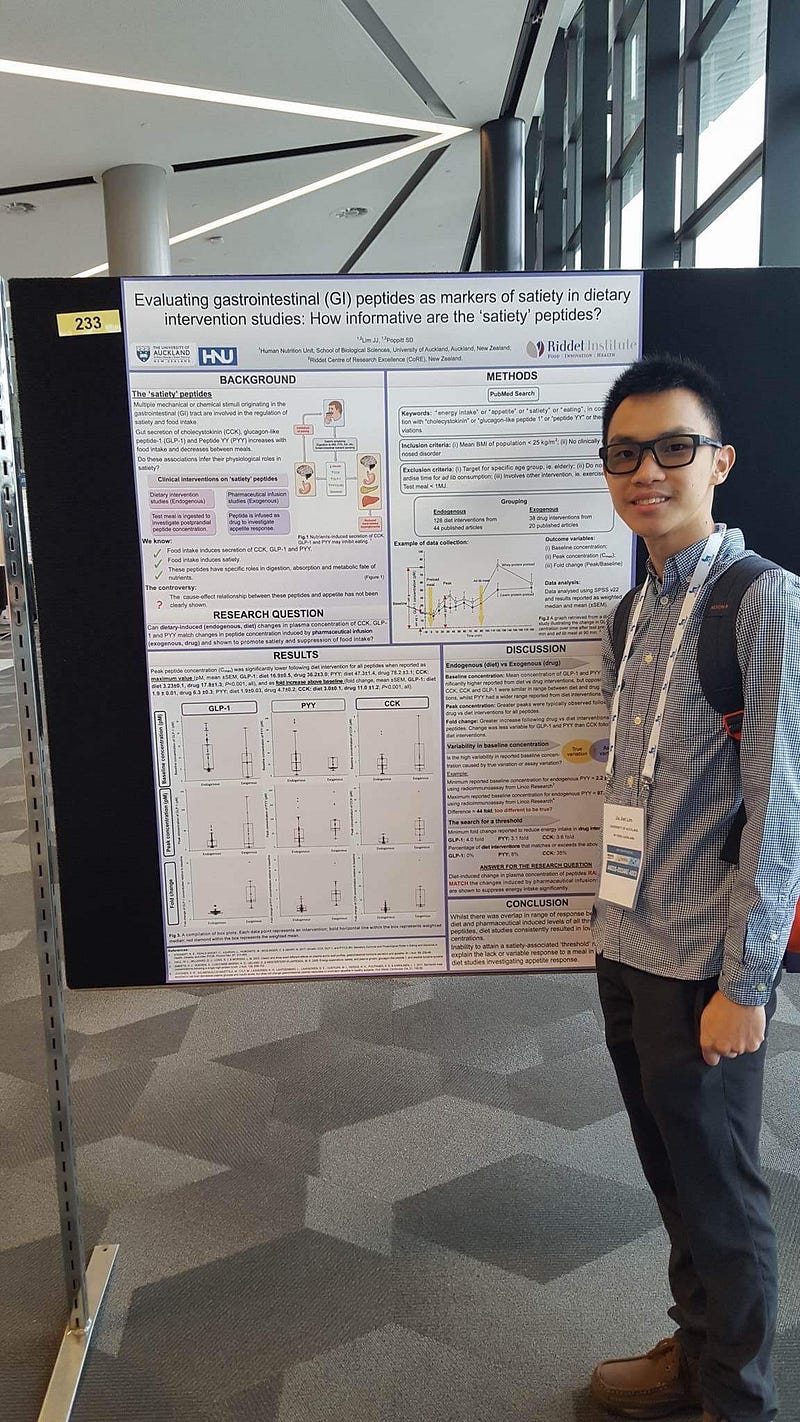
During the early months of my studies, I had to do my research while studying for the English course and complete assignments like an undergrad student. In my first six months, I completed a draft for my literature review, which was subsequently presented at the Australian and New Zealand Obesity Society (ANZOS) annual conference 2017. I claimed it as a great achievement. Nevertheless, a literature review is the most boring part of a PhD, yet it is essential to form a solid foundation for my understanding of the entire project. The most difficult part of a literature review is how to easily recall the required information after reading hundreds of articles. I wished I had more guidance back then.
Then, I conducted an acute intervention study during the second part of Year 1. This study was a joint study along with another PhD student within the same research unit. Hence, I was quite lucky that I am able to complete one literature review and one acute intervention study at the end of Year 1. I don’t think many PhD students are able to complete this. Since our research unit was very established and experienced in conducting such an intervention study, hence completing this study was a gentle breeze. The completion of the intervention study was also with the help of several very helpful interns at the research unit. There was really, plentiful of help. I really have to emphasise the help I received as it would take a longer time to complete without them.
Meanwhile, I also received training in blood biomarkers measurement at a laboratory and also attending several key workshops organised by the university, including:
- A literature review workshop on how to efficiently use various search engines to look up scientific publications.
- A data management workshop on how to organise big data in an Excel spreadsheet.
- A statistics workshop on how to efficiently perform statistical analysis using the SPSS software.
- A thesis formatting workshop on how to construct your thesis draft using Microsoft Word function.
These skills that I learned would prepare me for the next few years of doctoral studies. At that point in time, I was almost certain that I could complete my thesis within 3 years.
A Slow Year 2
I started my Year 2 with the excitement to input all data into an Excel spreadsheet. Believe me, I was amazed by how different people responded differently to the same treatment. If you have a background in Biological Science or Medical Science, this wouldn’t surprise you. It is common to compile all quantitative data into a single master Excel spreadsheet for statistical analysis. Although data entry appeared to be a simple task, it actually took me a while to figure out the best way to have all data in a single master spreadsheet due to the large number of data collected at multiple time points following three different experimental treatments. I modified the Excel spreadsheet several times along the way until I attain a final master spreadsheet. I did not receive any guidance in this data entry, but I’m fine with it, as it is a part of a self-learning process.
Concurrently, I measured blood biomarkers at the laboratory. Since I am a hands-on person, each progress towards the completion of biomarker measurements was stimulating. Inside my head, “I knew there were only 1000 blood samples, and I have measured 200 blood samples, which was 20% towards completion!” This was in contrast to thesis writing, in which I thought, “How far am I towards completion? It could have no end.”
After having all the data required, I did some simple statistical analysis and came up with some key preliminary findings that answered my research hypotheses. I thought I did a great job! Also, I won 3rd place in the poster presentation competition organised by the School of Biological Sciences!
Then, I was supposed to develop a study protocol for a longer-term weight-loss intervention study. Remember I received plentiful guidance in the study design during the acute intervention study? Unfortunately, I did not receive as much guidance in the design of this study.
To complicate things, I was trained as a nutritionist, whereas delivering a weight-loss program is more of a dietitian’s expertise. If case you didn’t know, nutritionists are trained to understand the science behind weight-loss, but dietitians are trained to deliver a weight-loss regime, face-to-face. As such, I had to receive practical training from a Registered Dietitian. Due to my lack of prior experience in this area, I spent about 6 months developing the protocol and learned along the way, with the most challenging part being delivering dietary advice, consultations, and monitoring of participants’ compliance.
My supervisor and I decided to deliver a partial diet replacement as a dietary regime to induce weight-loss, using commercially available meal replacements. However, the negotiation process between us and the meal replacement company took us additional 2 months to come to an agreement because there were certain details that both sides could not agree upon, as well as some miscommunications and constrained by the research budget.
At the end of Year 2, it didn’t seem like I achieved as much as my Year 1. I believe if I were given more guidance in the developing of the study protocol for the weight-loss study, I would not have spent that much time. Yet, I learned technical skills that could not be written on the thesis. By now, I am almost certain that I would not complete my thesis in 3 years.
A Stormy Year 3
From Feb 2019 till Dec 2019, I coordinated the weight-loss study. I had to deal with participants almost every day, either face-to-face, by email or by phone. During this time, there was no time for reading and writing. My diaries were filled with appointments. Very often, I had to call participants to assess if they were able to follow the diet, or if they faced any problems, and tried my best to provide guidance in the best interest of the study as well as their well-being. Since this was a scientific study, I had to ensure participants follow the procedure as much as they could, therefore maintaining frequent contact with participants was an important task.
I could not say I coordinated the study perfectly as I was under the pressure to complete the study within this year. For example, I could give each participant more attention if I had more time or if our research team had more research staff. There were also interns working on this study. To ensure the quality of research, I also had to monitor the interns’ performance.
I could say Year 3 had some of the busiest moment throughout my studies. I felt so relieved when the data of the final participant was collected, just in time to have a good but ‘fake’ Christmas break, just because I had to resume writing a large part of my thesis.
Write At Home Year 4
Year 4 was 2020 when the COVID 19 pandemic started to affect New Zealand and the world. The blood measurement of the weight-loss study was halted due to the nationwide lockdown. But I was able to get it done when the lockdown had eased.
2020 was also the year I started to write on Medium because I thought that I could use this opportunity to improve my writings and put my thoughts together by writing them out. Of course, not all articles I posted on Medium were related to my studies. Several months later, I stopped writing on Medium due to “writing fatigue”. I then concentrated on my thesis writing and spent more time with my partner.
I was grateful that I had most of the articles saved on my working computer since Year 1 so that I didn’t have to do a lot of article search while I was writing my results and discussions. I was also grateful that I had a good understanding of statistical methods so that I did not rely on the statistician too much. I encourage all students to take statistics course seriously if you ever wish to pursue a research career, it is an invaluable tool.
26 Feb 2021, I finally submitted my thesis for examination. I spent months editing my English language so that the language could help the thesis sound convincing. Whilst thesis submission was a significant milestone, the examination is there for a reason, to judge and to critique the work of a PhD student. Certainly, I will be prepared for it. Having submitted a PhD thesis also meant that I had to look for a job soon. There will be about 6 months between initial thesis submission and post-viva final submission. 6 months for job search isn’t very long, I’d better start looking now. The first step was to update my LinkedIn, which I’ve just completed. Feel free to connect with me here if you wish to have further conversation with me regarding my doctoral studies.
It is very important to understand that the nature of a doctoral study is different between subjects.
Finally, my PhD progress is intended as a reference for you. I could not say my progress is good or bad because you cannot compare the progress of one student to another. For example, those who do not run a longer-term intervention study may complete their data collection sooner than I do. However, they might need to get more data in another way, such as by doing more lab work, more statistical analysis, or even conduct another acute clinical trial. I also know some PhD students who reported up to 6 clinical trials during their studies. However, those studies are joint studies with several other PhD students. Therefore, their hands-on burden on study design and data collection is shared amongst themselves. Occasionally, some students just used existing blood samples or data that were collected several years back, because now the research group has the funding to perform exploratory analysis which was not initially planned.


