
A Reclining Buddha
Rests in a parking lot.
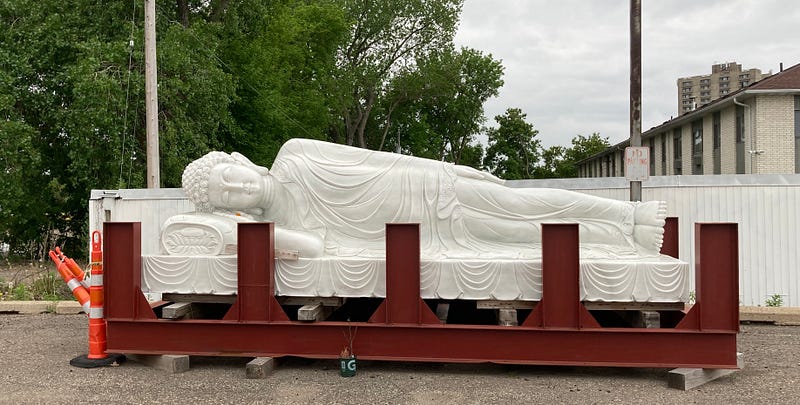
There is a new immigrant in town.
A white marble statue of the Buddha. I wouldn’t have seen it if the usual freeway exit ramp weren’t closed.
We were heading home after some yard work at the old house where my son lives, when a huge blur of white caught my attention. My husband turned the car around so I could investigate. We drove down a short residential street which was an oasis of bright azaleas, tulips, and creeping phlox and pulled up near the parking lot where the statue rests.
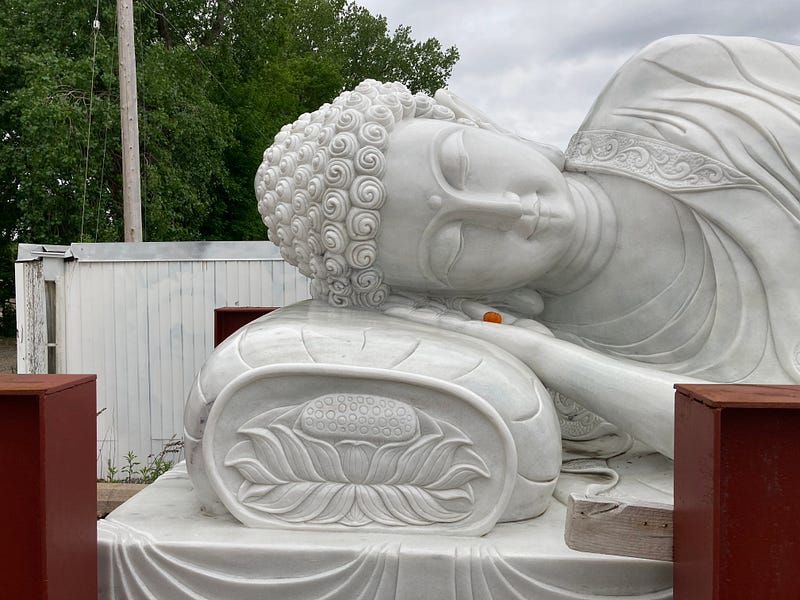
I dashed out of the car to get a closer look. I know nothing about Buddha statues, but here was this serene figure with a clementine resting in his palm. A garden pot filled with burned incense sticks sits on the asphalt.
Why is this marble statue outside?
The building it rests beside is on it’s third incarnation. Forty years ago it was a sporting goods store filled with guns. For another decade it was a uniform store filled with medical scrubs. The building is on a hill next to the city works department.
Now it is a Vietnamese-American Buddhist Temple. Derelict properties often get turned into churches, mosques, or temples. The city would prefer the taxes, but it is better than an empty building that they have to maintain.
The statue looks much too big to get in the front doors, but I’m not an engineer. There must be a plan I don’t know about. Maybe that’s why its in the parking lot?
My day of devotion
A week later, I made a special trip to the Buddha after dropping off fresh food for my son. The nearby businesses were closed due to the protests over George Floyd. I had bought some clementines, but kept two for the Buddha. I found a penny in his palm. I put my two oranges there, in case someone stopping by needs refreshment.
Later, I peered inside the glass doors of the temple and saw seated Buddha statues set around the perimeter. I could call the phone number posted on the front door, but I’m not sure what I would ask.
Honestly, I prefer to wonder.
The Reclining Buddha
I had no idea what a Reclining Buddha signified so I looked it up. It represents the historical Buddha during his last illness, when he is about to enter (parinirvana) to a higher place where he will not be reborn. After Buddha’s death, his followers decided to build a statue of him lying down.
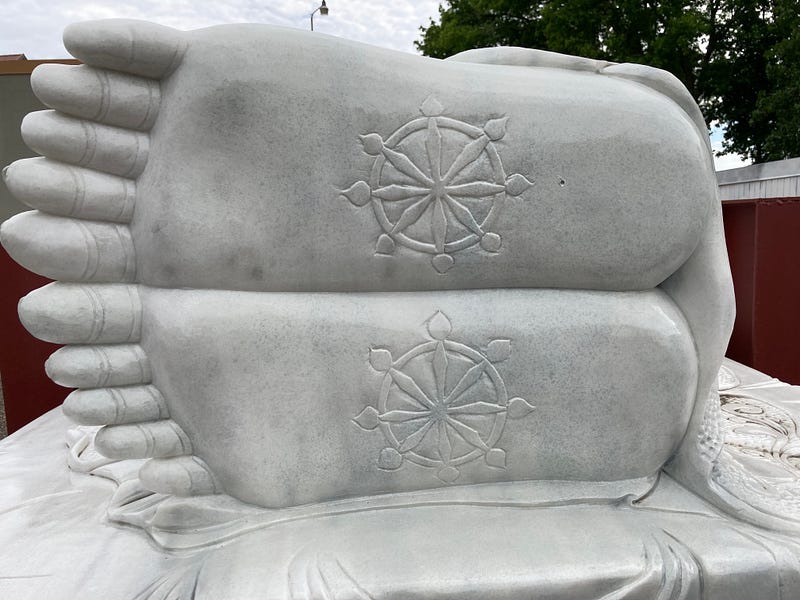
I didn’t recognize the symbol on the Buddha’s feet either. It is a dharma wheel.
Since the statue is on a hill near a bridge, I imagine that if the Buddha were upright, he would have a clear view of the many church steeples that pierce the landscape of the neighborhood below. Even more church groups occupy the 19th century corner grocery stores. The economic renewal to this poor community comes in tiny hiccups. When it stalls, spiritual communities fill the gap.
The Happy Prince
The image of the statue standing, reminded me of Oscar Wilde’s story The Happy Prince. I was in the 5th grade, when an elderly nun left the cloister at Convent of the Visitation to read the story to our class. She never explained why, but we sat on the library floor in our drab navy uniforms listening to her read. (You can read the story here.)
It is the story of a swallow who takes refuge at the golden statue’s feet, but is woken up by the prince’s tears. He is so high up he can see the poverty that he didn’t know existed. Since he cannot move, he asks the swallow to help him relieve the suffering he sees. The first task is to give an orange to a child suffering from fever.
Thirty years later, my mother gave me the fairy tale collection for Christmas. I burst into tears as I recalled the memory. She had me read the tale to her like we used to do before I started school.
The first time I began to read, I was in my mother’s lap. She read to me during the afternoons. I liked to listen to her voice buzz as I rested my head on her chest. I remember seeing the word “to” and saying it out loud. It was a shared moment. She then pointed to other words and let me sound out the rest. It was late spring outside.
Now, I make excuses to drive by and check on the Buddha. It seems improbable, but faith and devotion can spring up overnight like weeds coming through the asphalt.
The first two photos were taken on Friday, May 22nd, 2020 and the 2nd two on June 4th, 2020 after his first funeral. George Floyd died on Monday, May 25th, 2020.
(6/16/20 Update: I contacted the temple and shared the story. They have been closed because of COVID19 and have funding problems for the next phase. They have invited me to join them on Sundays when they reopen.)
Thanks to Aikya Param