
She Had Her Dream Baby Thanks to My Mom and the Wonder of Traditional Chinese Medicine
A recent encounter prompted this sharing
While attending a friend’s wedding recently, I ran into Mrs. H, whom I haven’t seen for about twenty years. During our chat, she happily showed me a couple of pictures of her son from her cell phone, indeed a handsome boy.
Mrs. H asked me to pass on her gratitude again to my mom, who helped her to accomplish her dream to have this child. She also told me that later on, she was able to help out some patients with similar situations.
The story goes back 20 years.
Mom was visiting us from China at that time. Mrs. H, a TCM practitioner herself, lived in the same town but we didn’t know each other. Through a random event, she happened to find out that Mom is a professor/doctor specializing in gynecology of Chinese Medicine, and reached out for help. She very much wanted to have a baby near the age of forty but had difficulty conceiving. Even with IVF, there was still no luck.
Mom prescribed herbal medicine for her and offered comforting words. She also gave Mrs. H a couple of lectures on TCM gynecology upon her request, delivered from our family dining table.
After taking herbal medicine for some time, much to her delight, Mrs. H was able to get pregnant.
The boy is now in college.
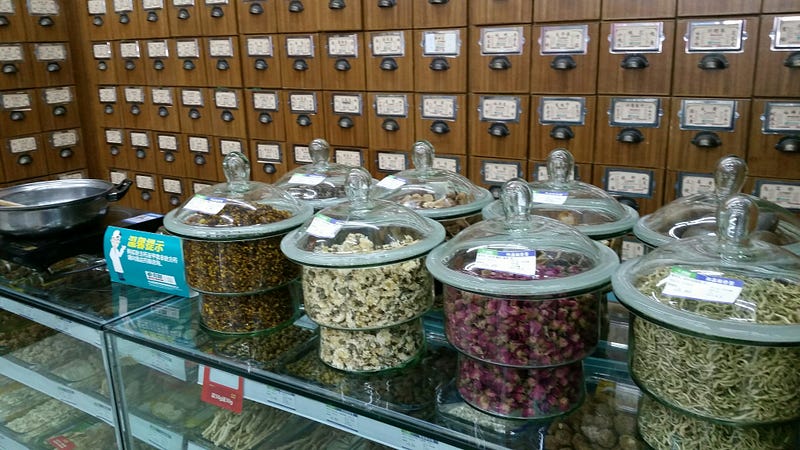
TCM, which originated from Taoism and the philosophical concept of Yin Yang, was established in ancient times and documented in medical classics more than 2000 years ago. While acupuncture has gained much popularity in the US and other parts of the world, herbal medicine is the mainstream of TCM in China.
It’s also something I grew up with. I remember when I was a kid, whenever I was sick, I would prefer to drink herbal medicine soup, despite its bitter taste. Here comes a confession: I was simply afraid of getting shots, and also not comfortable with swallowing pills.
There is the very first Chinese herbal classic called 《神农本草经》, or Shennong’s Materia Medica Classic, written in the Han dynasty between 202 BC-220 AD, one of the four TCM classics. It described 365 substances, divided into three classes i.e. Superior (上品), Middle (中品), and Low (下品), based on their function to human health and disease care. Essentially, 120上品 herbs such as ginseng, dates, and goji berry, are considered beneficial to human health and can be taken routinely with little restriction, 120 中品 can be used as supplements to strengthen health as well as to treat illness however may not be suitable for long term consumption, while 125 下品 herbs have strong medical functions and need to be prescribed with great caution.
A typical TCM prescription involves ten plus minus herbs. While there are over three hundred commonly used herbs, the total amount to choose from has expanded beyond one thousand along the way. As shown in 《本草纲目》, or Compendium of Materia Medica, an encyclopedic book of Chinese herbology by Li Shizhen, which was published in the 16th century during the Ming dynasty, the recorded substance was already close to two thousand.
Also, it is worth noting that the characteristics or the function of some herbs can be modified through processing and treatment called 炮制 (páozhì), such as stem, roast, bake, etc. It’s a subset of herbal medicine and also a course offered in TCM colleges. For example, when ginger is roasted in fire, its Warm nature becomes stronger and changes to Hot. Warm or Hot here is not referring to the physical temperature of the substance, but rather its effect on the body’s function. Besides Warm and Hot, Cold and Cool are on the opposite spectrum of nature for herbs (as well as food in TCM), while Neutral can be considered the 5th category. In the processing of herbs, sometimes additional substances can be added as well including seasoning, wine, etc to further reinforce the therapeutic effect.
As we can imagine, there would be so many varieties when it comes to herbal prescriptions, with different combinations and doses. Following guiding principles established in medical classics, TCM doctors could construct a health profile of a patient based on multiple signals collected during diagnosis, then design a prescription with different herbs to collaboratively work together for treatment and healing. It is also somewhat subjective though, when it comes to diagnosis and prescription, as it strongly relies on the skill and practice of the TCM doctor.
Thankfully, there are certain classic prescriptions by medical sages that were validated through generational clinical practice, which can be adapted and tailored to the individual patient. It is quite common for TCM doctors to recommend a revisit in a week for new patients and about two weeks for established patients. The prescription can then be modified based on the progression of the patient’s symptoms. Certainly a very personalized approach.
Thanks to this recent encounter and the encouragement from Mrs. H, I am sharing this piece, a reminder of the wonder of TCM.
Thank you for reading. I write about culture, work-life learning, and the ancient wisdom of Traditional Chinese Medicine for better living. Click here if you would like to be notified when I publish.


