
A Quick Guide to Citing Properly on Medium
Here are ways in which you can add references to your online articles.
If you are anything like me, you know that writing can be hard, and generating ideas can be harder. It is okay to do your research for ideas and sometimes draw from them. But if your article includes someone else’s idea (as-is or paraphrased), and you have not acknowledged their work, it is not only morally or ethically wrong, but it is also stealing!
If you don’t attribute the content of your writing appropriately, you and your articles can have severe consequences, not just on Medium, but on the Google search engine too.
When you “cite” something in a text, you are identifying the source. In a way, you let the reader know that you are drawing on someone else’s ideas. You can either provide a link to the citation or connect the citation to a “reference” list. Not citing someone else’s work leads to “plagiarism.” Plagiarism is taking other’s work and passing them off as your own intentionally or unintentionally. It is a severe offense against the original author, and they can take action against your article. Therefore, critical to your writing journey is referencing; remember to cite everywhere required!
Here’s what Medium says about plagiarism:
“Medium defines plagiarism as any act of taking the words and/or ideas of others and presenting them as original or without proper acknowledgement or permission. This includes directly copying ideas and text (whether entire articles, paragraphs, or sentences), as well as paraphrasing and slight re-writes (often known as “mosaic plagiarism”), and failure to cite sources….
…Detected instances of plagiarism on Medium may result in suspension of posts or accounts, and having Partner Program payments withheld.”
As a rule of thumb, you should cite numbers, images, sentences, phrases — basically anything that you have directly and consciously referred to in another source. And yes, even if you use numbers from a source and have done some analysis on your own, you must cite it.
Importantly, if you’re taking a phrase or a sentence as-is from a different article, put it in quotations and reference it. If you are paraphrasing, you need not put it in quotes, but the phrase or sentence still should be attributed to the source article. If what you write is common knowledge and easily searchable, and you have written the text in your own words, you don’t have to cite it.
It is, in some ways, easier to cite in academic writings. Writers can choose from some commonly used styles, such as APA, MLA, and Chicago, based on the writing theme and audience. All the citation formats have precise and concrete guidelines on how to cite a digital source, non-digital source, full stops, commas, italicized words, font size, etc.
On the other hand, there are no fixed protocols for citing sources in non-academic writing such as blogs and stories. Therefore it can get confusing and sometimes frustrating. So here’s a quick guide to show you some methods for adding references.
Citing in non-academic writings.
The goal of all citing and referencing formats is that the reader should be able to find the original source easily. You can achieve this goal either by using any academic referencing formats or using other ways to direct the reader appropriately.
Here are three methods I follow or have come across, and the pros and cons I see with them.
1. One of the most common methods of citing on a blog or online article is hyperlinking the phrase or the word. On Medium, you highlight the word, right-click, and click on the link button, add the link, and hit enter.
Caution: Before you move on, check if the link is taking you to the right page.
I often struggle with whether I should hyperlink the entire sentence or just one word. See an example from one of my articles:
She later told Mr. Dumont, “No, I did not run away; I walked away by day-light, and all because you had promised me a year of my time.”
In this example, I could have either highlighted the word “told” or the entire sentence within the quotations. Some may prefer one over the other. That’s your call. Just make your best judgment.
Pros:
- The author can easily direct the reader to a specific source.
- It is easier to reference numbers or data to a particular source.
Cons:
- Websites and content in them can change, and you have no control over it.
- The reader cannot tell if the link is a reference for further/additional reading or if it is meant to direct the reader to the source of a particular sentence or idea.
- If you have more than one reference to a sentence, it is not easy to provide multiple links.
- The source must have an online website.
- I have heard of instances where hyperlinks distract readers. When readers see a hyperlink, they may click it and start exploring the source website. Eventually, they may lose track of time and your article.
2. This method is similar to how Wikipedia references sources. You can add a number as superscript in the text. Next, at the end of the article, reference the number to the specific source.
On Medium, to add a superscript, use ^ before the number. For example, when you type “power ^ 1”, it gives you “power¹.” Unfortunately, you cannot add footnotes automatically on Medium.
But, you can manually add your reference list at the end of your text by adding the number, the corresponding author’s name, journal, and article, and hyperlinking the article (if it is available online). See example below:
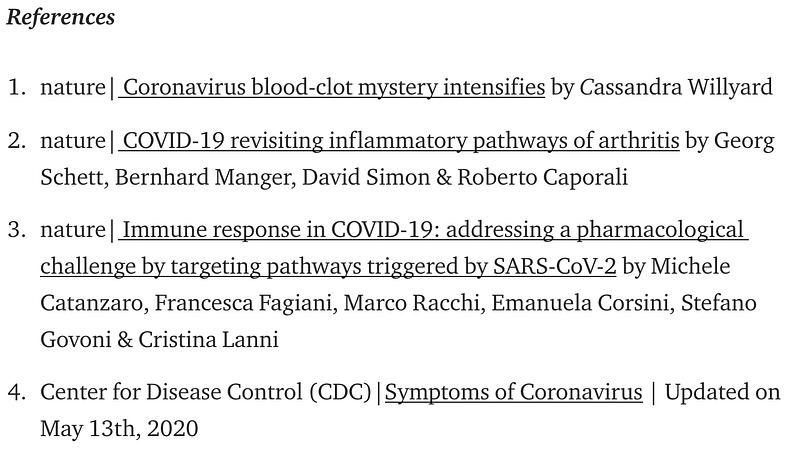
Providing a journal name and author legitimizes your writing. Additionally, you can give the date of publication, or the date you viewed it. Adding the date you viewed an article tells the reader that you may not be aware of current changes or updates on the website.
Whatever format you use, be consistent in the entire article.
On Medium, if you want to get fancy, you can create a code block for your reference list by typing triple backticks, i.e., ``` in a new line. You can then type-in reference numbers and corresponding citations. See example below:
References1. nature| Coronavirus blood-clot mystery intensifies by Cassandra Willyard
2. nature| COVID-19 revisiting inflammatory pathways of arthritis by Georg Schett, Bernhard Manger, David Simon & Roberto Caporali
3. nature| Immune response in COVID-19: addressing a pharmacological challenge by targeting pathways triggered by SARS-CoV-2 by Michele Catanzaro, Francesca Fagiani, Marco Racchi, Emanuela Corsini, Stefano Govoni & Cristina Lanni
4. Center for Disease Control (CDC)|Symptoms of Coronavirus | Updated on May 13th, 2020Caution: To avoid error, I suggest adding reference simultaneously when you add the superscript.
Pros
- The reader will not get distracted with hyperlinks.
- It gives a more formal feel to the article.
- It feels neater to have all the references listed in one place.
Cons
- Some readers may find it intimidating to read articles that have a superscript and a reference list at the end.
- You have to add to the reference list while writing the article and check and update the numbers as you keep editing the draft. Or else, you may interchange the numbers and links.
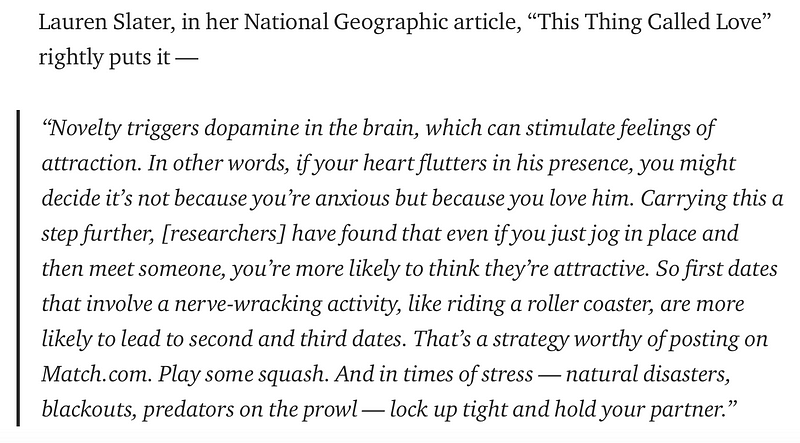
3. This method is not very different from the first one. While referencing, you can state the name of the author, the name of the article (hyperlink the article if it is available online), and quote or paraphrase. See example:
Pros:
- You are directly attributing the quote or the sentence to the author, as said in a particular article.
- This method is more helpful if you do not have an online link to the article.
Cons:
- The story may look wordy if you have many such references.
- Suppose the author of the source article has interviewed another person and is quoting their response in the article, citing can get lengthy.
There may be other ways to reference someone else’s work. Whatever method you choose, keep it consistent throughout your article.
Useful tip: I have seen writers reference some interesting articles in a separate section called “Further Reading.” In my opinion, this section adds to the article’s credibility as it tells me that the author has done their research and wants readers to expand their knowledge.
“When you have wit of your own, it’s a pleasure to credit other people for theirs.” ― Criss Jami in Killosophy
If you have referred to other articles, crediting them in your piece should be one of the most critical steps in your writing journey. I hope you see value in citing other authors, and I hope this guide helps you with adding references to your articles.
Further ReadingPlagiarists on Medium, Fyi. by Linda Caroll
My Stolen Medium Article by Edward Iftody


