
A Quick Experiment on How Medium Determines Your Earnings
I’m a professional writer, but a Medium noob. The claims that people make about earning “thousands of dollars” writing for Medium have always made me chuckle. They usually start with “build your follower base until you have several thousand,” as if that can be done overnight, and as if those months shouldn’t be counted when describing your earnings.
But then I got bored in Covid lockdown, bought a Medium subscription with all the coffeeshop money I’ve been saving, and got interested in how earnings work.
I don’t like the lack of transparency, and have gotten disturbed by how little writers actually know about how they get paid on this site.
So I ran this quick, unscientific experiment to test some of the rumors that other writers have floated around about earning on Medium.
How People Think Medium Pays Them
Between some of these “I Made XXX Dollars Writing for Medium, Bow to Me and Lick My Shoes” articles, Medium’s own official pages, and various discussion boards about Medium’s payment system, I’ve picked up several hypotheses about how much you earn for an article:
- You earn when Medium members read, not when non-members read
- Reading time is important
- External links are meaningless
- Earnings increase exponentially by view (for example, readers 1–100 will net your article a little, readers 101–200 bring more money per view, while 201–300 will earn even more, etc.)
I’ve also heard that “claps” are either (a) very important, (b) not important at all, or (c) the “wrong metric” to look at (“it’s fans that matter”).
One of my articles was published, curated, and received well enough that I thought I could put Hypothesis 4 to the test.
My Experiment
This is the article:
It was published on November 10, got 64 views right away, then 124 views on the 11th, was shared on Twitter by Medium’s Head of Curation (to almost no effect), and hemorrhaged readers on a quick decline into the pit of despair.
Such is the life of political articles on Medium.
On the evening of Nov. 14, I put my experiment into action.
In one of those Facebook groups for Medium writers, I did the Medium Quid Pro Quo: I dropped a link to my article, told people to drop links to theirs, and promised to read the first 20. Then, I was going to compare the rate of the earnings that I got from their traffic (they would be views 271 et seq.) to the rate of the earnings that I got from earlier traffic.
If Hypothesis 4 were true, then I would get more earnings, per person, in the 24-or-so hours after my little quid pro quo than I got, per person, during the article’s first hours of life.
Indirectly, the experiment would also test Hypotheses 1–3: This was an external link from Facebook, so would Medium members coming from off-platform still produce earnings for Yours Truly? How tightly connected were my earnings from their traffic going to be to the Member Reading Time metric that Medium so enjoys trumpeting in my stats?
Primary Result: Earnings-Per-Reader Do Not Seem to Increase Exponentially
Here’s the money shot (in this case, quite literally):
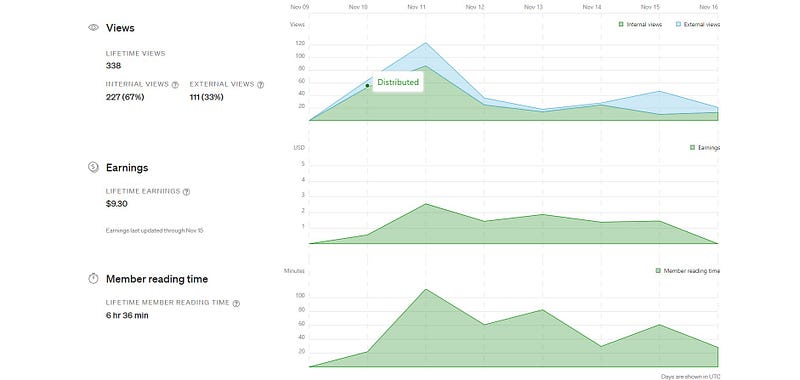
You can see the experiment at work on November 15. The blue line of external views rises without a corresponding rise in the green line of internal views. That’s the traffic coming from Facebook, largely through my quid pro quo post. On Nov. 15, during the experiment, the article got 47 total views —views number 271 through 318. Of these, 10 of them were internal, and 37 external, nearly all from Facebook.
Altogether, those views earned me $1.46, or 3.1 cents per view.
I compare that with the per-view earnings I got in the article’s earlier days and get:
- Nov. 10: 64 views (these were view #s 1–64) (53 internal / 11 external) for $0.57 = 0.89 cents per view (yes, that’s less than a penny per reader)
- Nov. 11: 124 views (65–188) (87 internal / 37 external) for $2.56 = 2.0 cents per view
- Nov. 12: 36 views (189–224) (25 / 11) for $1.44 = 4.0 cents per view
- Nov. 13: 18 views (225–242) (14 / 2) for $1.88 = 10.4 cents per view
- Nov. 14: 28 views (243–270) (25 / 3) for $1.39 = 5.0 cents per view
Early on, Hypothesis 4 was looking to be true — the earnings-per-view metric was going up exponentially. Then came Nov. 14, the day before my experiment, when that exponential rise disappeared. Then on Nov. 15 it continued to decline:
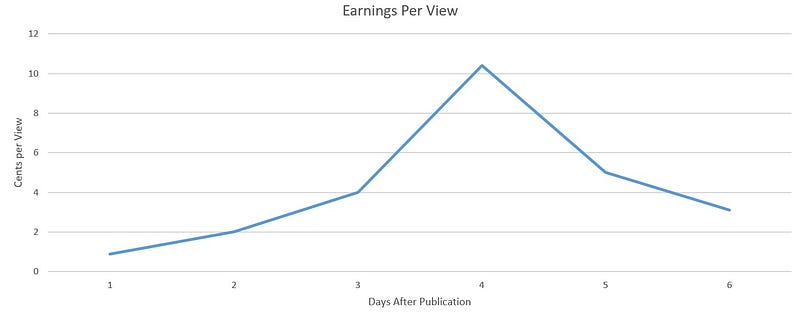
It appears that Hypothesis 4 — that earnings-per-reader increase exponentially — does not hold up.
“But wait!” you may ask. “Your experiment captured external readers. That’s what tanked your earnings per reader!”
Not so. My experiment was the sixth day after publication. On the fifth day after publication, the earnings-per-reader dropped precipitously, and 25 of those 28 views were internal.
Collateral Results: Member Traffic from External Links and Member Reading Time
I had predicted that the experiment would also produce data that could challenge or support other claims about how Medium pays its writers. In particular:
- Member reading time is a factor in earnings
- Reads that come from external links are meaningless
- You only earn when Medium members read
There definitely seems to be something to the importance of member reading time. In the graphs provided by Medium in your stats, the rise and fall of earnings for an article correlates to the rise and fall of member reading time. To wit, for my article:
- Nov. 10: $0.57 for 21 minutes (2.7 cents per minute (CPM))
- Nov. 11: $2.56 for 112 minutes (2.3 CPM)
- Nov. 12: $1.44 for 60 minutes (2.4 CPM)
- Nov. 13: $1.88 for 82 minutes (2.3 CPM)
- Nov. 14: $1.39 for 29 minutes (4.8 CPM)
- Nov. 15: $1.46 for 61 minutes (2.4 CPM)
There’s definitely a trend, though there is also definitely an anomaly.
As for the value of reads that come through external links, they seem to be the same, as long as the reader is a Medium member.
On Nov. 15, I flipped the script for this article and pulled 79% of my 47 readers from external sources. However, I still got 61 minutes of member reading time, so many of these readers were members, not internet randos. The result: Those external-heavy 47 views earned me nearly the exact same as the internal-heavy 36 views that I got on Nov. 12.
Is there a difference? Yes. Is it huge? No.
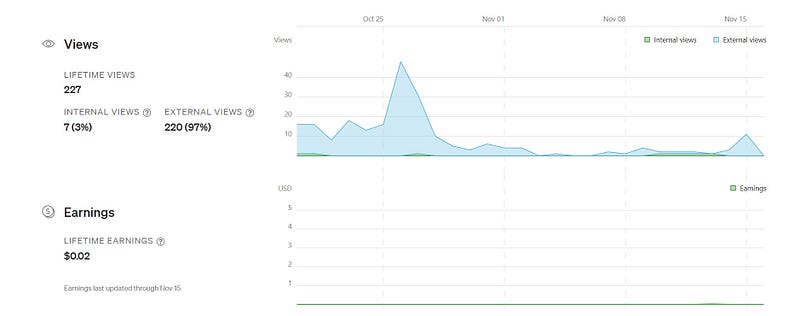
It’s a completely different story when the external views come from non-members. I self-published this article and hustled it on social media:
I picked up plenty of clicks, but nearly all from non-members. As a result, I made two whole cents, and only when a few people stumbled on it while dredging through the Medium platform:
Takeaways
It’s important to stress the limited size of this study: It only focused on a single article. However, the big takeaway seems to be this:
You get paid when MEMBERS read, seemingly even if they reach your article from external sources
Which is good, because this is actionable. Having done this study, I’m not going to go out of my way to tout my Medium articles on my social media pages, anymore. When I put them up on my Facebook page, my friends read them. They’re not members, so I don’t earn for that, so, professionally speaking, it’s a waste of my time.
Which is a shame, for Medium as a business. They’ll lose traffic. Both of my Twitter followers are very devoted.