
A Question of Privilege
How privileged am I?
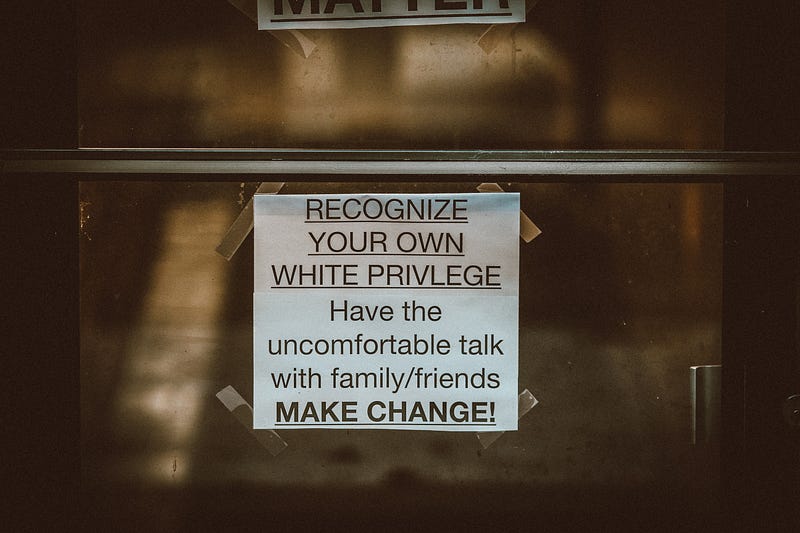
I live in the fairly conservative American Midwest, but signs like the one above have cropped up on my social media feeds and occasionally on a sign posted here and there in a big city nearby. This got me thinking.
How privileged am I?
All throughout human history some people were more privileged than others. They were brighter, ran faster, had more creative minds. Privilege is often seen in terms of economics and personal wealth. Was/am I privileged economically?
Economic Privilege
My parent were quite wealthy, but they escaped East Germany in 1961 with nothing and built a good life for themselves and us children by pursuing education and applying their work ethic. They loved to travel and used a considerable part of their income to do that.
Often we kids tagged along. By the time I was 15, I had already seen most of Europe and parts of Africa. Yes, I felt privileged to be able to see so much of the world, but I also saw my parents make choices.
The new Mercedes and all the options they had so carefully selected became an unwise purchase when my parents decided to build a house. I still see my parents around the kitchen table when they, with some sadness, decided not to order the car. I also saw a degree of frugality and the wise use of money that I would emulate later.
I was certainly privileged to have parents who were strategic with their money and who valued education. We children could pursue the education we wanted, and my parents were also fully supportive of my gap year.
So, yes, I had some economic privilege and am still in the position now. My average (not median) net worth puts me in the top 20% of all Americans. However, I achieved this based on my salary as a teacher. I achieved this because I am frugal and was/am strategic with my money.
Wealth can be a privilege, but no one in my family was ever wealthy enough to have this corrupt them or had money just handed to them.
Gender Privilege
When I grew up in Germany, I never felt that I was considered in any way less than my male peers. I was born intelligent and did very well in German prep school (Gymasium) and college. I assume intelligence is a privilege, but just like economic privilege, it takes work ethic to succeed.
However, there is definitely a certain male privilege. I was not aware of that early on, but when I traveled the Middle East, I became very aware how much easier and safer traveling was as a man. Later in my professional life, I never personally encountered the infamous glass ceiling, but I know it still exists.
Males may still enjoy some historical privileges, but to be male is also (in some ways) a disadvantage. Males are more likely to be both perpetrators and victims of crime, and academic success looks more and more female. Men struggle with gender roles just as much as women do or perhaps more so.
The most eye opening conversation I had on the topic of gender, however, was decades ago with a friend who considers himself a transvestite.
He said then that he was a normal, rational person with a mild mental illness. He was a man who felt like a woman. For 40 years he had kept that hidden, got married, and had children. The situation for trans people was certainly very different then.
He never insisted on pronouns. After all, you cannot determine how other people see you. That is up to them. His sons still called him “dad” and refer to “him” as a male person — as do his friends (like me) from the old days. He was thrilled though when he was at a conference where no one new his history and someone directed him to the woman’s restroom. He had achieved his goal then.
When I asked him about the difference between living as man and then as a woman, he admitted that women are certainly more vulnerable. When he was is a strange neighborhood at night, he would tuck his hair in and push out his broad shoulders. He never took hormones because he didn’t trust them and was physically in every way a man.
Even though I could relate to women being more vulnerable, it was the second difference he mentioned that really hit home with me and validated what I had felt for a long time.
He said that as a man, he could be at conference table, and if he had something to say, he would lean forward, look a person in the eye, and he would be acknowledged and would be heard.
When he attended conferences later where everyone only knew him as a woman, it was quite different. He laughed when he said, “I lean forward. I look the person in the eye. I do exactly the same things I did as a man — and I am ignored.”
I could tell how frustrating that was to him because I had felt the same frustration many times. I still remember one seminar so distinctly when I offered an idea and was ignored. Literally a minute later, a man suggested the exact same thing, and everyone approved. A young man sitting next to me looked at me and mumbled, “She just said that.” He said that in a low voice as if he was ashamed. Was he ashamed for me, or for the others because they did not hear me?
Of course, we can demand to be heard, but there is a gender difference there, too. A man who stands his ground and demands to be heard is considered assertive. A woman, however, is considered too aggressive. Perhaps that is one reason I chose education, a field still dominated by women. At least there, my voice is heard.
Privilege Based on Origin
I certainly always felt privileged to grow up in a country where women are equal according to the law. As I traveled, I realized that in many parts of the world women really have no rights at all, such as the 15-year old Egyptian girl I met in Cairo when she was married to a 40-year old.
In many parts of the world, women still have no voice at all. However, I set out to examine my own privilege. I felt that privilege most distinctly when I applied for my green card. During my interview, I definitely felt my “European privilege” since I was questioned much less that immigrants from other parts of the world.
Ironically, immigration is easier when you don’t come here as an economic or political refugee, and that is a very cruel irony.
White Privilege
The term “white privilege” implies that non-white people (especially African-Americans) face disadvantages that the privileged group does not have. I realize my personal experience with African-Americans is limited to middle class, college-educated people like me.
When an African-American colleague told me how she instructed her son, I really felt her concern of raising a black son. He was getting his driver’s license, and she instructed him on what do do when pulled over by police.
Stop the car right away, and open your car window. Raise your hands high. Say ‘Hello, officer’ and be polite. Ask if you can reach for your registration. Do not move until the police officer instructs you to.
As I listened, I realized that I never had to tell any of this to my daughter. My colleague definitely thinks there is white privilege. But she didn’t have the same concerns for her daughter either. Perhaps gender is more of an issue here.
To me the term “white privilege” is not all that useful. The real issue is that we still have too much poverty and lack of opportunity in this rich country. Many people of all races are still disadvantaged. White people in Appalachia and other poor areas in the U.S. probably don’t feel any more privileged than black people on the south side of Chicago.
Police brutality affects all races as well. While almost everyone has heard of George Floyd, very few have heard of Tony Timpa. Police officers need much more and better training, especially on de-escalation techniques.
Conclusion
In general, I think success and failure are based on too many variables to be linked to just someone’s gender or race.
So am I privileged? I would have to say that I think so. I was born with certain traits that often lead to success: I am intelligent, conscientious, and diligent. My parents’ financial situation also allowed me to be open minded through travel and education. I am European, which has opened many doors during my travels. The effect of male privilege on me has been rather minimal.
I do not go through life thinking that I am privileged, however. The word “privilege” sounds to much like something just handed to us. I have achieved what I have achieved in my life mostly based on my own efforts.
All of us are privileged in some ways and not so much in others. But what we make of our lives is up to us!