
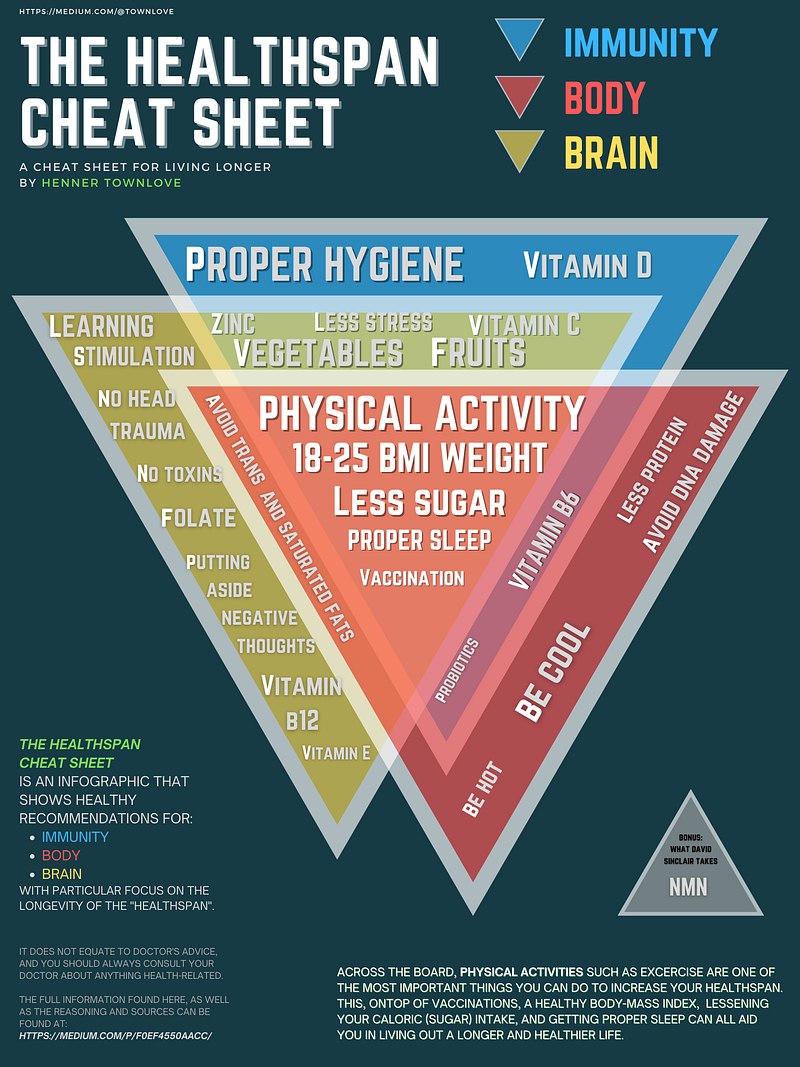
A Printable Health Cheat Sheet For Living Longer
Put it on your fridge
Longevity and the Healthspan
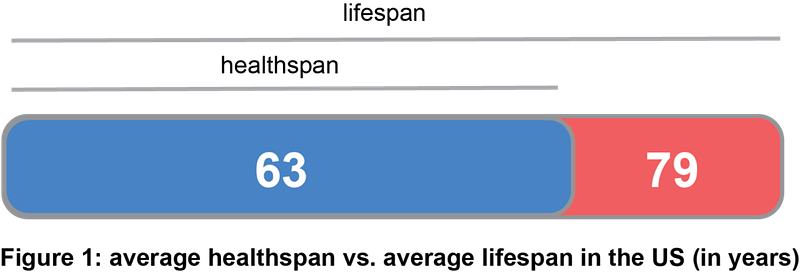
In the context of longevity, we must establish what it truly means to have a meaningful and longer life. What if you lived up to a hundred years old, yet you have been bed-ridden for the past 50 years?
This is where the concept of the Healthspan comes in. According to pathologist Matt Kaeberlein, the healthspan is the period of life spent in good health, free from the chronic diseases and disabilities of aging.
There are many things that can cause a premature death, it could be accidents, murders, pathogens, radiation, nukes, sadness, or just walking into the wrong room. It can even be argued that the universe itself wants to extinguish all life. But for the purpose of this article, I would like to focus more on improving longevity, particularly in these three key areas:
- ⚔️ Immunity
- 🧠 Brain
- 🏃 Body
My reasoning for why I grouped these three separately is because of this case of an old lady that I heard stories about. My mom worked in a retirement home and she told me stories about this old lady in her 80s. She was frail and couldn’t move pretty well. However, she had an active mind, and can recall a lot more things than the other residents do. You can converse with her as though she was 30 years younger. What’s her secret? constant reading — she said. Now, she’s passed on, but I am told that she made a contract and that her brain was to be donated to science. So, this led me to think that your brain doesn’t have to grow old even if your body does. And then I heard about DNA Methylation, it’s basically the phenomenon wherein your cells don’t produce the right proteins due to the DNA strand being suppressed, and this is what some scientists believe to be what causes aging. You can literally tell when a person will die just by looking at the amount of Methylation on their DNA. Luckily, new innovations have now been brought forth in an attempt to delay this methylation process. But what if you don’t die from aging, instead you die from viral or bacterial infections, this is where Immunity comes in. The best way to not get a disease is to prevent it. Whether it be practicing proper hygiene or taking vital nutrients, or vaccines.
Immunity

Immunity is our first and only line of defense against pathogens. According to NCBI, the immune system has the vital role of protecting our bodies from harmful substances, germs, and cell changes that could make us ill. The entire system is made up of various organs, cells and proteins. One cannot have a long lifespan, yet alone healthspan if one dies prematurely because of diseases. This is why it is essential to build habits and take in vital nutrients that can aid our own body’s defenses. This is perhaps more so important now as we deal with a global pandemic. Vaccines are an easy way to help our bodies defend themselves on a longer scale. Viral vaccines are those that contain either attenuated or an inactivated form of the virus. Our body then reacts the way it should and produces the right immune response. It is essentially target practice for our immune system. Taking in the right nutrients can also build up one’s immunity. Vitamin C can reduce inflammation which is a symptom of many viral infections. Vitamin D is also important in that it protects you from respiratory infection. It does this in a way that is similar to vitamin C, where it helps promote the production of cathelicidins and Beta-defensins. B complex vitamins such as Vitamin B6 are vital to biochemical reactions in the immune system as well as in the creation of red blood cells and neurotransmitters. These are mainly found in green vegetables, and can also be found in chickpeas. Besides vaccines, proper nutrients and vitamins, there are also other ways to improve immunity. Zinc, a mineral, is also essential in keeping the immune system strong, as well as helping heal wounds, and supports normal growth .According Harvard Medical School Health Publishing, you can significantly boost your immune system by quitting smoking, eating a diet high in fruits and vegetables, regular exercise, maintaining a healthy BMI, less alcohol, proper sleep, and proper hygiene (regular handwashing) as well as minimizing stress. These all work hand in hand in improving one’s immunity.
In summary: Vaccines, Vitamin C, D, B6, Zinc, Exercise, Fruits and vegetables, Proper weight, Proper sleep, Proper hygiene, Less stress
The Brain
To live to a hundred is one thing; however, to be mentally active, and having a healthy brain is another. Forty percent (40%) of elderly people have had some form of memory-loss by the time they reached 65. This is why Alzheimer’s and dementia are one of the worst diseases you can have. Because, in a way, it gives your life a bonus death — a death of the mind. Many families have been devastated because of this. Individuals who’ve had dementia will eventually forget loved ones, sons and daughters, basic day-to-day functions, as well as their own identity — they “die” long before their life even ends.
According to physician-psychiatrist and brain disorder specialist, Dr. Daniel Amen, there are 11 Major Risk Factors that will lead to an unhealthy brain.
- Blood Flow (lack of) — Decreasing blood flow to the brain prematurely ages it. Dr. Amen advises an increase in physical activity and exercise. Avoiding nicotine and caffeine are effective ways to increase blood flow.
- Retirement & Aging — When people retire, they begin to do less physical activities which relates to number 1. Additionally, elderly people no longer learn new information and make new memories. This is why it is advised that elderly should read a lot, create things, and make sure the brain gets stimulation.
- Inflammation — Inflammation means that there is an immune response happening and sometimes these responses damage our own cells more than any pathogen. Incorporating Omega 3 fatty acids can keep your body from over-reacting. Dr. Amen suggests using Fish oil supplements instead of actual fishes because fishes sometimes contain heavy metals. He also suggests using probiotics. Poor brain health has been linked to both low Omega 3 and Omega 6 fatty acids in the blood.
- Genetics — Sometimes risk factors are just in our DNA, however it’s our habits that turn on and off certain genes. Alzheimer’s or dementia are high genetic risk factors. If you have one or more family members with this disease, then you are more likely to inherit them. But you can decrease the risk. It is not a death sentence but instead a wake-up call. The apolipoprotein E4 (ApoE) gene dramatically increases your risk of alzheimer’s. Dr. Amen advices exercise, eating the right food, and suggests spice turmeric. Furthermore, another study found that reducing cholesterol levels also suppresses these dementia-causing genes.
- Head Trauma — NFL players often suffer from significant brain damage due to the nature of their sport. Having a decrease in physical impacts on head region can decrease the likeliness of brain damage. Dr. Amen treats these patients with exercise, vitamins, multiple vitamins, and Brain and Memory power boost supplements.
- Toxins — Substance abuse can have a significant negative effect on the brain. Dr. Amen advices no alcohol, cocaine or marijuana. He furthermore adds that smoking, Carbon monoxide, heavy metals, and mold in home that releases toxins can lead to an unhealthy build-up of toxins in the body, as well as the brain. When gasoline companies dropped lead (Pb) from their ingredients, the murder rate dropped dramatically 23 years later. Dr. Amen also advises to check beauty products such as lipsticks as they may also contain lead.
- Mental Health — Chronic stress, emotional trauma, grief, depression, bipolar disorder, A.D.D. all these can have adverse effects on your brain. Positron Emission Tomography (PET) scans comparing a brain of a normal person vs a depressed person shows less activity on the depressed person’s brain compared to the normal person. Dr. Amen recommends exercise to boost your mood, along with fish oil, as well as not feeding one’s negative thoughts and thinking positively. Cortisol — a stress hormone, is also one of the factors responsible for brain degradation, which levels can be regulated by exercise.
- Immunity — When pathogen finds their way into your body, you can count on your own immune system to combat these invaders. Vitamin C, and Zinc are important micronutrients that we needs in small quantities for the proper functioning for our immune cells. Furthermore, Vitamin C is an antioxidant that can get rid of free-radicals in your brain. Zinc has also been found to play a critical role in regulating communication between cells in the brain. Bacterial infections are also a danger, which can be treated with antibiotics.
- Neurohormone Deficiencies — Low thyroid can be improved by proper diet. Eating seaweed which is rich in iodine, as well as nuts and baked fish can help improve thyroid function. Low testosterone can also be improved by exercise and lifting weights, eating protein and vitamin D supplements. Minimizing stress can also work. Estrogen levels can also be increased by ingesting phytoestrogens present in soybeans and tofu. Progesterone can be increased naturally by maintaining a healthy body-weight ratio and reduction of stress, however it’s a balancing act between estrogen given that those two hormones sometimes counteract each other.
- Diabetes — According to Joseph C. Masdeu, MD, diabetes increases your risk of damage to blood vessels over time, including damage to the small blood vessels in the brain. Being diabetic, overweight and both can lead to nerve damage . Dr. Amen suggests to stop eating too much sugar and to maintain a 18–25 Body Mass Index (BMI).
- Sleep — According to the National Sleep Foundation, for adults, at least 7 hours of sleep is already adequate to keep your brain functioning normally as it should. Dr. Amen notes that a lack of sleep turns off blood flow to the brain.
If we are aware of these risk factors and we do something about them, only then can we have bright minds. An easy way to remember these is through the acronym mnemonics ‘BRIGHT MINDS’.
According to Neal Barnard Md, with a focus on Alzheimer’s, Beta-amyloid proteins come out of the brain cells and accumulate as plaques in the brain, and they disrupt cell to cell communication. This triggers an immune response, destroying brain cells in the process. The same APoE4 gene mentioned by Dr. Amen above that causes Alzheimer’s in a genetic level can be triggered by the consumption of saturated fats and trans fats. These fats can also contribute to heart disease and cholesterol. However, changing one’s diet can drastically cut these memory problems by 80% regardless if you have the gene or not. Unsaturated fats as an alternative can lower cholesterol levels and decrease heart diseases. Barnard also recommends Vitamin E as a cure for the accumulation of too much Metals in the brain — too much iron and copper produces free radicals. You only need a little bit of iron in order to function. Vitamin E has antioxidant properties. These are found in spinach, mangoes, nuts and seeds, avocados. However, Barnard suggests not to rely too much on supplements because they usually provide one form of the vitamin. Nuts and seeds eaten at 1 oz is already enough. He also recommends picking brightly colored fruits and vegetables as an easy way to remember healthy choices, in which he reasons the abundance of anthocyanins (blue/purple), lycopene (red), and beta carotene (orange), all of which are antioxidants. One such example are grapes and blueberries. Additionally, according to Mia Nacamulli, B12 and folic acid deficiency also equates to brain disease and mental decline. Folate can be derived from nuts and eggs.
In summary: Physical movements, Learning new things, Stimulation, Omega 3 and 6, probiotics, No head trauma, No toxins, drugs, Putting aside negative thoughts, Avoid trans and saturated fats, Vitamin B12, Folate, Vitamins C, Vitamin E (food), Zinc, Less sugar, and Adequate sleep.
Body

As your body grows or repairs itself from damage, the cells try to access your DNA. Otherwise they’d have no idea what type of proteins to build. Which is why it is important for your DNA to not have too many changes or damage. This is where the body’s epigenome comes in. The epigenome is made up of chemical compounds and proteins that can attach to DNA and direct such actions as turning genes on or off, controlling the production of proteins in particular cells. In the realms of longevity, there is this new concept called the Horvath’s clock, otherwise known as an epigenetic clock. It is a biochemical test that can be used to measure biological age. The test is based on DNA methylation levels. This clock per se can arguably tell you when you’re gonna die. You can be 30 years old, but your epigenetic clock can tell us that you are — biologically — in your 50’s. DNA methylation is a normal process that happens whenever your DNA re-wraps itself. However, as your cells try to access your DNA to produce proteins by unwrapping your genetic code, as soon as it re-wraps itself, methylation occurs, these methyl molecules in a way suppresses proper gene expressions, thus creating the wrong and dysfunctional proteins, which some scientists argue is what causes aging. Harvard University geneticist, Dr. David Sinclair proposes that the epigenome is the one that’s responsible for most of our aging woes. In Derek Muller’s Veritasium video: ‘How to Slow Aging’, he — along with Dr. Sinclair — tackles the many ways we can slow down aging and prolong our healthspan, as well as new insight into how we can even reverse it. There are many things that can cause aging, one is DNA damage. Radiation from the sun can damage one’s DNA; individuals with lighter skin are more prone. Another concept is the longevity genes, these are genes found in primitive life forms like bacteria, but are also found in humans. These genes are switched on whenever there are drastic changes in temperature and there’s a lack of food. They essentially switches an organism’s mode of living into survival, repair and protect, instead of growing and reproducing. According to Sinclair, there are three types of longevity genes: there are Sirtuins which control the information in the cells; there are AMPK (AMP-activated protein kinase), which senses how much energy we take in, in the form of sugar; and lastly, there are mTOR (mammalian target of rapamycin) which control and respond to the amount of proteins we take in. These genes turn on our general defenses against aging including increasing telomere length. These genes create enzymes that maintain the epigenome whenever there is a lack of food in the environment or whenever temperatures rise or fall too much. In summary, these are the six things you can do to slow down your aging:
- Avoid DNA damage — Wear sunscreen, avoid the sun, avoid x-rays
- Eat less — Caloric restriction can activate your AMPK genes (less sugars) →could be basis for intermittent fasting
- Eat less protein — Protein restriction can activate the mTOR gene →could also be basis for intermittent fasting
- High intensity interval training — Physical activity, do some exercise
- Be uncomfortably cold — these will activate longevity genes. Additionally, it could be the basis for the benefits of cold showers.
- Be uncomfortably hot — these will activate longevity genes
All the aforementioned, Derek says, will triggering your longevity genes, switching your body from grow and reproduce to repair and protect mode.
Dr. Sinclair then further explains that if eating less is too much, his newer experiments might prove to be promising. He was working on experiments with mice involving the molecule NMN (Nicotinamide mononucleotide) which raises NAD levels that elicit hyperactive defenses similar to the effects of longevity genes. These NMN-infused mice ran 60% further while some ran so far that it broke the treadmill. Lastly, Sinclair states that there are also ways to reverse aging, essentially switching your epigenome back to an earlier stage. He did this by injecting three of the four cell reprogramming factors discovered by Japanese Scientist Shinya Yamanaka(called Yamanaka Factors) into the eye of a blind mice that were blind through old age, what happened was their eyes reverted to a younger state and they regained their vision. This was carefully controlled as to not revert the eye too far back to a stem cell.
Sources: Veritasium
Bonus: What David Sinclair personally takes

Despite now being 50 or so years of age, David looks much younger. This may come as no surprise since he studies how to combat aging. Let’s take a look at some of his secrets.
These are what David Sinclair Takes, according to Fastlifehacks:
- Resveratrol — 1g/daily — mornings with yogurt
- Nicotinamide Mononucleotide (NMN) — 1g/daily — mornings
- Metformin (prescription drug) — 1g/daily — 0.5g in the morning & 0.5g at night — except on days when exercising
- Vitamins? Aims to get majority from diet, but does supplement a few including vitamin D & K2
- Statin (prescription drug) — taken since his early 20s due to family history of cardiovascular disease
- Aspirin — 83 mg daily
Sources and reasoning via: Fastlifehacks
Thanks for reading


