Mature Flâneur
A Prayer for Milford Sound
Will New Zealand’s Most Iconic Fjord be “Lost to Tourism?”
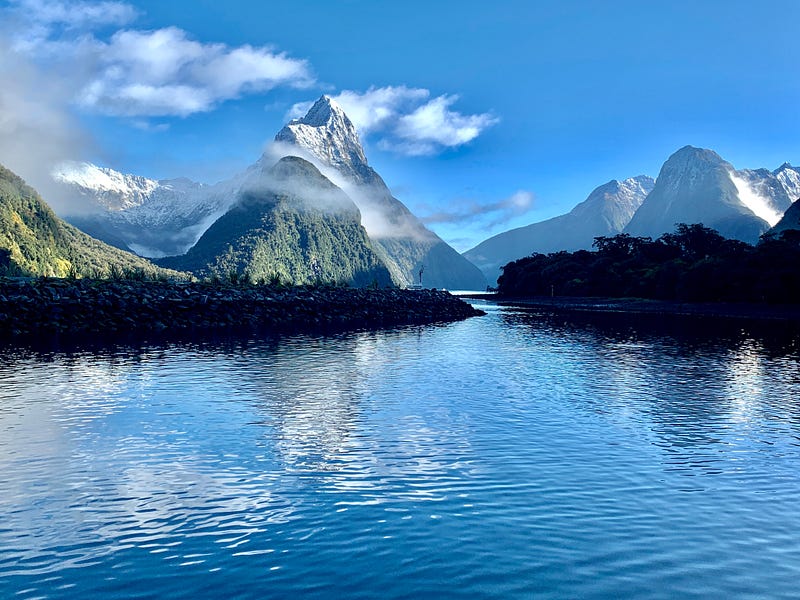
The “Eighth Wonder of the World,” Rudyard Kipling called it. For over 140 years, Milford Sound has epitomized remote, pristine, awe-inspiring nature. Conjure an image of New Zealand — a mist-shrouded mountain rising straight up from the sea — and chances are you are recalling a photo or poster you once saw of Milford Sound.
We are no different. Teresa (my intrepid spouse and co-flâneur) built our entire trip to New Zealand around Milford Sound and nearby Queenstown. On departing Queenstown, we were all in for Milford Sound. Yet, mingled with the excitement was a bit of fear. There was snow in the forecast, and the authorities had already announced the high mountain road — the only road into the fjord — was going to close at 4:30 that afternoon (Technically, Milford is a fjord, not a sound).
Online, we learned that snow chains were required for the tires of all cars driving that road in winter. We gulped, but found a service station in Te Anau that rented chains. Te Anau is the last town on the road before Milford Sound — still two hours further into the wilderness. The friendly woman at the gas station in Te Anau told us our spiffy Polestar 2 had wheels that could not, in fact, be fitted with chains without damaging them. But, no worries, she said with a bright smile, no need for chains; we were well ahead of the storm.
I gulped again and shook off my anxiety. Two months previously, Teresa and I had driven the Grössglockner Alpine Road in Austria, with twenty-foot snowbanks on either side of the road and it was snowing! Without chains on our tires. I’m a Canadian for God’s sake, I reminded myself. I don’t need no stinkin’ chains.
So, back in the Polestar, with the weather sunny-cloudy as we entered the Fiordlands National Park. The Fiordlands dominate the southwestern portion of New Zealand’s South Island. A high mountain range runs north to south through the island, and cuts right through the centre of Fiordland. These mountains are the result of two tectonic plates colliding. The Pacific Plate gets pushed up while the Australia Plate gets pushed under, creating the mountains in Fiordland known as the Southern Alps; and they are still rising about 2 centimeters ( just less than an inch) per year. “As fast as your fingernails grow,” is what all the tour guides tell us.
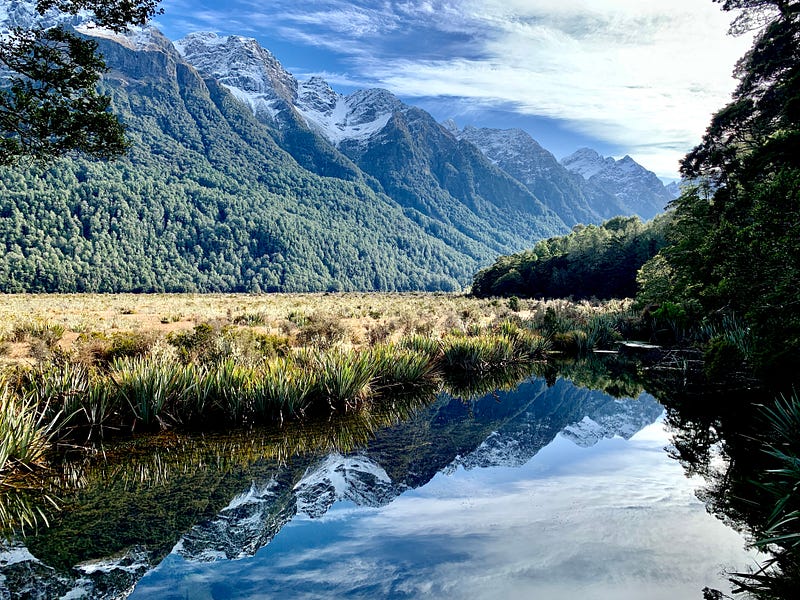
These mountains trap the hot, moist air blowing over the Tasman Sea from Australia, creating rainforests on the hills and snowfields on the peaks. During several ice ages of the past million years, massive glaciers formed over the Southern Alps, each gouging paths to the the sea as they expanded. The legacy of these now-melted glaciers is etched upon the dramatic, steep slopes of the fjords, some over a kilometer from peak to water’s edge, then dropping hundreds of meters further beneath the dark-blue surface.
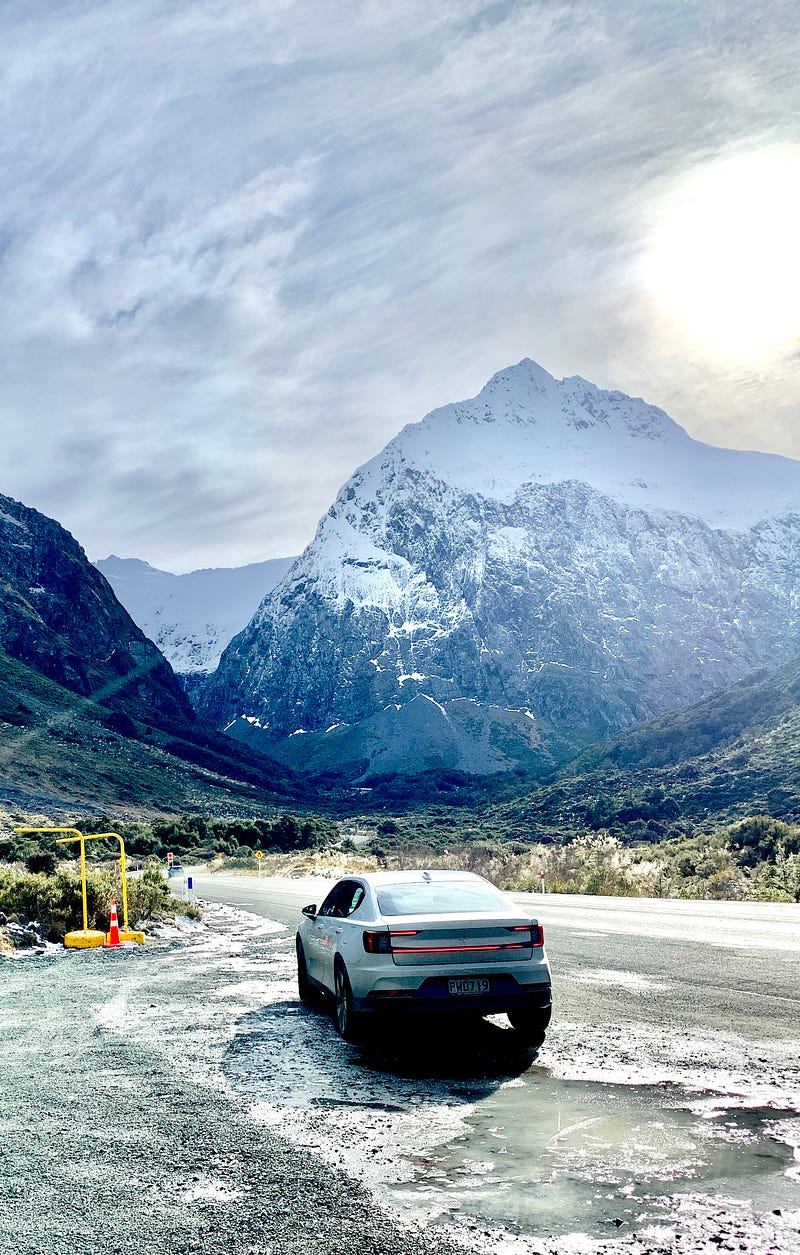
We drove up through the winding alpine road, higher and higher, until forest disappeared and the snow line came closer. Just before the tunnel through the Homer Pass, we paused at a turn-off to soak in the dramatic view of the mountains that surrounded us. I noticed the remains of a snowman at the roadside, built after a recent storm.
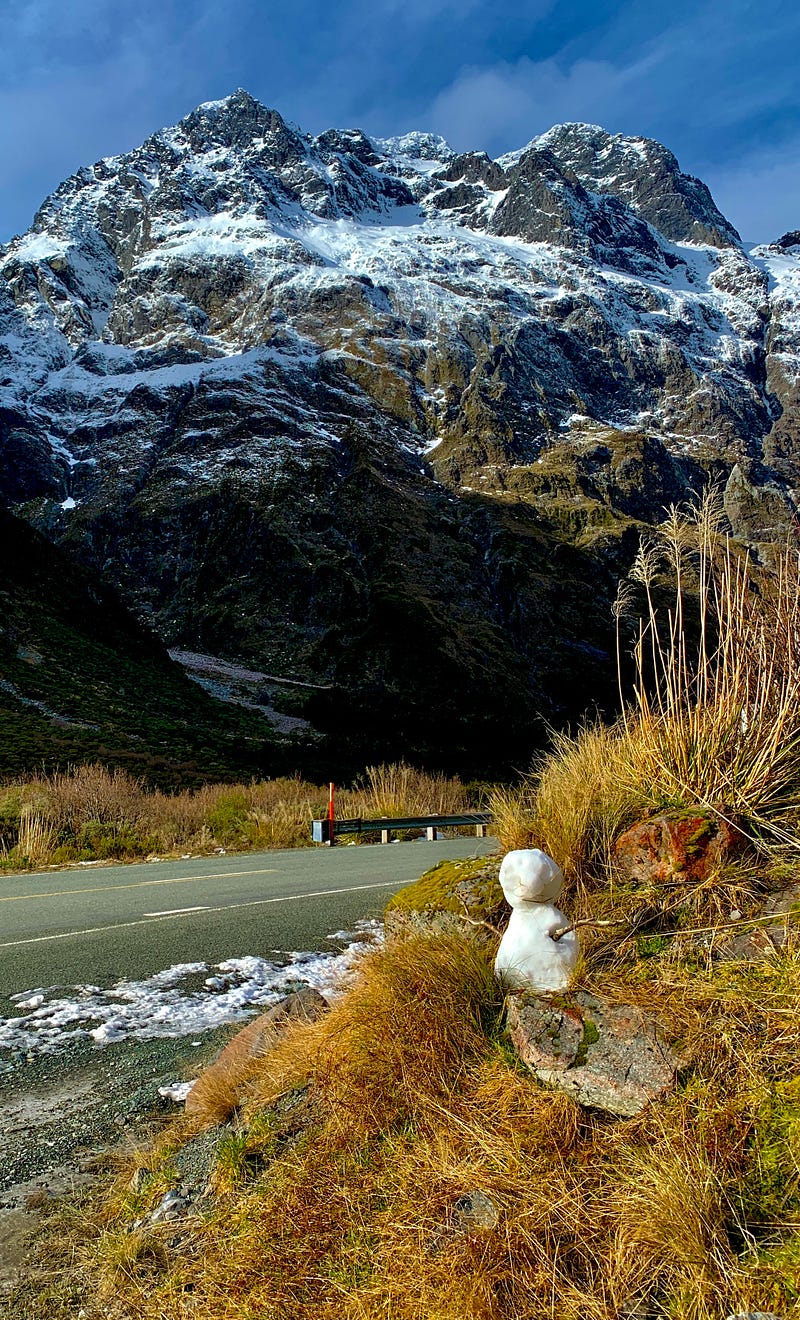
Through the dark, small tunnel, and out the other end, we emerged into Fiordland. The road now dropped steeply. Soon we were back in the rainforest. Rain — not snow — began to fall. To be honest, we have driven on far worse roads in Austria and Norway, where I seriously feared for our lives, even driving 10 km per hour. The Kiwis, however, build great, well-maintained roads through the wilderness. Of course, this particular road had to be built to handle the perpetual summertime traffic. In 2019 alone 870,000 people visited Milford Sound, most of them traveling along this road via tour bus, car or even camper van. Post-pandemic, the numbers are rising fast once more. It made me very happy we were arriving in mid-July—the dead of winter. We were the only car on the road for many miles.
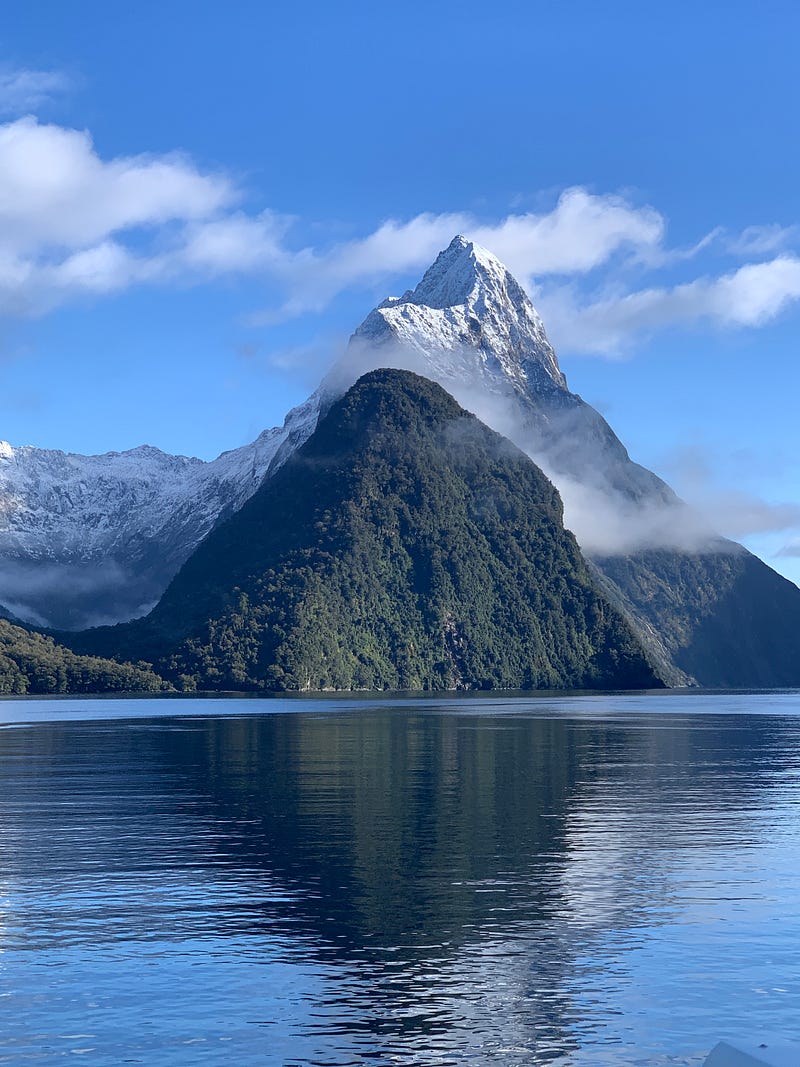
Within half an hour of the tunnel, we reached the water’s edge. Pulling into the parking lot of Milford Sound, we faced the open fjord and there it was, all the more beautiful for being shrouded in mist, right in front of us, that incredible iconic view:
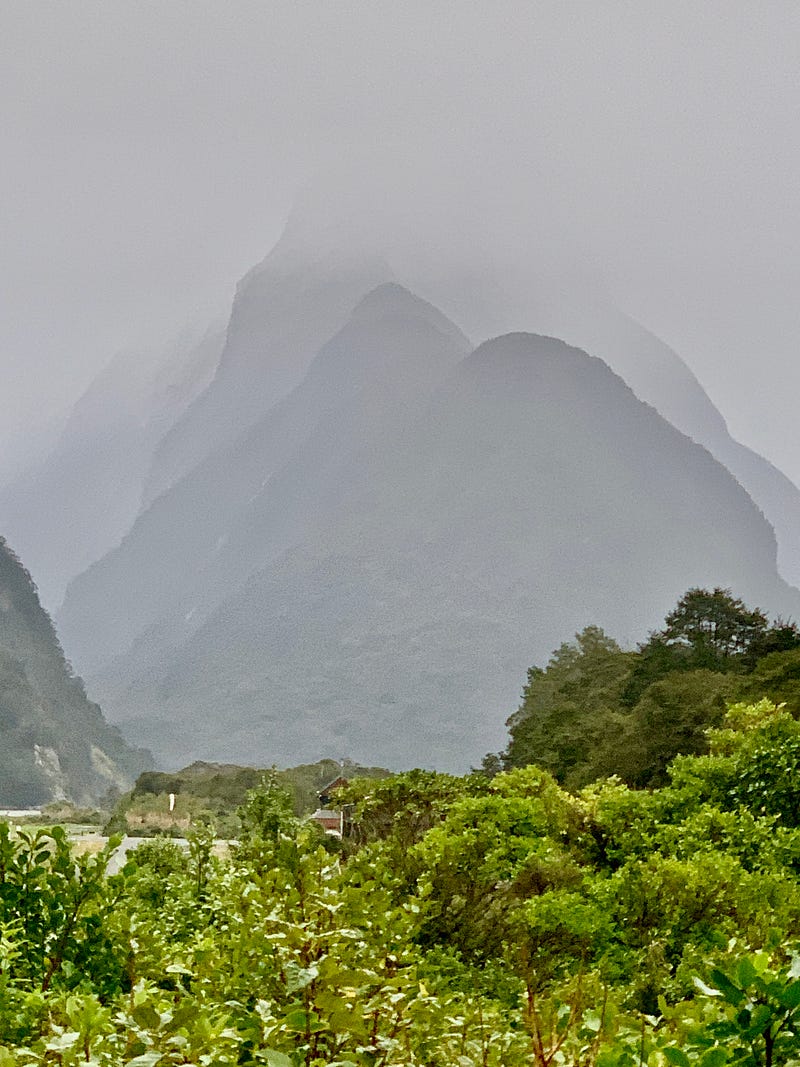
The parking lot was nearly empty, the water placid and clear of traffic. At that point, so near to our arrival, we did not realize just how lucky we were to experience quiet in Milford Sound.
We checked into the Milford Lodge — the only hotel in the fjord. The lodge is beautifully constructed of small brown-and-black cabins that are almost invisible in the forest. We got a room overlooking the riverbank, with a view of the mountains outside our glass sliding doors. I went out for a hike in the light rain, just to get the lay of the land, and also, to search for kea birds.
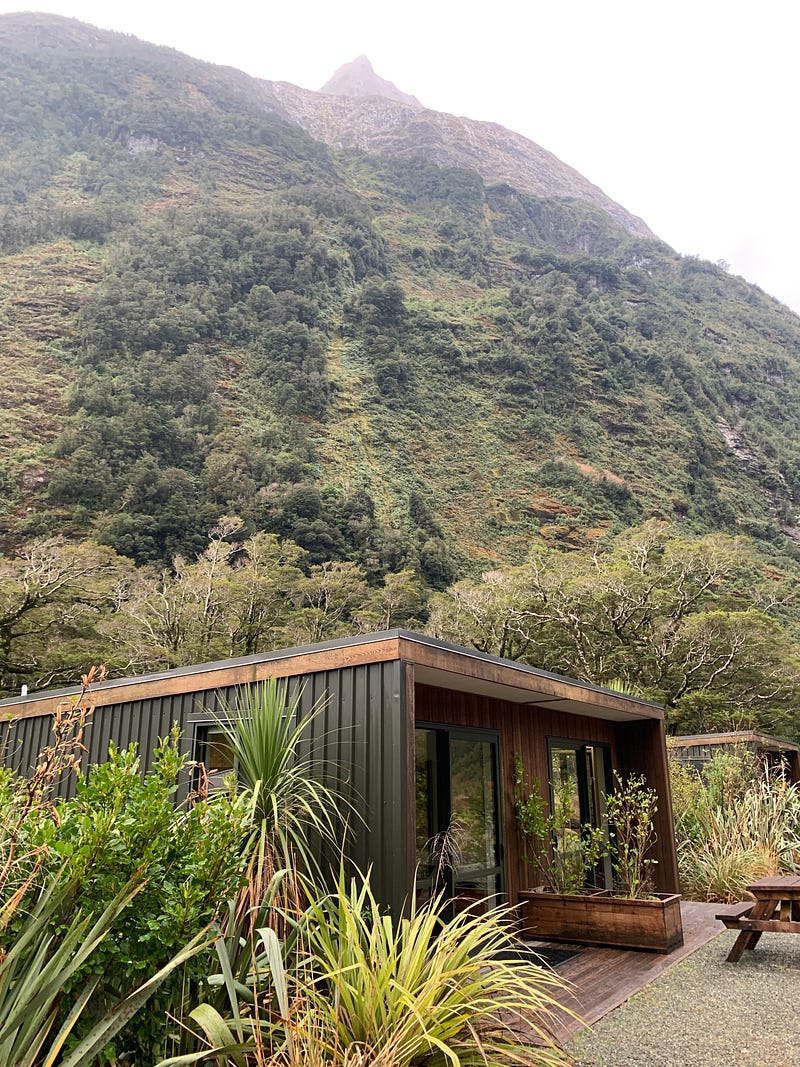
At reception they told us please, please do not feed the kea, because feeding them turns them into beggars — not to mention that human food is bad for them. Kea are a rare and endangered species of alpine “land parrot.” Unlike their more famous relative, the flightless kakapo, kea can fly, but mostly they don’t have to. They just walk around.
Behavioral studies have shown them to be highly skilled at problem solving, with the intelligence level of a four-year-old child. I don’t know about other four-year-olds, but my son Josh was one hell of a mischief-maker at four. So are kea. A Milford kayak guide later told me kea sometimes show up by the launch area and wreak havoc on their gear. “They will destroy a running shoe in under ten minutes,” he said.
At dusk, shortly after I returned from my walk, a pair of kea arrived right at our doorstep. They hung around our picnic table, looking for scraps. They found none, but discovered us, looking at them from the other side of the glass sliding door. They sauntered over for a closer look.
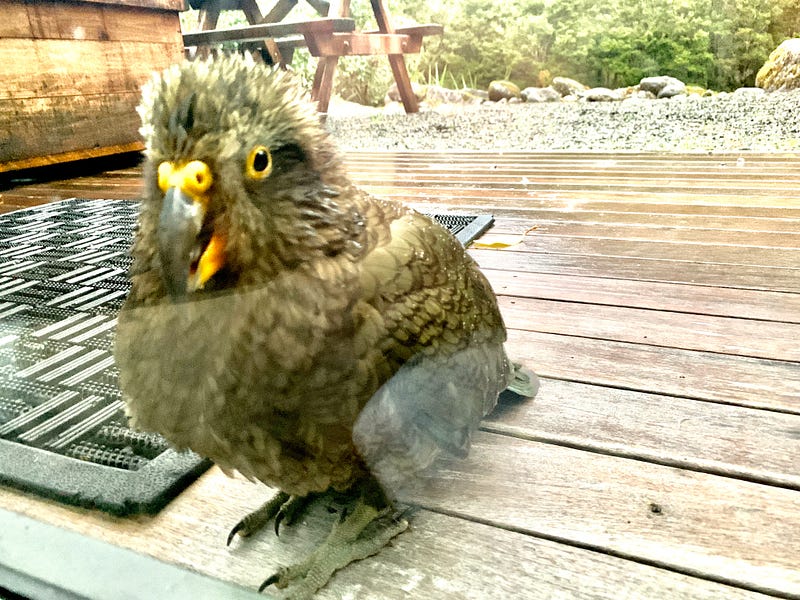
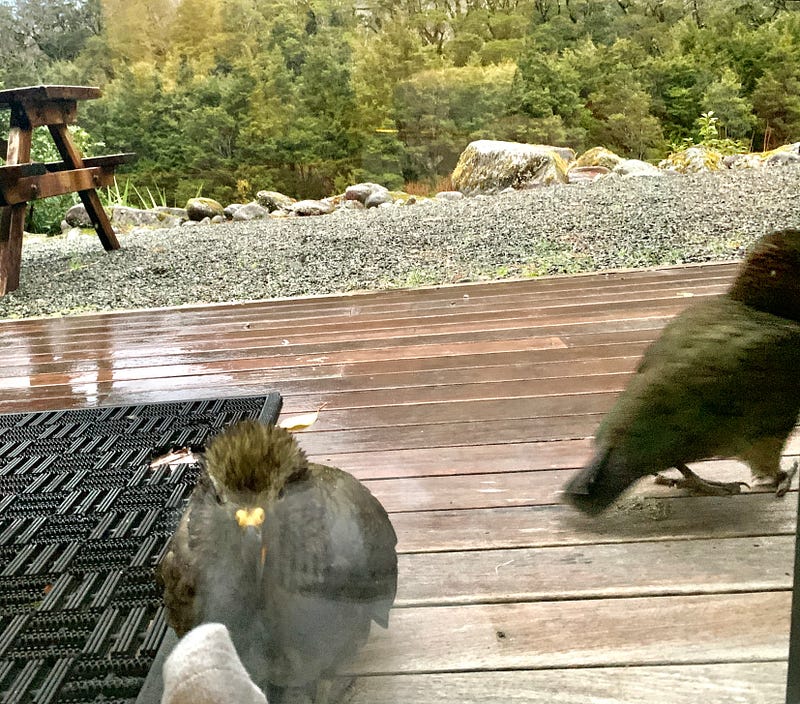
I wiggled my toes and one bird tapped at the glass with its beak, as if intent on nibbling the white sock on my foot. It stared right at my face, as if to say, “What’s your deal, pal?” Its mate, however, read the room. It could tell we were not going to feed them and moved on toward the next cabin. The pair kind of reminded me of Teresa and me at a museum. I want to pore slowly over every exhibit. Teresa gets the general idea, then she’s ready for the gift shop, no need to linger:
I was enthralled by these feisty little birds, capable of surviving in this harsh alpine-fjord climate, and choosing to walk. Something in the back of my brain made me think I had heard of them before…Monty Python! The Dead Parrot sketch: “He’s not dead…Perhaps he’s pinin’ for the fjords?” Oh My God — it wasn’t a fictitious Norwegian Blue Parrot — the sketch could have been about a real kea parrot that actually does live in fjords!
The next morning we were booked for our cruise of Milford Sound on an early boat, to beat the tour buses from Queenstown. It had rained hard at night, but now the sky was a bright cerulean blue. It was a bit of a shock to drive from our camouflaged cabin in the rainforest to the cruise ship wharf. It looked like an airport terminal. It was the biggest building in Milford Sound, hosting close to a dozen tour booths, each with their own ship tied up outside on the wharf. In summer season, each boat runs three, two hour cruises a day. And that’s not counting larger ocean cruise liners that pull into Milford Sound regularly throughout the summer. But we forgot all that the moment we stood in the wharf and looked out. We simply gaped at Mitre Peak, now fully visible:
Our company, Cruise Milford, ran one of the smaller ships. The crowd was light that day. Perhaps the overnight closing of the road had discouraged others? With about twenty passengers aboard we motored the full length of the fjord to the Tasman Sea and back again.
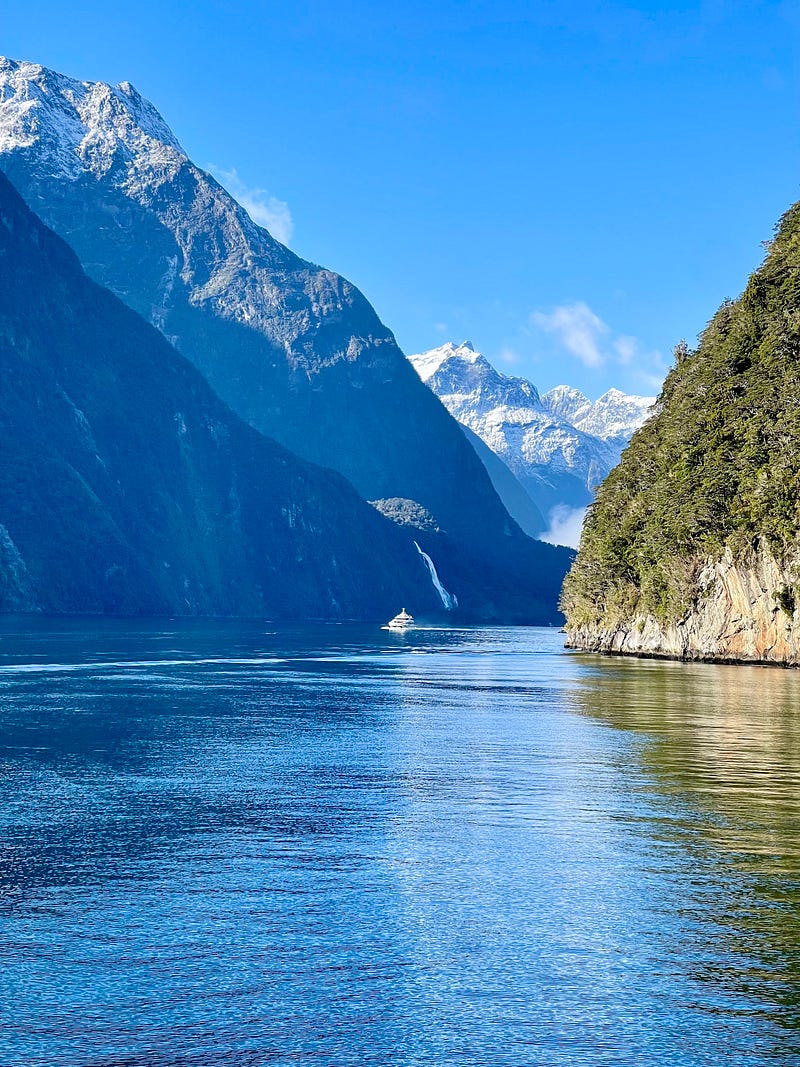
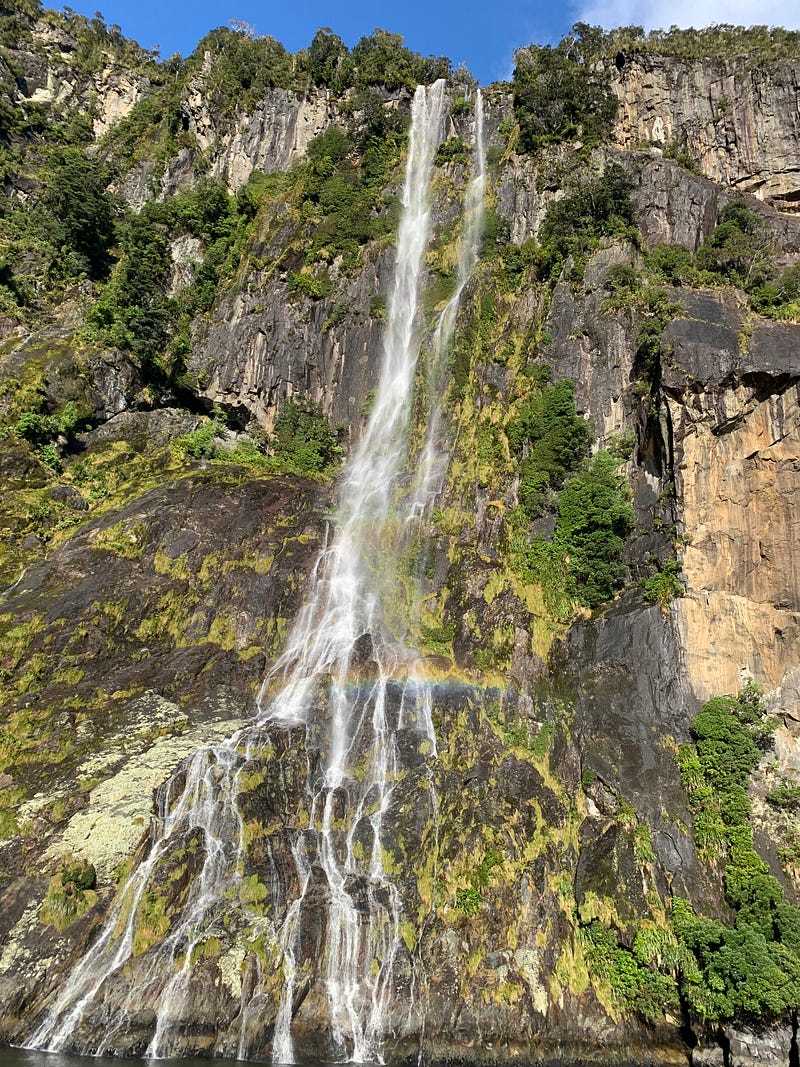
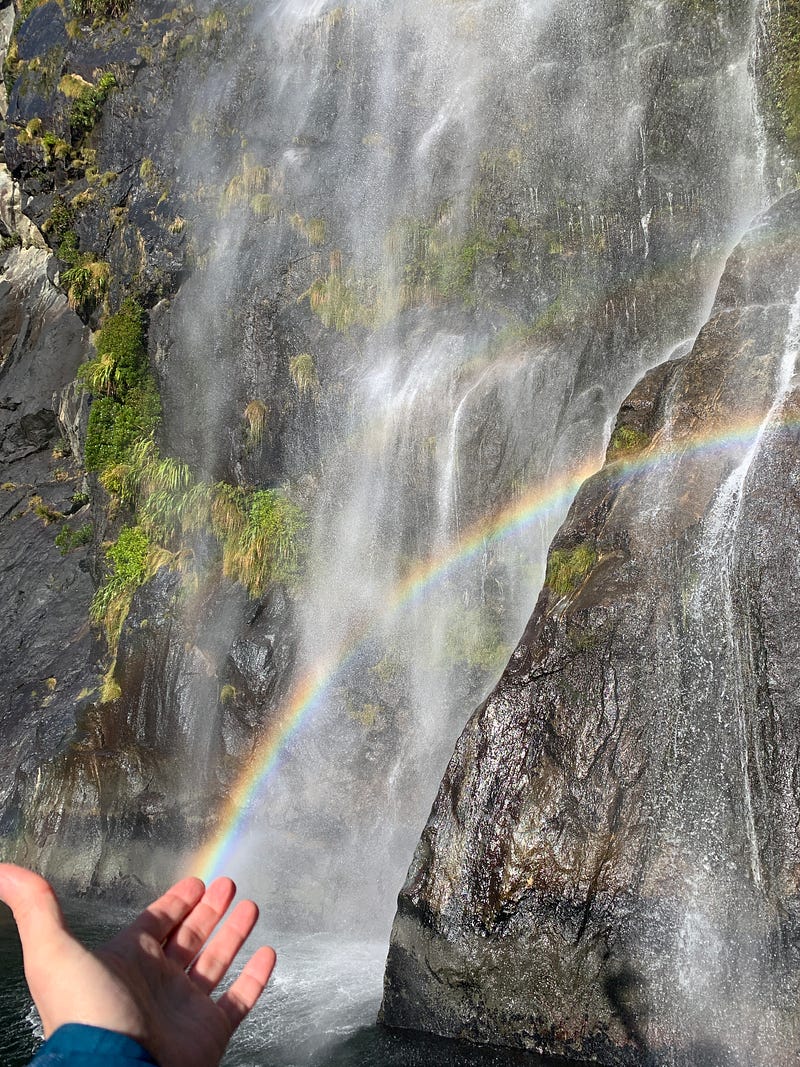
Due to the recent rains, waterfalls streamed down the high cliffs on both sides of us, creating rainbows — and even rain showers, when the captain deliberately manoeuvred the ship right under one of the falls.
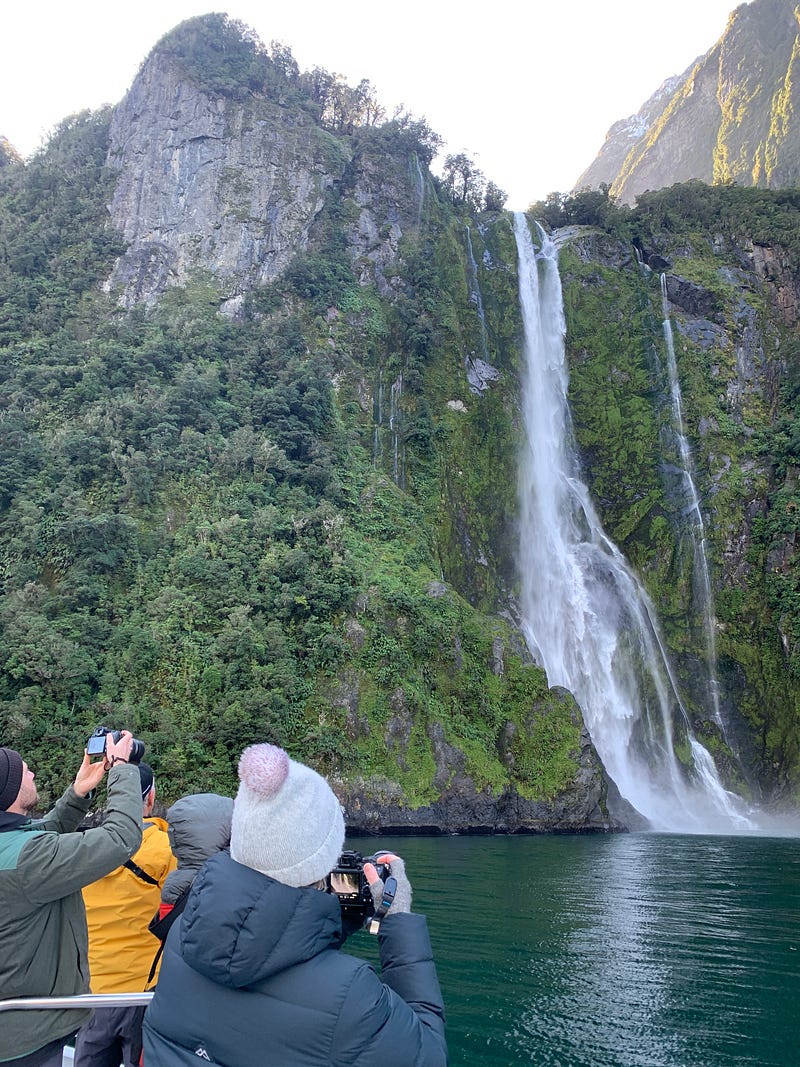
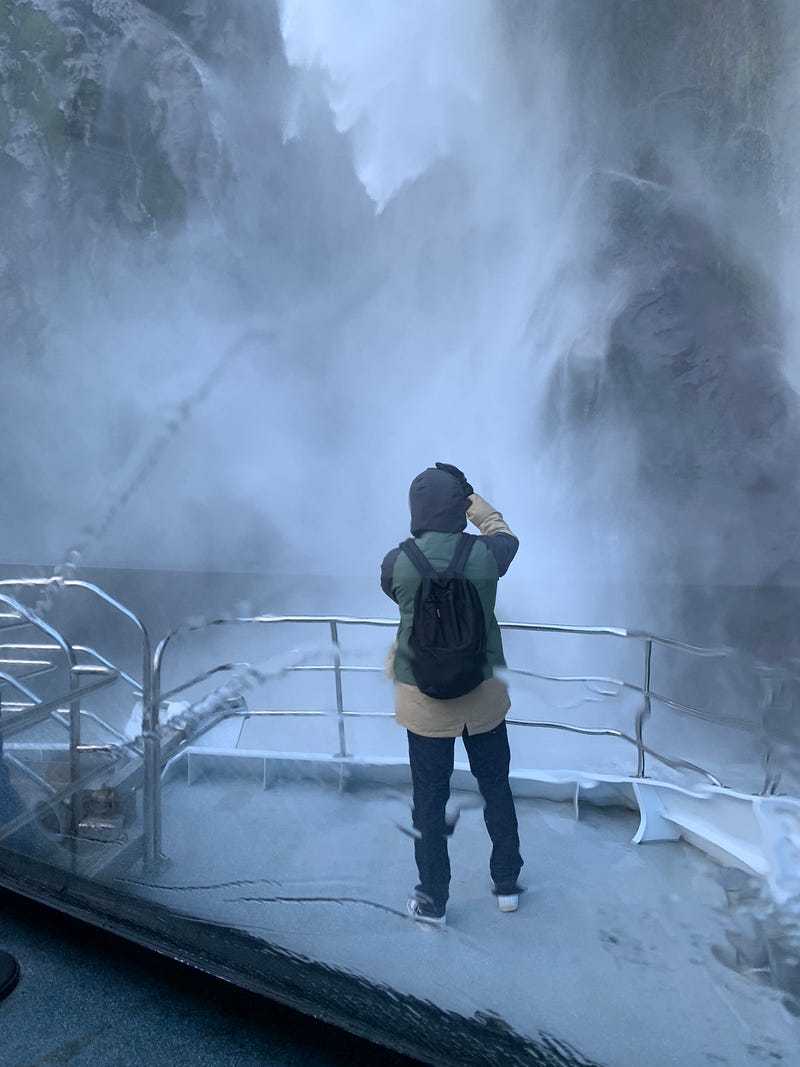
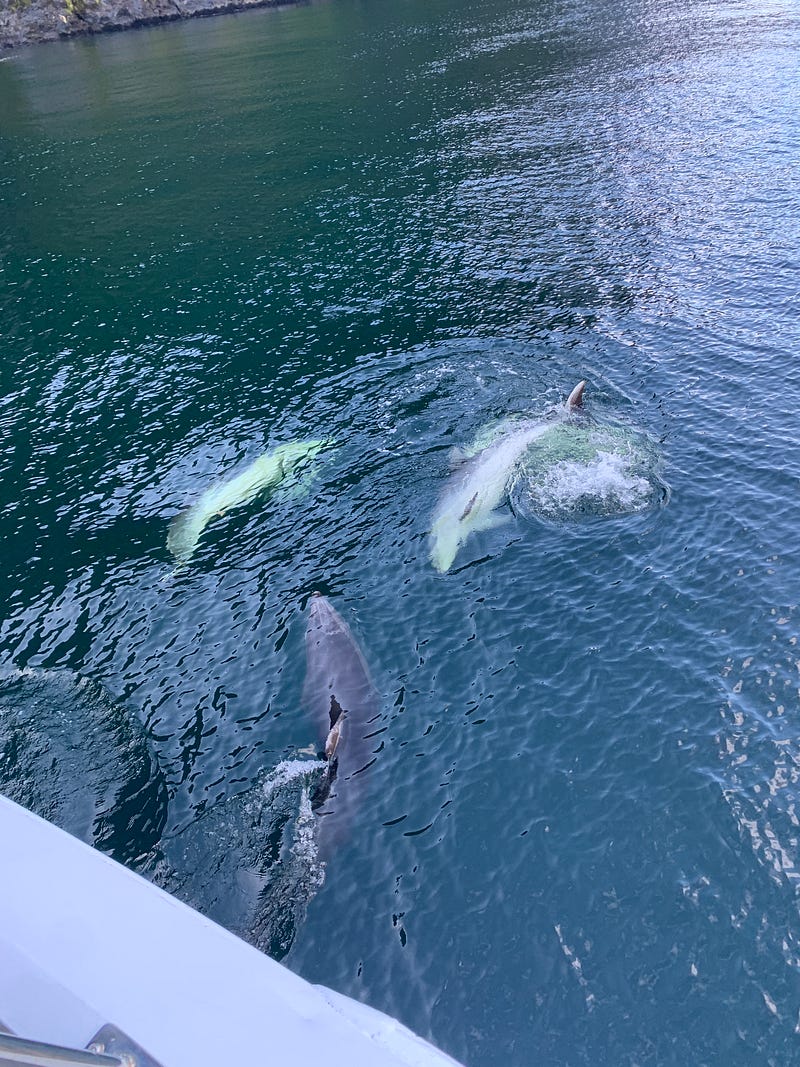
We saw seals on the rocks, and dolphins rose next to us, splashing around playfully before taking off. Whales come into the fjord too, from time to time, our captain said, and even sharks.
The next day I went kayaking with two other paddlers and one local guide, Pauly. Mel and Andrew were Australians and had never kayaked before. Pauly told them this was not a problem. The weather was calm, and our sea kayaks sturdy and stable. We floated along in no big rush to get anywhere fast, just enjoying being out on the calm, deep water.
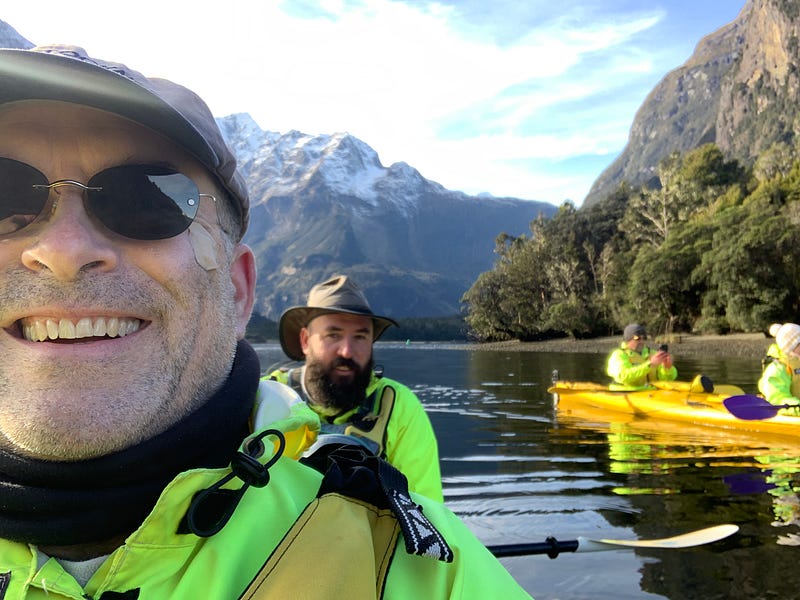
Milford Sound at kayak level seems a lot bigger and quieter than from the cruise ship. These had all departed up the fjord shortly after we hit the water, and soon we were in silence as we paddled. Then a plane flew in down the fjord and landed on the little airstrip that is hidden from the road. Pauly told us that during the summer, some 300 flights a day land and take off in Milford Sound — the fast and expensive way to get to the cruise ships.
“All day long, there’s a roar of engines overhead,” he told us. It was hard to imagine in this vast emptiness.
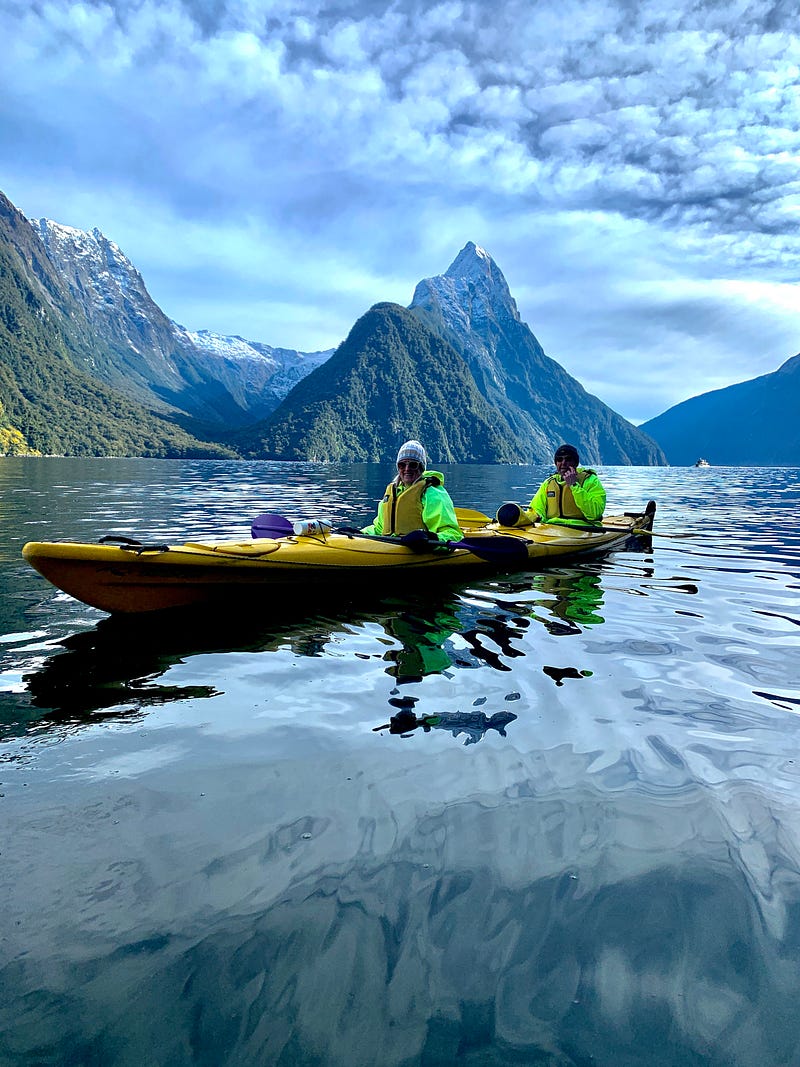
Pauly told us that the government had a master plan, Milford Opportunities that calls for shutting down the airport, and imposing a hefty charge for foreign tourists entering the fjord by the road. I took a look at it online. The aim is to lessen the traffic (replacing cars with electric hop-on-hop-off buses), and increase the number of days visitors spend getting in and out of the fjord. Basically to slow the whole experience down. Apparently the tour companies operators are not happy with the government’s gran plan, not at all! Pauly said there was a video about the controversy, called Is Milford Sound Lost to Tourism? which I also found on line:
Here are three of the most memorable quotes from the various officials and tour operators interviewed in the mini-documentary:
Tourism is an extractive industry. It uses the scenery and the extraordinary geography, but we don’t get anything for it.
If you charge visitors, many of them will start going to other sounds — Doubtful and Dusky that currently are pristine. Milford is already lost to tourism.
The solution isn’t always to build a bigger car park.
I could see both sides of the story. It was frankly surprising Milford Sound has so far not been destroyed by the tourist hordes. But, I was not exposed to the congestion and exhaust fumes of the summer months. And who knows what damage the constant noise of air and sea traffic is causing both marine and land creatures? From my perch, as a visitor, I would have gladly paid a steep fee, knowing it was going to help preserve this wild land.
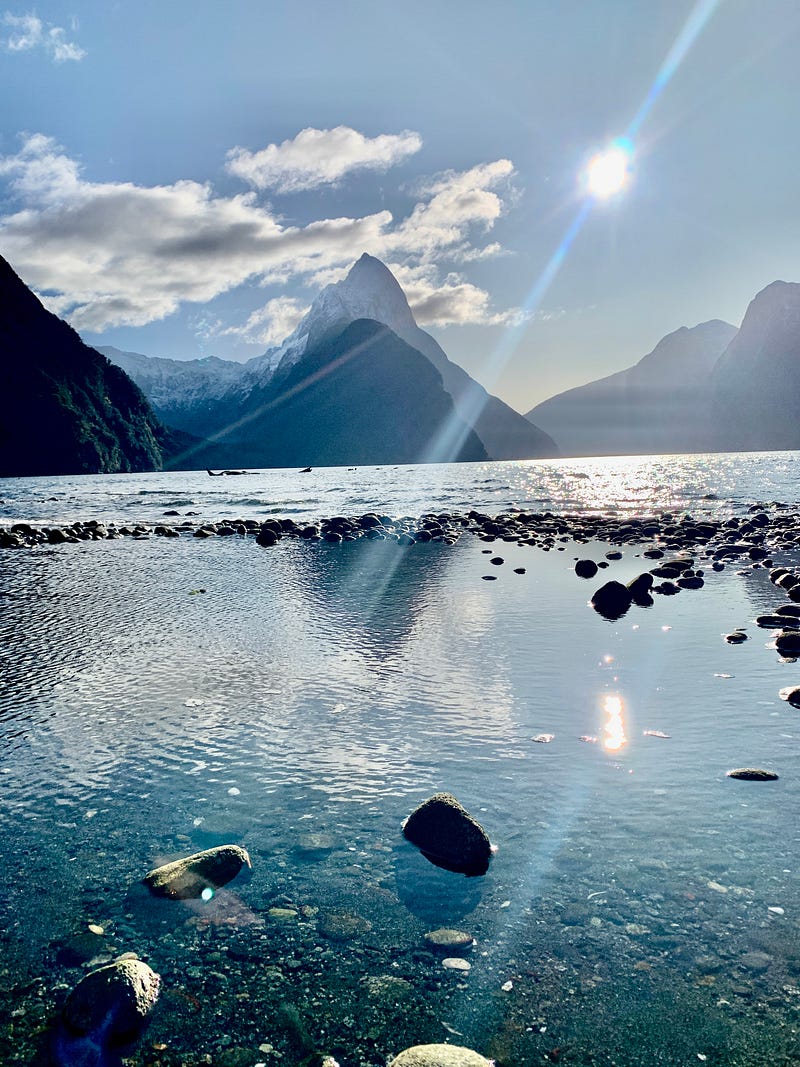
If you ever go to Milford Sound, pause at the foot of Mitre Peak and just feel it: the sheer awe of standing in nature’s grand cathedral. Then say a prayer for the master plan, and for the people with the passion and fortitude to preserve this place for the future.
***
Good news! My new book about slow travel in Europe has just been published! Here’s some places where you can order it: