
A Practical Guide to Mindfulness
How to incorporate mindfulness practice into your daily life

Mindfulness. Unless you live completely off-the-grid, you have almost certainly heard of it. Maybe you are vaguely familiar with the concept, having seen it on the cover headline of Psychology Today, or maybe you are a seasoned mindfulness meditator who considers himself an expert.
Perhaps you lie somewhere in between. Whoever you are, mindfulness is inherently difficult to grasp for many, so you should feel no shame in seeking clarification. Today, we will not only define mindfulness, but discuss why mindfulness matters.
Mindfulness is far more than a fleeting fad — mindfulness offers immense value to mental health, physical health, and overall wellbeing and happiness.
Trust me, I know. Since I began practicing mindfulness, while it hasn’t been a perfect journey — no worthwhile endeavor is — I have experienced the positive effects firsthand. As someone who struggles with persistent OCD, it’s a big deal.
Mainly, the peace of mind. The tranquility that comes with having achieved a genuinely mindful state. The sharp awareness of your existence and your surroundings, without the emotional attachment to them. The ability not to suppress your emotional state, but to accept it for what it is. Simply let it be.
So, what is mindfulness?
Words cannot aptly sum up the sensation, the experience, of mindfulness. When practiced correctly, mindfulness is an active cognitive experience. Many mistake it for a passive practice, since the idea is to become fully immersed in the present moment.
However, becoming fully immersed does not require detaching from your body and your surroundings. Not entirely, at least — it’s a fine line. The goal is to actively observe and absorb your thoughts, feelings, surroundings, and experiences through all five senses. Without giving in to the emotional or cognitive implications of analysis, judgment, or emotional investment.
Mindfulness truly isn’t that complicated. Theoretically, it’s a simple concept. Practically, it’s a habit that is often difficult to grasp, and even harder to master.
The reasons are simple. The human mind evolved to think, react, judge, analyze, interpret, and orchestrate emotions. All active processes of cognition. Cognition is a great skillset, but it inevitably collides with mindfulness.
This is because mindfulness relies heavily upon one’s ability to temporarily quiet the creaky cognitive gears in the brain. Thinking occurs as naturally as breathing. But unlike breathing, you won’t die if you stop thinking. Thinking isn’t essential, physiologically speaking.
Maybe not permanently, but for minutes or hours at a time — to exist in a fully mindful state, free from the shackles of human thought — you’ll be fine.
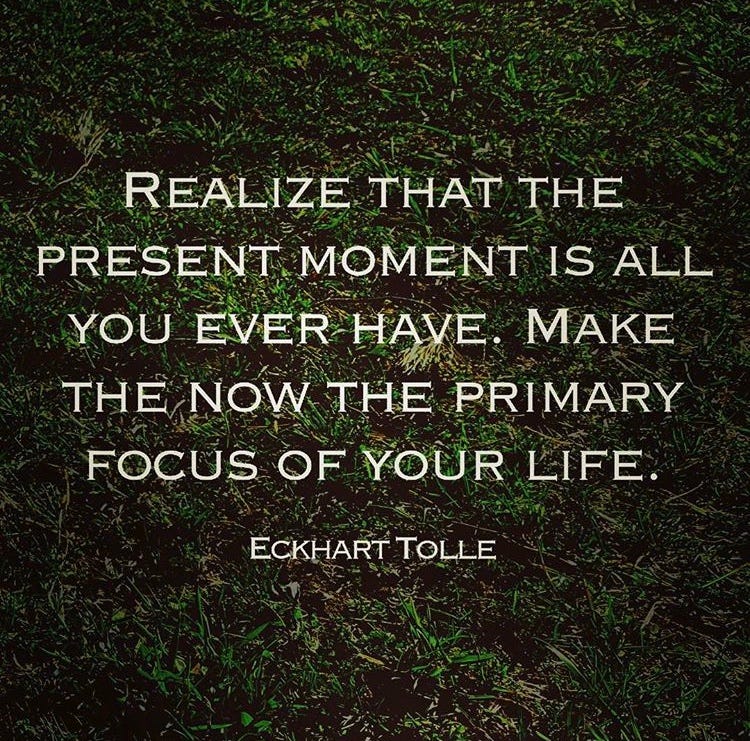
Mindfulness is the act of existing fully in the present moment through a state of nonjudgmental awareness and acceptance. Being fully, consciously aware of the tangible reality that exists right now. At this very moment in time.
“Presence is the key to freedom, so you can only be free now.”
-Eckhart Tolle
Take a moment to absorb the meaning of that statement. Don’t simply plow through it; now isn’t the time to speed-read. While efficiency has its place, mindfulness is unique in that it thrives on deliberate immersion in the present moment.
Tolle explains that the present moment, “the Now,” as he calls it, is “the one constant factor in your life” from which escape is impossible. Some might argue that it is possible to escape the present, but only by being so immersed in the past or the future that you can’t function in the present — a sad way to live, and one that still never truly relinquishes the existence of the present.
In other words, the presence is inescapable.
Once you accept that, you can begin learning to master mindfulness in a truly rewarding way.
Applying the Concepts
One simple exercise to practice mindfulness involves sitting or lying still in a quiet room.
- Find a quiet place to sit or lie down. Get comfortable and cozy, in whichever repose position feels most natural to you. On a bed, couch, armchair, whatever. What matters is that you’re comfortable.
- Close your eyes. Gently close your eyes.
- Focus on your breathing. Begin to draw attention to your breathing. Continue breathing naturally; don’t try to hold your breath or slow it down yet. Pay attention to your natural breathing rhythm.
- Once your attention is on your breathing, now practice a breathing rhythm. Dr. Weil Brady suggests practicing the 4–7–8 breathing technique. You inhale for 4 seconds, hold your breath for 7, then exhale slowly for 8. (Fletcher, 2019) But the exact breath counts are not as important as maintaining a steady rhythm. Which is why the 2–3–4 rhythm works fine as well. In this case, you inhale for 2 seconds, hold your breath for 3, and exhale for 4. Complete a few cycles.
- Pay attention to what you hear. Background noises, the water heater kicking on, cars zooming by in the distance, or simply silence. Repeat this with the remaining four senses; touch, smell, taste, and finally, sight. Saving sight for last allows you to eliminate visual distractions while you focus on other sense experiences.
- Embrace thoughts as they arise. They inevitably will. Especially if you’re still learning to master being present. Here’s a scenario: You inhale, hold your breath, exhale. Breathing rhythm is going well. You do it a few times. It remains steady. Now it’s time to move onto the five senses. You notice neighbors talking outside. You start wondering why they’re so loud. What the noise is all about. This is thought, not awareness. Gently bring yourself back to the present moment.
Practice makes perfect. The human mind thrives on habits. “You are what you repeatedly do.” So make mindfulness a habit. It takes 3 weeks.
Mindfulness Versus Thought
At its core, being present deviates from the process of actively thinking. Since thinking is a behavior, it takes your focus away from the state of mindfulness. After all, mindfulness is a state of mind, not a practice or a behavior. It requires no action beyond simply being aware of the presence and existing in it. Existing passively, without judgement, analysis, or interpretation. Simply observe. Observe without judgment. Only acceptance.
By simply becoming aware of the difference between mindfulness and active thought, you can actively incorporate mindfulness into your life each day.
Ultimately, mindfulness means being present. It means being aware. It means being consciously observant of your surroundings.
While this might be difficult for you if you are a chronic overthinker, it is essential to reaping the various mental health benefits of mindfulness habits.
Mindfulness has been shown to have an antidepressant effect on the brain, reducing stress, anxiety, and depression. All that mind clutter that hinders you from being your happiest, most productive self. Mindfulness has the capacity to improve mental health and increase happiness by boosting your mood, short-term and long-term.
At the end of the day, it is a practice. But mindfulness is far more than that, if you allow it to be. It is a way of life, a mindset shift that allows you to see and experience the world differently. Peacefully, quietly, nonjudgmentally. Give it a try. You may find it enlightening.
Fletcher, Jenna. “4–7–8 Breathing: How It Works, Benefits, and Uses.” Medical News Today, MediLexicon International, 11 Feb. 2019, www.medicalnewstoday.com/articles/324417.php.


