
A Post-Carbon Future for Humanity?
The Future of Humanity, Part 7
This is the last post in my modestly titled seven-part series on the future of humanity. The series starts here. Based on all the evidence and analyses we have reviewed in the first six parts, we can now draw some conclusions as to what a post-carbon future for humanity might look like. It won’t be pretty, but my hope is that it might be survivable. Think of the 21st Century as humanity’s biggest, messiest, and most horrible teachable moment. We are either going to learn how to live on this planet … or we’re not.
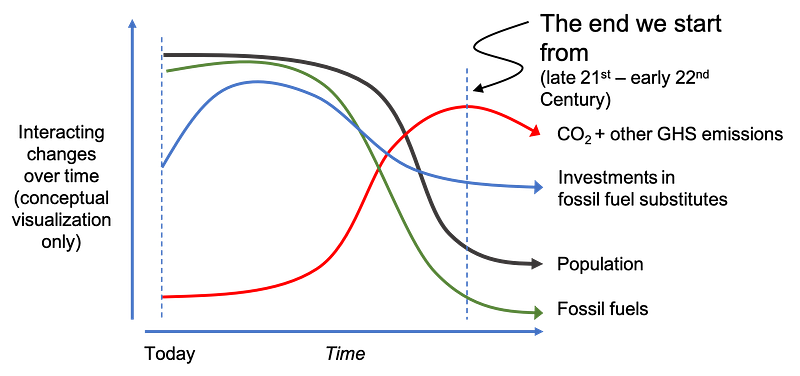
The graphic above depicts the key dynamics I believe might define the next stage in humanity’s transition to a post-carbon civilization. The curves are purely conceptual, not quantitative, and not on any common scale, except for Time on the x-axis. The logic works something like this:
- Green curve: Fossil fuel reserves will continue to shrink until they are depleted or abandoned sometime in the latter half of the 21st Century (source).
- Blue curve: The decline of fossil fuels will spur technological innovation and investment to find substitutes to replace oil, coal, and natural gas as energy sources, especially in industrial processes that currently rely on them (see Part 3 for examples, also source). These efforts will peak over the next few decades, but decline as fossil fuel shortages become more acute and financial resources become more constrained. The extent to which these efforts will achieve their goals is unknown, but a full-scale replacement of our most complex energy-dependent industries seems unlikely in the limited time available.
- Red curve: Greenhouse gas concentrations in the atmosphere will continue to rise as long as we continue to burn fossil fuels. But as fossil fuels become more scarce, we will burn less, and annual increases in emissions will decline (but overall concentrations will not). Since greenhouse gas emissions drive global warming, average global temperatures will continue to rise along with emissions throughout the century, likely reaching 2–4°C above pre-industrial temperatures by 2100 (source, source). Once fossil fuels are depleted or abandoned, however, temperatures should stop rising, although they will not fall for thousands of years (source). This is the world in which humanity will have to survive for the foreseeable future. (source)
- Black curve: As global warming inflicts unprecedented damage on the natural resources, ecological services, and infrastructures that sustain human life, many people will die. How many? That question is a topic scientists are reluctant to discuss (see Part 5, “The coffin in the room”). Scientists do (quietly) talk about how many humans the planet can “sustain” at various levels of wellbeing, a number that appears to fall somewhere between 1 billion and 5 billion (source, source). But they are less comfortable talking about what happens to the rest of the current population that is “not sustainable”. However, the implications are pretty clear. We are about to undergo the greatest humanitarian disaster in the history of the species.
Let’s not mince words. The damage we have already inflicted on the planet is a damning indictment of humans as a species. The damage we are going to inflict over the next 100 years will be even worse. Millions, possibly billions, of us are going to die as climate disasters and hothouse conditions render large areas of the planet unlivable for humans. We have wiped out other species, poisoned the land and water, destroyed the planet’s carbon sinks, and triggered global temperatures unseen in 125,000 years (source). Yet we are so invested in our current profligate ways that we cannot stop ourselves from continuing on our path of overconsumption and ecological destruction. So we will have to be stopped by the very physical limits we refuse to acknowledge as real, the finite capacities of planet Earth.
Humanity will transition out of the Age of Oil involuntarily, not voluntarily. Not everyone will make it out alive.
Five likely features of humanity’s post-carbon future
What emerges at the end of this involuntary transition to a world without fossil fuels is going to be a radically different civilization than the one humanity has built over the last 200 years — the one we now think of as “normal”. I believe this post-carbon civilization will differ from our current global civilization in five key respects: it will be smaller, simpler, more local, more obsessed with sustainability, and much more burdened with feelings of guilt.
Fewer people
As we saw in Part 5, humans are unlikely to emerge from our involuntary transition to a post-carbon world with anywhere near the current global population of 8 billion people. UN projections that predict world population climbing throughout the 21st Century seem profoundly out of touch with the devastating conditions climate scientists are painting for a 2–4°C hotter world. Although we have to date been unable or unwilling to calculate how severe population loss might be under different warming scenarios, anecdotal evidence and “casual” comments by climate scientists (reviewed in Part 5) indicate that a post-carbon world might only be able to sustainably support a population of somewhere between 1 billion and 4 billion humans — about one-sixth to one-half the number of people inhabiting the planet today.
Given that the effects of global warming will not be evenly distributed around the globe, we can expect the geographic footprint of these surviving humans to be much smaller as well. As large swathes of the planet become uninhabitable due to first- and second-order effects of global warming (see Part 4), surviving humans will cluster into relatively less-damaged “safe spaces” where the necessary land, water, and material resources are still available to sustain (smaller) human populations in an otherwise radically simplified and dangerous world of social collapse and energy descent (source, source).
Simplification
The world that emerges after the end of oil will be a simpler world than the one we inhabit today.
Recall the graphic from Tom Murphy introduced in Part 1 of this series. To discuss how simplification relates to humanity’s future, I’m reprinting it here, with the addition of three arrows — red, green, and black — representing three levels of energy capacity humanity might have at its disposal after the depletion or abandonment of fossil fuels later this century or early in the next.
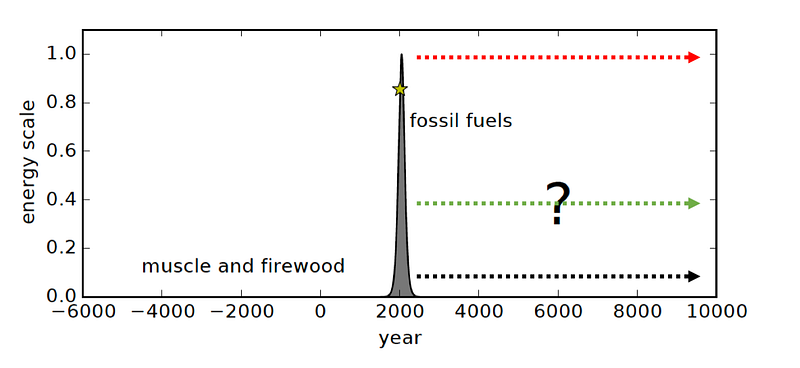
The red dotted arrow represents what might be called the utopian dream of an energy transition in which we emerge from the end of oil with a fully-functioning renewable energy infrastructure that gives us just as much energy — and therefore just as much complexity — as we have today, maybe more. However:
“While a one-to-one replacement of energy from fossil sources with energy from alternative sources may be theoretically possible, substitution is not happening at remotely the rate needed to avert serious environmental impacts from climate change or economic impacts from fossil fuel depletion. With less energy, we will eventually see less trade and transport (though perhaps global communication networks could be maintained, if scaled back).” (source)
We know that this is an impossible dream, built on a fundamental misunderstanding of sustainability and natural resource constraints on a finite planet, but it does still sell books (source, source, source).
The green dotted arrow represents a “moderate simplification” outcome. It is where we might end up if we manage to transition some, but not all, of our current dependence on fossil fuels to renewable energy sources. The sooner these substitutions are made, the less CO2 we will release into the atmosphere, the lower our maximum warming “peak” will be (possibly in the 2–3°C range), and the higher up the y-axis we might be when we exit the Age of Oil. How high on the y-axis? That will depend on how many of the “known unknowns” discussed in Part 3 we manage to solve before fossil fuels disappear.
If we figure out how to fly planes, power ships, and manufacture steel without fossil fuels, we will be able to build a much more energy-intensive post-carbon future than if we have not solved those problems.
Conversely, the black dotted arrow represents a “radical simplification” outcome, one in which we exit the Age of Oil with few or no scalable alternatives to fossil fuels in place. In this scenario, we will keep burning fossil fuels as we try to extend the unsustainable consumerism enjoyed by the rich North today. This will release more CO2, methane, and other greenhouse gases into the atmosphere, resulting in a hotter warming “peak” (this is how we get into the 2–4°C range) than if we had exited fossil fuels sooner. In the resulting extreme-heat conditions (detailed in Part 4 of this series), our economic options will be much more limited.
Simplification is definitely in our post-carbon future, but the question remains: how simple? A green arrow exit from the end of oil might result in a world looking something like a hotter version of America circa 1950. At that time, the world had a population of 2.5 billion and a much lower level of industrial capacity.
While world population was 3x smaller in 1950 than it is today (source), global GDP was 12x smaller (source), meaning that per-capita consumption has, on average (but very unequally), increased four times faster than population since 1950.
Although we think of 1950 as a pretty primitive time when compared to today, most of what we think of as the basics of modern civilization were in place. People did not have the Internet. GPS, or Amazon Prime, but millions of us did have clean water, indoor plumbing, electricity, food refrigeration, indoor heating and cooling, etc. Most survivors of the end of oil, I suspect, could transition into such a world relatively easily (albeit with a lot of grumbling about the weather and “the good old days”). If you’re looking for a literary version of what this world might look like, try Kim Stanley Robinson’s third “Three Californias” novel “Pacific Edge”, but hotter and with more sea-level rise.
In contrast, a black arrow exit from the end of oil might leave us facing a world that looks more like 1850 than 1950. If we indeed go ahead and cook the planet to 2–4°C above pre-industrial temperatures, we may become so overwhelmed by climate-induced catastrophes and disruptions that we never find the time nor the funding to build the renewable energy infrastructure needed to replace depleted/abandoned fossil fuels. If that turns out to be the case, we may end up with fewer survivors and fewer technological capabilities to rebuild much of the energy capacity lost along with fossil fuels. Such a transition would be a hard landing, to say the least. It is essentially the “Wood World” post-carbon future described by Alice Friedemann in her book, Life After Fossil Fuels (see also source). If you’re familiar with the “World Made by Hand” novels by James Howard Kunstler, that might be the kind of world we would be facing (minus the magical realism, plus a lot more heat).
Localization
In addition to being smaller and simpler, our post-carbon future is going to be much more locally-oriented. This reorientation will be necessary because the global supply chains that provide fresh food and products from halfway around the world to your doorstep may not be operating, or may be operating at much lower capacity and reliability. Human settlements will be much more on their own and much more reliant on their immediate surroundings than they are today (source).
Large cities, to the extent they are dependent on food, water, and energy imported from “elsewhere”, are likely to become unlivable for many. They will also become much hotter than their surrounding countrysides (source). Hungry residents can be expected to pour into those countrysides as their city’s supply chains falter.
People already lucky enough to live in areas close to arable land, fresh water, and available energy (e.g., hydroelectric, geothermal, biomass), and less exposure to the most extreme temperatures, will begin harnessing those resources for their local benefit. They will also begin protecting and defending their territories against waves of migrants who will want to join them. Significant local battles can be expected, especially where citizens are heavily-armed, as in the former United States.
Many functions that are “outsourced” today will be brought closer to home. Farming, forestry, and essential light manufacturing (e.g., food processing, textiles, clothing, lumber, furniture, tools) will all become more local enterprises, providing both employment and an opportunity for people to learn new (and old) skills that directly benefit their local community (source).
Sustainability
By necessity, our post-carbon world will finally come to appreciate sustainability. Recycling and salvaging will become major economic activities. Products will be built to last, not to use and discard. “Repair rather than replace” will become the new default response when household products and devices stop working.
The humans who survive the climate catastrophes of the 21st Century will most likely adopt a steady-state economic philosophy that emphasizes sustainability over growth, along the lines first described by visionaries like E.F. Schumacher, Nicholas Georgescu-Roegen, Herman Daly, and others decades ago.
I believe this new embrace of sustainability will happen by necessity because our descendants will finally have no other choice. Addicted as we are today to economic growth and over-consumption, we will not be able to abandon growth until growth abandons us. Today’s political elites cannot make the necessary changes on their own, because they are too wedded to the current system and too beholden to the entrenched interests that benefit from it. All evidence seems to indicate that only an involuntary collapse of the old system will create the conditions under which a new system can emerge.
Just as the world only found the motivation to build a new global order after experiencing the chaos and carnage of the Second World War, so too will the world only find the motivation to adopt a new system of sustainable economics after experiencing the death and destruction inflicted by global warming and the end of fossil fuels over the next several decades.
Guilt
Throughout the Earth’s history, many species have experienced ecological overshoot and collapse. Many have gone extinct as a result, many others have rebounded, finding new ways to co-exist with their natural environments. Human beings are unique in that we have self-conscious awareness of both our impending collapse and the reasons for it. Unlike species that have risen and fallen before us, humans are capable of imagining the consequences of our actions. As such, our descendants are likely to feel a heavy burden of guilt as they look back on the death and destruction we have heedlessly inflicted on the planet and each other.
I expect guilt, grief, shame, remorse, and regret will become deep currents in the belief systems of our surviving descendants. Future humans will rightly be ashamed of us and what we have done. “Penance” may become a more relevant consideration in their choices and plans, as they measure every decision in terms of its potential to avoid, or possibly even repair, the damage for which we as a species bear ultimate responsibility.
Humans seem to have forgotten shame and guilt in our current era. We are about to receive an epic reminder that we are going to have a lot to feel guilty about. If that burden of guilt helps our surviving descendants become more humble, more cautious, more empathic, and more respectful of the finite natural world in which they live, it will be a good thing in the end.


