
A Positive Cascade of Feelings From One Domino Hit
How the domino effect works in your favor around anxiety.
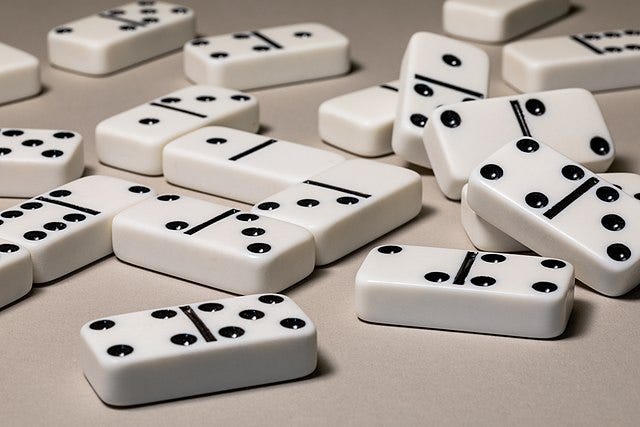

The domino effect is an amazing life hack.
For instance, a 2012 study, out of Northwestern University, found people who decreased their sedentary leisure time by a certain amount each day ALSO ate fewer fatty foods in a day.
The reduced fat intake was NOT an intention of the study.
And, study participants were never TOLD to eat less fatty foods. Rather, their nutritional habits changed as a result of spending less time on the couch watching TV.
One habit led to another, like dominos, knocking down the next one and so forth.
Human behaviors are often tied together.
This points to the domino effect which states that when you make a change to one behavior it will activate a chain reaction and lead to a shift in related behaviors.
You might notice this in your own life. For example, I wake up earlier than others in my family. This quiet time allows me to get a lot of work done before my family duties kick in. It also helps me stay focused throughout the day and I usually sleep soundly the following night. Even though I never planned to specifically improve my effectiveness during the day or improve my sleep, I got these side benefits because I changed when I wake up in the morning.
I’m a clinical psychologist and in my work I’ve noticed the domino effect occurring in my client’s lives. Specifically, I’ve seen related improvements as a result of managing client’s anxiety and apprehension.
Here are 3 domino effects following anxiety treatment.
1. Better Communication Skills.
Anxiety can hinder a person’s ability to communicate effectively. It causes them to stutter and stumble over words. Many clients avoid eye contact when talking with others.
My anxiety management tool — ART (anxiety relief transformation) teaches clients to visualize and mentally anticipate positive events. Positive events in family situations come first. Clients can visualize family members engaged in positive outcomes. These positive visualizations are reinforced in therapy and practiced at home. Eventually they bleed into communication in general and many clients report positive conversations, even with strangers.
Additionally, visualizing a positive event repeatedly leads to courage. Courage is a powerful domino. When one of my clients can say- with conviction -that they feel more courageous, I’m thrilled.
It means they are willing to move into uncertain situations and even risk failure.
2. Increased Openness to New Experiences.
Anxiety leads to avoidance behaviors where individuals shy away from engaging with new people or going to new places they’ve never been before. Fear of the unknown, the unfamiliar dominate their thoughts. Also they obsess over potentially negative outcomes.
Learning to handle anxious feelings encourages a more adventurous spirit. In my clinical practice, I teach my clients to identify triggers and create new rules to manage them. This increases their sense of control and enables them to try new activities, meet new people, and step out of their comfort zone.
The sense of openness enriches their lives and fosters personal growth. It leads to a more fulfilling and balanced lives.
3. Enhanced Decision-Making Abilities.
Anxiety often colors our judgment and decision-making abilities. It leads to second-guessing, doubt, and procrastination. I use a form of imagination — a derivative of visualization — where clients mentally simulate making choices that align with their best interests.
By unlearning fear responses and breaking the association between a trigger (an image or sound causing a fear response) and an external event, I’m able to shift a client’s mental images related to physical triggers. These clients are better able to manage their anxieties.
The domino effect happens — by managing fears. Clients make decisions with more confidence. Their improved decision-making abilities positively affect other aspects of their lives, such as career, personal relationships and everyday choices around fitness.
Conclusion:
The domino effect is a metaphor that became popular in American politics. In the 20th century, Eisenhauer used this metaphor when talking about Asian Pacific countries falling to Communism. It was also used in the Vietnam War. But its usefulness around anxiety treatment and other related psychological disorders is relatively new.
Thanks for reading. Sign up for my newsletter.