
Photography, Nature, Birds
A Pin-Tailed Whydah Sighting
Native to South Africa, the whydahs have arrived in Southern California
Like one of the ribbons set in motion by a rhythmic gymnast, a long swoop of feathers swooshed across the blue of a South African Sky.
“Pin-tailed whydah!” our South African naturalist guide exclaimed. “Breeding.”
Grabbing my camera, I managed to snap off a few shots, but the bird was so fast and moved so erratically that photographing it was difficult, and I did not get a decent picture. However, I’ve never forgotten the bird’s strange wave-like flight pattern.
You’d probably not be able to fly in a straight line either if, for a season, your tail grew to be twice as long as your body. About the size of a sparrow or finch, the pin-tailed whydah’s body is about 12–13 inches long. But for a few short weeks it sprouts a 20 cm long tail — all part of nature’s attempt to help him attract the ladies.
They are native to South Africa, so imagine my surprise when, a couple of summers ago, I saw that same swoop across the sky over my garden in Southern California! It couldn’t be, I thought — but it was, indeed, a pin-tailed whydah.
It turns out that they have been imported through the pet industry, and enough of them have escaped that there is a growing population of them in Orange County.
They are brood parasites, meaning that they lay their eggs in other birds’ nests and their young are raised by those foster parents (the foster birds’ eggs are not harmed). Ironically, one of the species the whydahs have targeted to use as fosters is another, non-native species, the scaly-breasted munia.
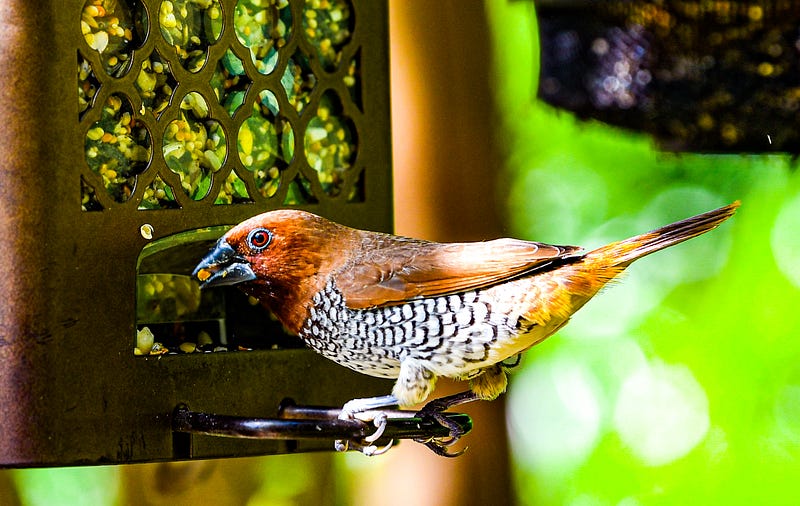
Invasive or not, both the pin-tailed whydahs and the scaly-breasted munias are gorgeous birds and both types seem to get along just fine with the finches and sparrows and doves which frequent my garden.
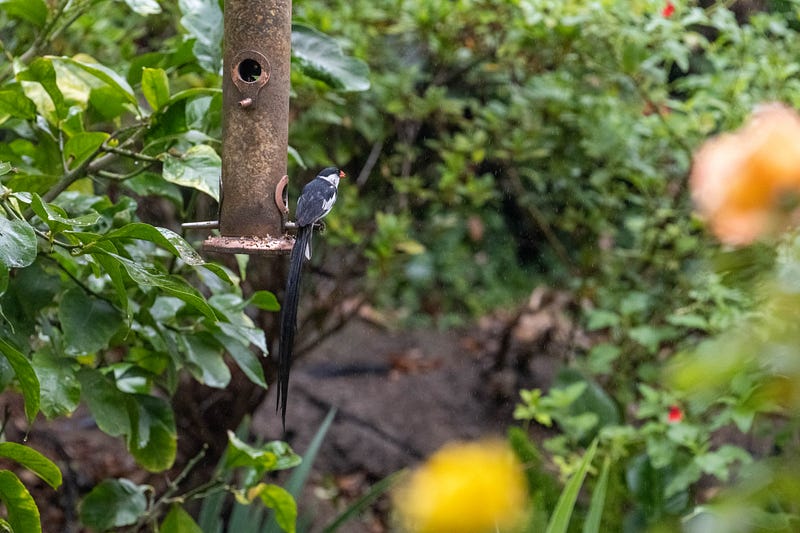
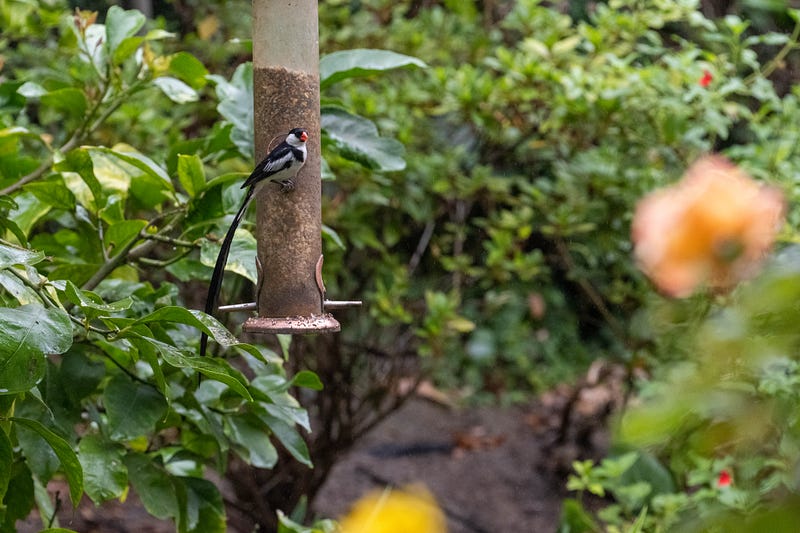
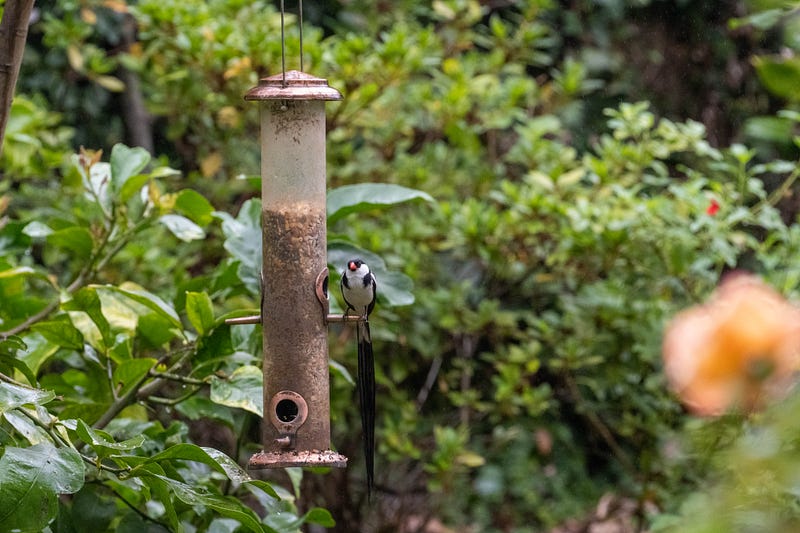
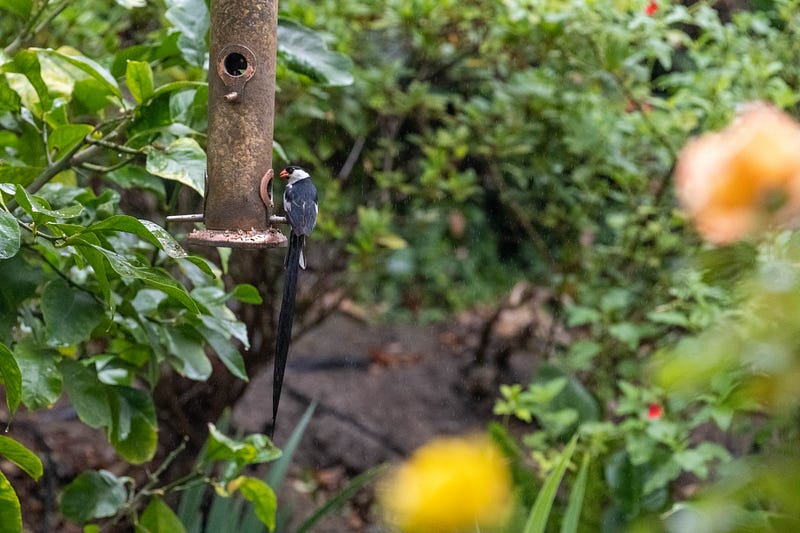
The whydahs are still a rare sighting though. And I never seem to have my camera on hand when one shows up. So, I was happy when this one sat still long enough yesterday morning for me to get a few photos. We were having our first (very welcome) fall rain and I was quite a ways away, so the photos are not as sharp as I’d like.
But you can see how long his tail is (meaning it is breeding season). I’ll keep you posted if I’m able to get more photos. This particular bird seems to have just decided that it enjoys my yard, so I’m hopeful that he’ll stick around. Who knows, we may soon have some baby whydahs who think that they are scaly-breasted munias?
Erika Burkhalter is a yogi, neurophilosopher, cat-mom, photographer, and lover of travel and nature, spreading her love and amazement for Mother Earth’s glories, one photo, poem, or story at a time. (MS Neuropsychology, MA Yoga Studies).
Thank you for reading. I hope that you enjoyed my photos and musings.
You might have noticed that this piece is published in my new pub, “Butterfly Dreams,” which I created to showcase some of my photos, poems and musings. If you’d like to see more pieces like this, you can “follow” the publication.
You might also like:
Photos, poem and story ©Erika Burkhalter. All rights reserved.