
A physics lesson featuring Betelgeuse and a 19th Century Romantic poet
On the 15th of January in Romania we celebrate the birthday of Mihai Eminescu, our most famous poet. Born in 1950, he is sort of like our Lord Byron, if you will. Think: loads of poems about the troubled genius capable only of impossible love for an ingenue muse who’s too ingenue to comprehend his genius; and about dreamy, magnificent nature. Like Byron as well, he was popular with the ladies, struggled with money through his own lack of common sense, lived fast and died young — aged only 39, possibly of complications from syphilis or side effects from its treatment. He also had some pretty disturbing political views (ultra-conservative, xenophobic, antisemitic), but that’s a story for a different time.
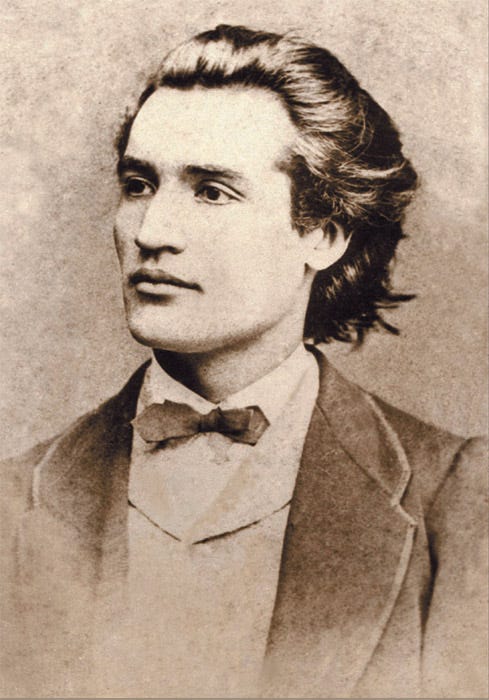

On his birthday this year, I re-read one of his poems, Unto The Star, and thought of Betelgeuse.
‘Tis such a long way to the star Rising above our shore— It took its light to come this far Thousands of years and more. It may have long died on its way Into the distant blue, And only now appears its ray To shine for us as true. We see an icon slowly rise And climb the canopy— It lived when yet unknown to eyes: We see what ceased to be! And so it is when yearning love Dies in the deepest night: Its extinct flame still glows above And haunts us with its light.
(Source: Poetica.net, translator unknown)
It is believed that Eminescu wrote this poem in 1883, although it was only published three years later. The concept of a light-year as a way of measuring distance had been around for several decades, with the first successful measurement of the distance to a star other than the Sun being carried out by German astronoimer and mathematician Friedrich Bessel in 1838.
In 1851, one year after Eminescu’s birth, German writer Otto Ulle wrote a popular article explaining the concept in layman’s terms: while it may sound odd to have a measurement for distance rather than time ending in “year”, it’s not unlike, say, “an hour’s walk away”. Eminescu was not the first Romantic poet to explore the concept in verse: the German-Swiss poet Gottfried Keller wrote a similar poem some years before, possibly inspired by the work of Bessel as popularised by Otto Ulle; which, in turn, inspired Eminescu to attempt his own take on the phenomenon.
Why Betelgeuse is such a great example
Situated in the Orion constellation, Betelgeuse is the tenth-brightest star in the night sky. It is also one of the largest stars visible to the naked eye. If it were at the center of our Solar System, its surface would lie beyond the asteroid belt and it would engulf the orbits of Mercury, Venus, Earth, and Mars.
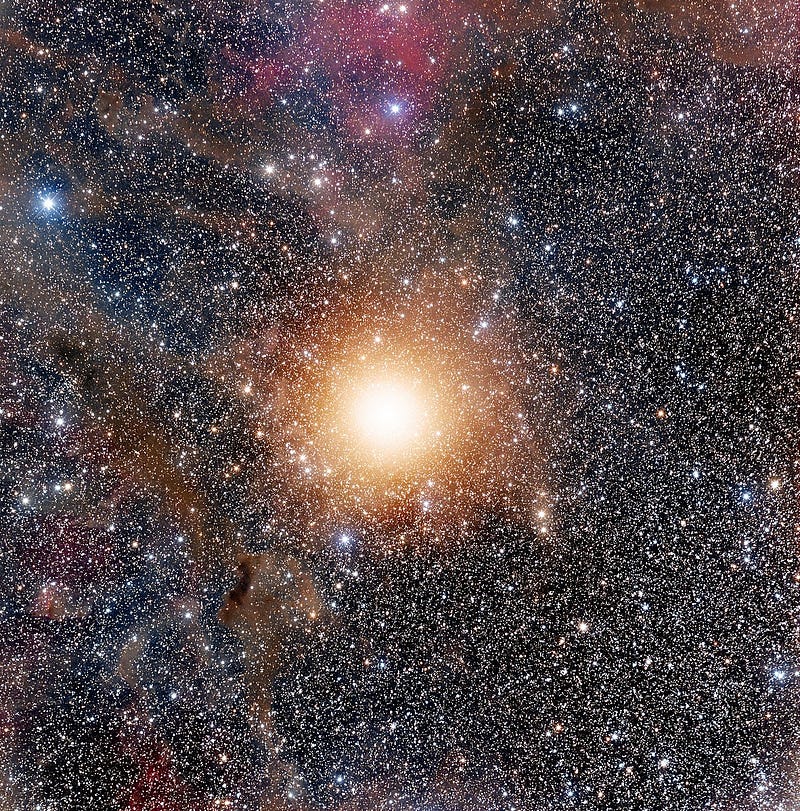
The star was first observed by ancient Chinese astronomers, who spoke about its yellow hue, then by Ptolemy, who described its colour as ὑπόκιρρος (hypókirrhos = more or less orange-tawny). Aboriginal groups in South Australia have also shared oral tales of the variable brightness of Betelgeuse for at least 1,000 years. In their folk tales, Betelgeuse is incorporated as the club of Nyeeruna (Orion), which fills with fire-magic and dissipates before returning.
So, Betelgeuse changes colour and brightness from time to time. It is what we call a semiregular variable star; its cycles of brightness have different lengths with some amount of regularity-but not too much. Betelgeuse is also what we call a red supergiant. This means that one day it will explode with the collapse of its own core and become a supernova.
And by “one day” I mean probably within 100,000 years.
While this is a long interval of time to think of, it’s still exciting to consider: this means it’s entirely possible that the explosion of Betelgeuse shall be witnessed by human beings. If you think about it, Homo Sapiens, as a species, was around 100,000 ago, sharing the Earth with Neanderthals and woolly mammoths. 100,000 years ago is when our hunter-gatherer ancestors are believed to have first started to migrate out of Africa. They had not yet started to speak what we would now think of as a language- that would only come 50,000 years ago; but they were using tools such as stone-tipped spears to hunt large mammals and cooked their food over fire.
So, within the next 100,000 someone may see Betelgeuse in the sky as a supernova. Could be us, could be our great-grandchildren, could be their great-great-great-great-great-great-*deep-breath*-great-great-great-great-great-great-great-great-great-great-great-great-great-great-great-grandchildren… we just don’t know. But it’s likely that the generation who will leave to witness Betlegeuse go supernova will be no further from us than we are from the time when Neanderthals and Homo Sapiens walked the Earth together.
Yeah, there was one time, in October 2019, when Betelgeuse began to dim noticeably, only to stop dimming and start brightening again in February 2020. It sounds that what happened was that, well, the our star let out a large amount of hot gas, and was obscured by the resulting cloud of dust. (I know, I know… Insert obvious joke with obligatory reference to Uranus). So, it didn’t become a supernova right there and then. But it got us talking about “What if…”.
So what would happen if Betelgeuse became a supernova?
Well, I’ve got good news and great news.
The good news is that this wouldn’t hurt us. It is just too far away. Betelgeuse is situated about 700 to 400 light-years away from us; it would take a distance of less than 50 light years away for a supernova explosion to have any kind of destructive impact on our planet.
The great news is that it would look absolutely gorgeous. For about a year, we would have a star in the sky as bright as a half-moon. For a few months, it may become brighter than the full moon and even be visible during the day. Astronomers and physicists will study it closely, poets will write about it and lovers will gaze at it holding hands.
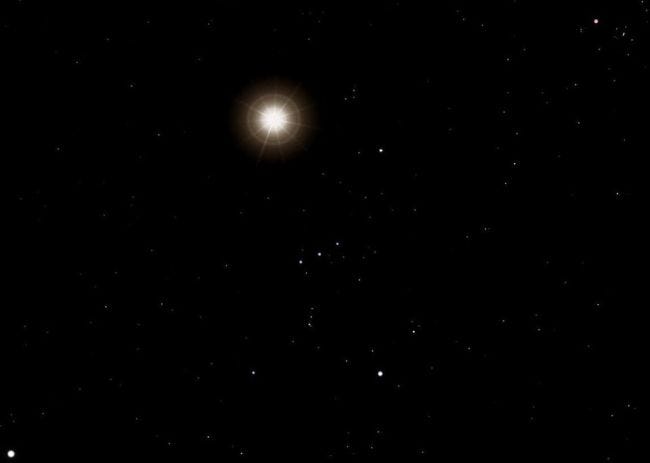

Whenever it would happen, this would be the first supernova explosion visible to humans in living memory of everyone alive, and the first one to be captured through photography or film, if indeed those would still be a thing by the time it happens. The most recent supernova in our galaxy to have been unquestionably observed by the naked eye occurred in 1608; and was described by German astronomer Johannes Kepler in his book De Stella Nova in Pede Serpentarii (On the New Star in the Foot of the Serpent Handler). So, the latest occasion for witnessing a supernova explosion by just looking up at the sky happened just around the same time that William Shakespeare wrote and performed Macbeth. (Although a supernova in the neighbouring galaxy Large Magellanic Cloud was visible through telescopes in the Southern hemisphere in 1987).
Actually, if we see Betlegeuse become a supernova within our lifetime, it means that it already happened a long time ago.
Let’s come back to Eminescu’s poem for a second:
Tis such a long way to the star Rising above our shore — It took its light to come this far Thousands of years and more. It may have long died on its way Into the distant blue, And only now appears its ray To shine for us as true. We see an icon slowly rise And climb the canopy — It lived when yet unknown to eyes: We see what ceased to be!
Betelgeuse is situated 700 to 400 light-years away from us; the best estimations we have place it at 650 light years away.
That means that if we were to see Betelgeuse go supernova within our lifetime, it had exploded at some point during the Middle Ages, most likely during the 14th Century and certainly before Kepler’s Supernova showed up to our eyes.
What was humanity doing back then?
The Hundred Years war had probably ended. In England, the House of Lancaster was gaining power, eventually seizing the Throne from the Plantagenets. France grappled with the tumultuous rule of King Charles known both as The Well-Beloved and The Mad, embroiled in a complicated alliance with the Lancasters across the channel. The Florentine republic was on the rise, with the Italian Renaissance about to start. Over in Asia, Tamerlane, the last of the great nomadic conquerors of the Eurasian Steppe, having already conquered Persia, was fighting the Delhi Sultanate in India and eyeing up Ming Dynasty China.
What was happening in Romania at the time, though, further connects our star to the writing of Mihai Eminescu. One of his most famous poems, The Third Epistle, that all of us who went to school in Romania studied at some point, describes an epic medieval battle, between Wallachian ruler Mircea the Elder and Ottoman Sultan Bayezid Yıldırım- The Thunderbolt.
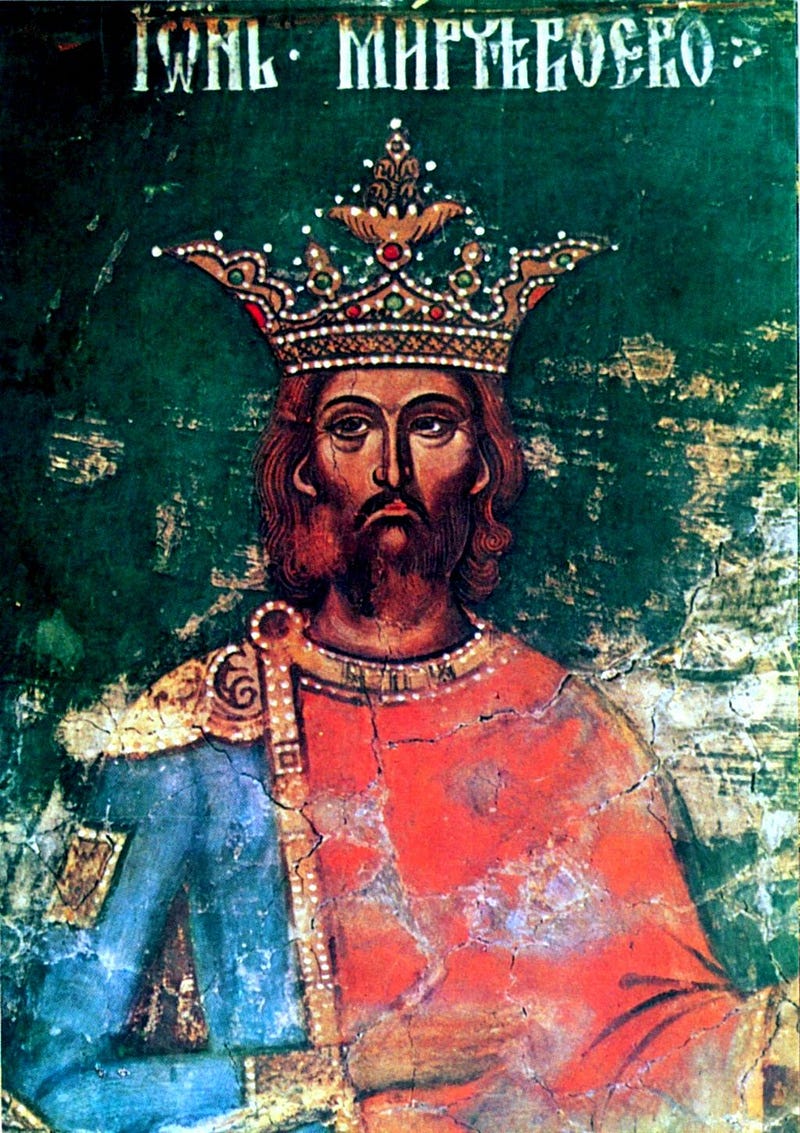

Mircea the Elder was the paternal grandfather of everybody’s favourite medieval Romanian- Vlad the Impaler. He greatly increased the territory of his country and brought stability to it, strengthened “the great army” made up of townspeople and of free and dependent peasants, and supported the Church.
Perhaps the greatest challenge to his rule were conflicts with the Ottoman empire, led by Sultan Bayezid I.
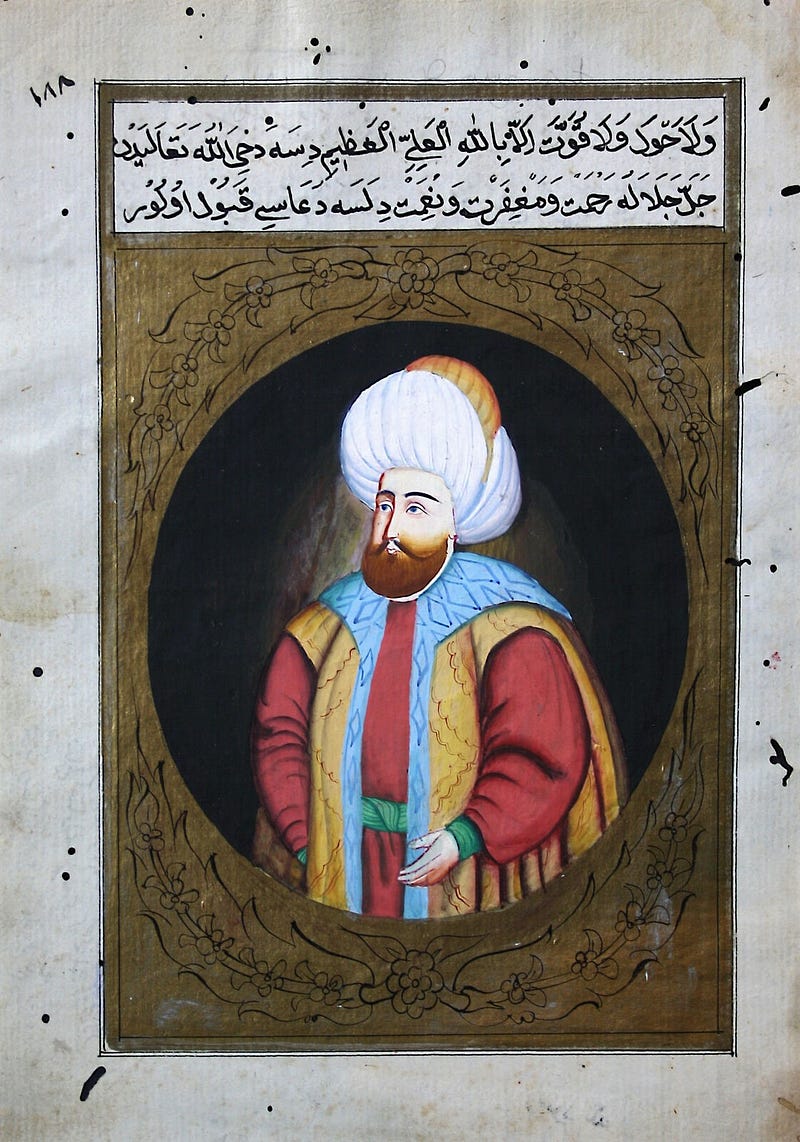
In 1394, Bayezid I crossed the Danube, leading 40,000 men, an impressive force at the time- and four times as many as Mircea the Elder could muster.
Eminescu describes their encounter in his Third Epistle:
“At a sign the way was cleared and there came towards the tent A man of calm and simple mien, a man with many years bent. 'Are you Mircea?" "Yes, your Highness !" “Bend the knee, for caution warns, Or else I’ ll exchange your crown against a rough wreath of thorns." "Whence you came for, o, great emperor, whatever may be your aim, While we’re still at peace I hail you, our greetings that you came; But, as to your good council, o may the good Lord forgive, If you dream to win this land by war and force imperative;
You would better return home now with a calm and peaceful mind And show in your imperial strength that you are just and you’re kind... Be the one or be the other, whatever God the Lord wills, Gladly shall we take our fate, be it war or be it peace”.
(Source and translation: Gabriel Ditu)
Bayezid is outraged at Mircea’s modest but firm demeanour. “How dare you, you puny dotard, think that the Great Ottoman empire could stumble on an old tree stump?”.
Yet, Mircea, again, reminds him:
To that old dotard, Emperor, aught one courtesy accord For over all of Wallachia ’tis he the chosen lord. I do not wish it upon you to know the wrath of our folk Nor for the great furious Danube to engulf your fleeing host. […] Emperors great and unnumbered, for their cruelty renowned, Came to us with hungry eyes for our water and our land; And I would not care to brag, but tell you this thing I must: Little time went by until they all were water and were dust. […] I only defend the poverty and needs of a struggling land And therefore all the rocks and streams and hills that over us stand And all that grows and moves and breathes here to me is an ally true, While every blade of grass and stone is an enemy to you, We have small armies, but love of our soil shall rid This flowering land of all its foes. Prepare, Bayezid !”
(Source and translation: Gabriel Ditu)
Mircea chose to fight what would now be called a guerrilla war, by starving the opposing army and using small, localized attacks and retreats, and using tactical knowledge of the terrain to his advantage- hence the reference to rock, streams and blades of grass being allies to him and foes to the Sultan.
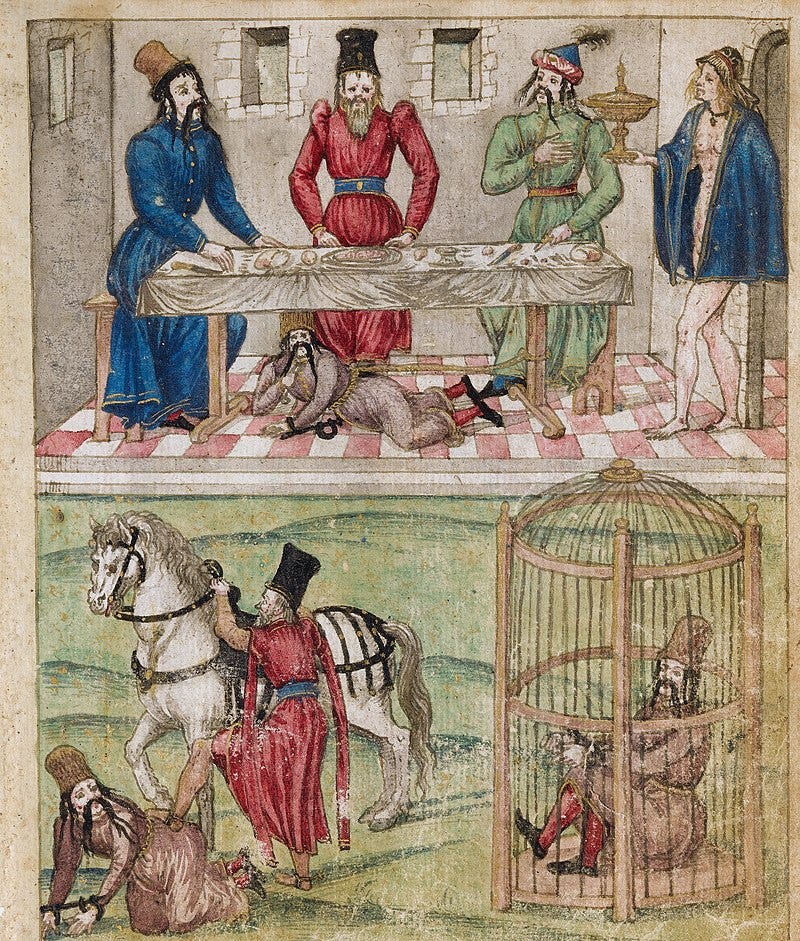
On October 10, 1394, their armies clashed at the Battle of Rovine, which featured a forested and swampy terrain, thus preventing the Ottomans from properly spreading their army; Mircea won the fierce battle and threw the Ottomans out of the country. Eight years later, the prideful Bayezid would be defeated, captured and humiliated by someone fiercer and even more powerful than him: Tamerlane.
.jpg)