
A Perspective Shift That’ll Help You Achieve Your 5-Year Goals in A Year (or Less)
It’s time to radically redefine the meaning of a goal

The law of causality governs our universe — every effect has a cause and vice versa. And a mind-blowing video by Andrew Kirby showed me an incredible application of this.
Like falling dominoes, every action you perform causes certain effects that become causes for other effects, and so on — building indefinitely long cause-effect chains.
With this framework, we can define time as a mapping between a set A of causes and set B of effects. For example, the mapping between the cause set [Working out Hard, Eating Clean, Sleeping 8 Hours] and the effect set [Your Dream Physique] is say 5 years.
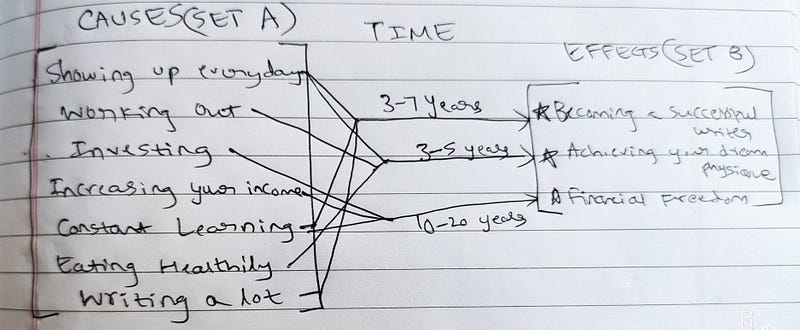
In this context, a goal is nothing but a desired effect in a particular snapshot of the future. So there are only two ingredients to achieve a goal:
- Triggering the necessary set of causes.
- Time for the mapped effects to manifest.
Here’s Where It Gets Magical
Consider this — if you triggered the exact set of causes required for a certain goal, your goal would manifest instantaneously.
But you’d need infinite knowledge and wisdom to do that, which is impossible.
Let’s talk practicality — if you could better choose the causes you trigger, wouldn’t the time required to reach your goal be reduced? Consider these two scenarios:
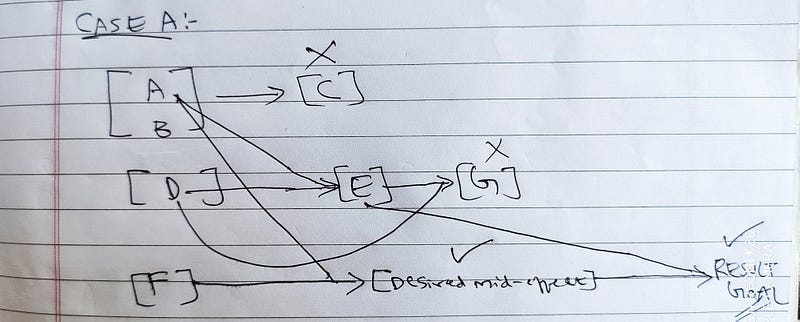
- Case A: Your goal’s cause set is [A, E, F]. You start with [A, B], which triggers an unnecessary C. Then you try [A, D] which triggers E. [D, E] causes an unwanted G. [A, F] gives a desirable mid-effect. Adding E into the mix finally results in the goal.
- Case B: You start off with [A, E] which triggers a helpful sub-effect. Adding D into the mix gives an adverse effect. You step back, analyze, and throw F in. Boom! Goal achieved.
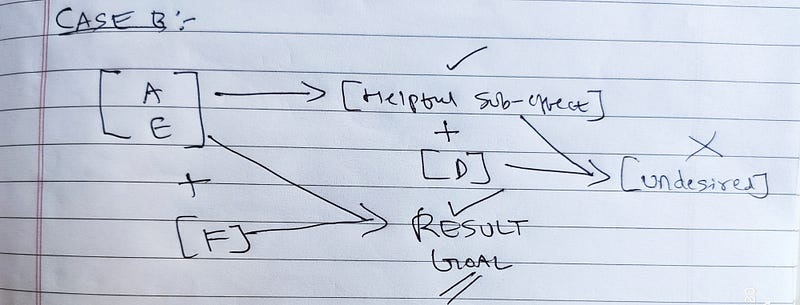
Why is Case B faster? — Better selection of the causes to trigger. Time is inversely proportional to the preciseness of the causes.
So the more accurate the causes you trigger, the faster will you reach a certain goal.
With this way of thinking, even 5 and 10-year goals can be reduced to 1-year ones.
The Real Key to Fast-Forwarding Your Goals
I have close to 4k followers and Ayodeji Awosika has 84k. If we both lost our accounts, Ayo could ramp up a new account to 4k followers leagues faster than I would — and I could beat a complete beginner to it.
Similarly, if I lost all my gains, I’d be able to build my physique from scratch in less than 2 years — not 5 like the first time.
That’s the power of experience. It gives you highly specific knowledge — often stuff that you don’t even know you know.
“Experience takes dreadfully high school wages, but he teaches like no other.”
— Thomas Carlyle
This is the key to 2, 3, or 5Xing the speed with which you race towards your goals. Here are 4 ways to milk the most out of this:
#1 — As Nike Goes, “Just Do It”
Who’s more likely to go viral? The beginner that spends weeks honing his first “masterpiece” or one that bangs out article after article?
It’s the latter. Just the act of doing, even if it results in failures, hammers invaluable knowledge and wisdom into you.
F*ck perfection. Just get started — YouTuber Marques Brownlee with 15M subscribers started off with blurry webcam recordings. Joe Rogan went from a clown comedian to the world’s #1 podcaster.
#2 — Read. Read. Read.
Reading is a cheat code everyone can access, but only a few choose to.
By reading a book, guide, or article, you get to “steal” a distilled version of the author’s experience — and give yourself a turbo boost.
Just one book on online writing revolutionized my success as a writer. Over 90% of my finance knowledge came from a single article collection. And just a handful of books triggered almost all my life-changing insights.
The craziest part is the synergy — the more you read, the more ideas & insights you gain, the more new ones sprout up. After a point, you develop a rich self-sustaining ecosystem of ideas and knowledge that expands by itself.
#3 — Find Mentors
Being mentored by someone is richer than reading their books or watching their videos.
At work, a colleague has become my unofficial mentor — all it took was genuine appreciation and constant communication. And for life coaching, I’ve joined my friend Dipanshu Rawal’s paid 8-week mentorship program.
I’m mentoring my brother in fitness and in 3 months, he’s made more progress than most make in a year — a mentor is a literal hack.
Reach out to the people you find inspiring — you never know who’s your life-shaping mentor. Paid or free, that guidance will be invaluable.
#4 — Build a Tribe of Like-Minded People with Similar Goals
As a beginner writer, when I had reached out to my idols and other similar writers, I did not know how incredible the effect would be.
The group put all our growths on steroids — we were a bunch of motivated, albeit stumbling writers. Now, each of us has thousands of followers and multiple top writer tags.
Leverage the incredible power of synergy — every member will benefit from the pooled knowledge and experiences.

How to Optimize the Causes Outside Your Control
Garnering experiential knowledge can help you better choose the causes in your control. But what about the external ones?
Here’s where putting yourself out there comes in. By doing so, you increase the probability of favorable causes coming your way. This can even eclipse the causes you trigger by yourself.
Why do you think the cheerful engineer who sucks at programming but aces presentations keeps getting promoted while the introverted coding prodigy stays stuck?
Talk to new people. Constantly try new things. Attend events and gatherings. Over-communicate things. Ruthlessly grab opportunities. Pick up hobbies. Socialize as much as you can.
Another powerful way is by being kind and doing good things. Karma is real — by propagating through the causal chains, your good deeds can yield you manifold returns.
Even more than the potential reward, the act of good itself is rewarding.
“The best way to do ourselves good is to be doing good to others; the best way to gather is to scatter.”
— Thomas Brooks
Final Thoughts
The next time you set a goal, don’t think of it in terms of timelines and milestones. Think of it as a cause-effect mapping — weed out the unnecessary causes and optimize the necessary ones.
You’d be surprised by how the 5 and 10-year goals of most people will seem attainable in just a year or two.