avatarBrian Loo Soon Hua

Free AI web copilot to create summaries, insights and extended knowledge, download it at here

3730

Abstract

e-roman-penises-carved-into-hadrians-wall/137034">Hadrian’s Wall</a> in what is today the northern edge of England. Since the Wall still stands steadfast, perhaps the penises carved into it are indeed doing their job as supernatural protectors!</p><h1 id="c372">Phalluses defeating the evil eye</h1><p id="d452">The Romans believed that excessive envy (<i>invidia</i> in Latin) towards someone could bring about negative energies and bad luck to that individual. Collectively known as <i>malus occulus </i>or the “evil eye” these malevolent energies could be defeated by invoking the protection of the fascinum.</p><p id="ea22">Due to this fear of the evil eye, penises were everywhere in ancient Rome. The mosaic below is a typical example.</p><figure id="43cf"><img src="https://cdn-images-1.readmedium.com/v2/resize:fit:800/1*4T_nE4KLhhQIbesZHLB6zw.jpeg"><figcaption>Roman mosaic from Antiochia. Public domain.</figcaption></figure><p id="5618">It depicts a naked dwarf whose monstrous penis has a mind of its own and joins a barking dog, a cat, a scorpion, a centipede, a snake and a pecking raven in attacking yet another disembodied floating evil eye getting pierced by a trident and a sword. Talk about overkill!</p><p id="f3a0">Some fascini were meant to be worn on chains like amulets around the neck. Others were finger rings. Many were so small that they were most likely worn by children. Some were even designed as lamps to light up the house at night and chase evil away.</p><figure id="6565"><img src="https://cdn-images-1.readmedium.com/v2/resize:fit:800/1*4jmvreC1dRu6XUsEd1KShw.jpeg"><figcaption>Tintinnabulum from Herculaneum. Public domain.</figcaption></figure><p id="b393">Other fascini were designed as <i>tintinnabula</i> or wind chimes. This fantastic one was made in the shape of a gladiator fighting his own penis that had transformed into a rabid dog. The ringing bells were meant to chase away evil entities and the protective power was further enhanced and made extra potent by addition of the fascinum in the design.</p><p id="1760">Fun fact: In 1819, when King Francis I of Naples visited the Pompeii exhibition at the National Archaeological Museum with (horrors!) his wife and daughter, he was so embarrassed by the erotic art that he ordered the collection to be locked away and be made accessible only to “people of mature age and respected morals”.</p><figure id="0b9f"><img src="https://cdn-images-1.readmedium.com/v2/resize:fit:800/1*4-MjkSTs5oaWgP_D2UwcCQ.jpeg"><figcaption><a href="https://en.wikipedia.org/wiki/Tintinnabulum_(Ancient_Rome)#/media/File:Tintinnabulum_Pompeii_MAN_Napoli_Inv27854.jpg">Tintinnabulum of Mercury</a> from Pompeii. Image credit: Marie-Lan Nguyen</figcaption></figure><p id="8ac0">This tintinnabulum depicts the God Mercury with multiple giant erections growing from his head, in addition to one in the anatomically-correct location. Three of his penises originally sported tinkling bells, now lost.</p><p id="d13b">Tintinnabula were hung at doorways as talismans. They were usually found near thresholds in homes and shops, in courtyards and near bedrooms. The wind would cause the to ring.</p><p id="fa32">They could also be used as doorbells with several of them being attached to a cord that could be pulled by a visitor at the front door. Imagine ringing a Roman doorbell made of these obscene little figures!</p><p id="dad9">The photo below shows a collection of bronze fascini, the one at the top has a <i>manu fica</i> on one end and the usual erect phallus on the other.</p><figure id="5ff6"><img src="https://cdn-images-1.readmedium.com/v2/resize:fit:800/1*O4JLHJotG5dOldfOW5r6ag.jpeg"><figcaption>Bronze fascinum found in Reims, France. Public domain.<

Options

/figcaption></figure><p id="04ee">The manu fica or fig sign — a fist with the thumb protruding between the middle and forefingers — represents sexual intercourse and was also traditionally used by the Romans to chase away evil spirits. A talisman with a fascinum on one side and a fig sign on the other was twice as powerful! The lower left fascinum has wings (a very common feature) and the other one is a double fascinum with two erections!</p><h1 id="c5b1">Protector of freeborn Roman boys</h1><p id="1dc9">In ancient Rome, it was illegal for a Roman man to sleep with a freeborn Roman woman except his wife nor was he allowed to sleep with freeborn Roman boys and men. Yes, the Romans had no concept of gay versus straight and a healthy man was expected to enjoy sex with men and women so long he was their superior and they were slaves or prostitutes or foreigners. When freeborn Roman boys were in the public baths, they wore necklaces with fascini on them to signify their privileged status while they were naked. In this case, the fascini signaled to adult Roman men that these boys were off limits and that they should not be molested or raped!</p><h1 id="19a2">Modern equivalents</h1><p id="24d5">The concept of envy bringing about misfortune and bad luck survives to this day in Mediterranean countries, long after the fall of the Roman Empire. The belief is still particularly strong in Southern Italy, Greece and Turkey.</p><p id="e62e">In modern Turkey, the more proper and thankfully much-less-obscene <a href="https://en.wikipedia.org/wiki/Nazar_(amulet)">nazar boncuğu</a> is hung in homes, workspaces and public areas to provide protection from the evil eye in much the same way as the fascinum. It even appears on Turkish airplanes!</p><h1 id="a9d5">Linguistic descendants</h1><p id="01bf">The word “fascinum” gave rise to the Latin “fascinare” meaning “to enchant or bewitch”. This was borrowed into English where it became “fascinate’, “fascinating” and “fascinator”.</p><p id="6c7b">Every time I watch Star Trek and hear Mr Spock say “fascinating”, I can’t help but chuckle at the fact that he is invoking the fascinum, often multiple times per episode.</p><figure id="8489"><img src="https://cdn-images-1.readmedium.com/v2/resize:fit:800/1*swjHmJpp6kUrhMEoMYO_qg.jpeg"><figcaption>The <a href="https://commons.wikimedia.org/wiki/File:Kate_in_Ottawa_for_Canada_Day_2011_cropped.jpg">Duchess of Cambridge</a> in a fascinator. Image credit: <a href="https://www.flickr.com/people/pat00139/">Pat Pilon</a></figcaption></figure><p id="e0af">Or for that matter, when I see pictures of the (in)famous fascinators worn by fashionable modern Englishwomen to very posh social events.</p><p id="7147">I wonder whether anyone would be keen to inform Kate Middleton or Meghan Markle that those little fascinators they are wearing on their heads are really named after the old Roman word for an obscene but powerful penis talisman?</p><h1 id="f54e">References:</h1><p id="440f">Daniel Ogden, <i>Magic, Witchcraft, and Ghosts in the Greek and Roman Worlds: A Sourcebook</i> (Oxford University Press, 2002)</p><p id="e73f">Grant, Michael. Erotic Art in Pompeii: The Secret Collection of the National Museum of Naples. London: Octopus Books Ltd., 1975.</p><p id="970f">Johns, C. 1982. <i>Sex or Symbol? Erotic Images of Greece and Rome</i>. London, British Museum.</p><p id="8768">Richlin, Amy. The Garden of Priapus: Sexuality and Aggression in Roman Humor. New Haven: Yale University Press, 1983.</p><p id="51f2">The Fascinum — The Meaning of the Symbol: <a href="https://primeclinicatx.com/the-fascinum-the-meaning-of-the-symbol/">https://primeclinicatx.com/the-fascinum-the-meaning-of-the-symbol/</a></p></article></body>

Art and Archeology

Roman Penis Talismans

The fascinating history of the fascinum and why the ancient Romans had an obsession with shockingly provocative penis art
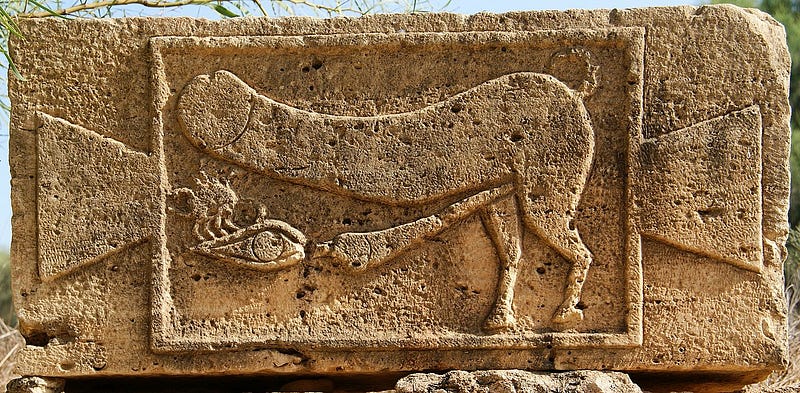
Fascinum bas-relief in Leptis Magna. Image credit : rob Stoeltje

Schoolboys visiting the ruins of Leptis Magna (in modern Libya) often end up pointing inanely and breaking into fits of raucous laughter while gawking at one monument — a shockingly obscene fascinum carved on a bas-relief. This particular beastie is shaped like a large erect penis standing on a pair of horse legs. It even sports its own miniature erection and had been depicted by the artist as being right in the midst of ejaculating on a floating eye with a scorpion-like creature riding on top.

I am not making this up. This trippy penis-creature is an ancient protective symbol and the eye with the scorpion perched on it is a symbolic representation of the evil eye or malus occulus. And yes, evil is being vanquished by being ejaculated upon.

Meet the fascinum, the most popular protective talisman against black magic and evil spirits known to the people of the Roman Empire. And yes, the Romans had a bizarre penis obsession.

One fascinum, two fascini

A fascinum (also known as a “fascinus”) is a representation of the divine phallus. The Romans made fascini (often with wings, legs, tails, secondary penises, attached male bodies and some even with a woman riding on top!) into amulets and effigies, carved them into bas-reliefs, painted them on frescoes and incorporated them into naughty windchimes and oil lamps.
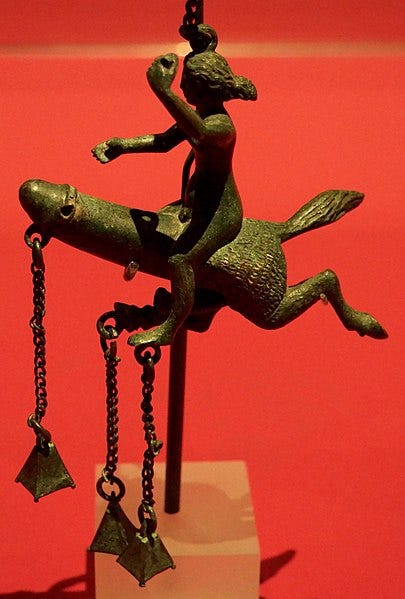
Woman riding a fascinum. Wellcome Collection

The protective magic of the fascinum was due to it being, among other things, a representation of the virile regenerative powers of the phallus. After all, we owe our very existence to an ejaculating penis, so to the Roman mind, it must represent some potent supernatural force.

Fascini were also powerful because Romans thought of sex in terms of domination — a strong male penetrates lesser beings- women, girls, boys, male slaves — thus defining himself as a true virile Roman man. A penis is a symbol of a man’s dominating power and could thus be extended into the supernatural world. The Romans believed that dark forces could literally be f*cked into submission!

Finally, the fascinum’s power over evil could be due to its shocking appearance — perhaps the evil spirits got distracted by the obscene shapes and were too busy laughing or cringing in shame to actually harm anyone.
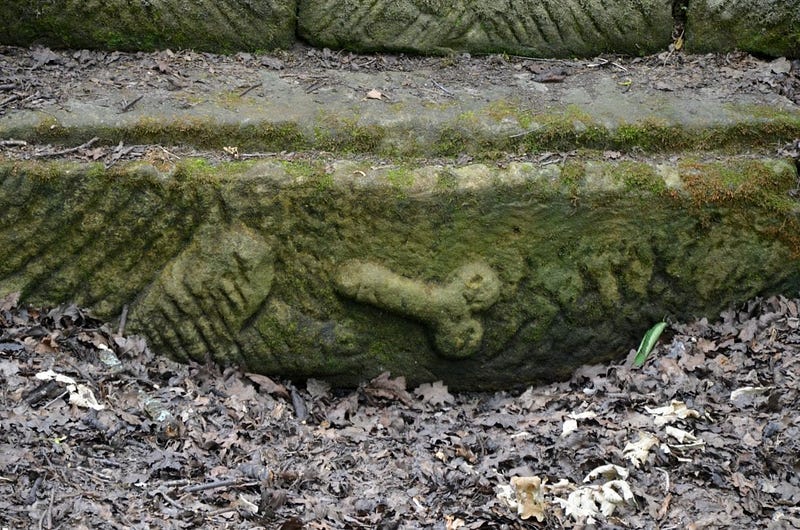
Chesters Bridge Abutment, Hadrian’s Wall. Image credit : Carole Raddato

Whatever the explanation, fascini were so popular that they were brought by Roman centurions to all corners of the Empire — even all the way to Hadrian’s Wall in what is today the northern edge of England. Since the Wall still stands steadfast, perhaps the penises carved into it are indeed doing their job as supernatural protectors!

Phalluses defeating the evil eye

The Romans believed that excessive envy (invidia in Latin) towards someone could bring about negative energies and bad luck to that individual. Collectively known as malus occulus or the “evil eye” these malevolent energies could be defeated by invoking the protection of the fascinum.

Due to this fear of the evil eye, penises were everywhere in ancient Rome. The mosaic below is a typical example.
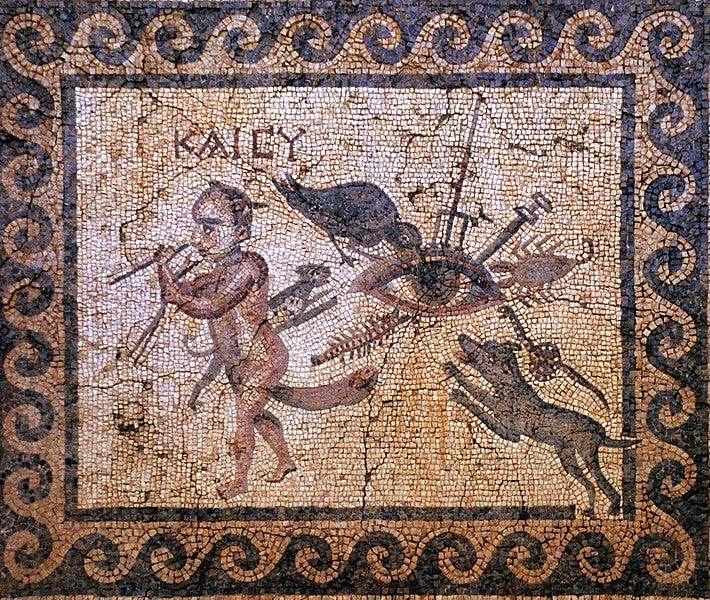
Roman mosaic from Antiochia. Public domain.

It depicts a naked dwarf whose monstrous penis has a mind of its own and joins a barking dog, a cat, a scorpion, a centipede, a snake and a pecking raven in attacking yet another disembodied floating evil eye getting pierced by a trident and a sword. Talk about overkill!

Some fascini were meant to be worn on chains like amulets around the neck. Others were finger rings. Many were so small that they were most likely worn by children. Some were even designed as lamps to light up the house at night and chase evil away.
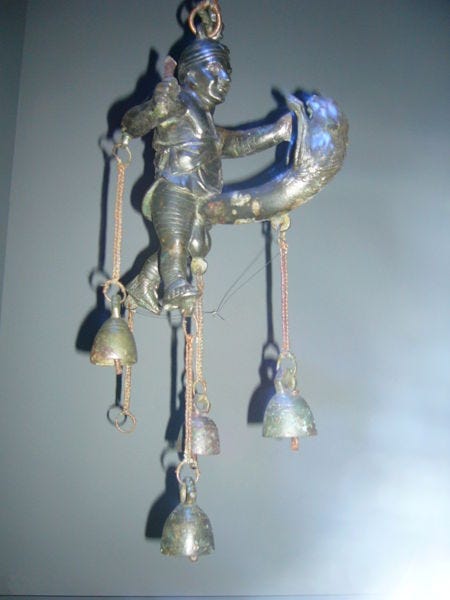
Tintinnabulum from Herculaneum. Public domain.

Other fascini were designed as tintinnabula or wind chimes. This fantastic one was made in the shape of a gladiator fighting his own penis that had transformed into a rabid dog. The ringing bells were meant to chase away evil entities and the protective power was further enhanced and made extra potent by addition of the fascinum in the design.

Fun fact: In 1819, when King Francis I of Naples visited the Pompeii exhibition at the National Archaeological Museum with (horrors!) his wife and daughter, he was so embarrassed by the erotic art that he ordered the collection to be locked away and be made accessible only to “people of mature age and respected morals”.
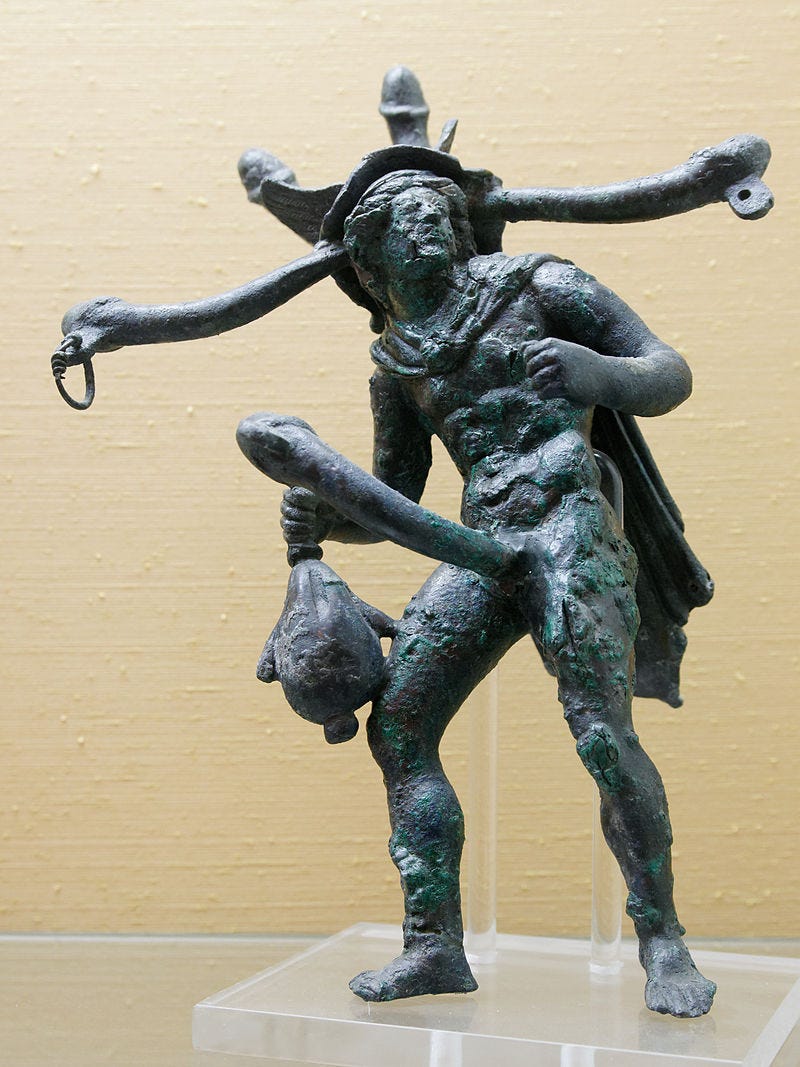
Tintinnabulum of Mercury from Pompeii. Image credit: Marie-Lan Nguyen

This tintinnabulum depicts the God Mercury with multiple giant erections growing from his head, in addition to one in the anatomically-correct location. Three of his penises originally sported tinkling bells, now lost.

Tintinnabula were hung at doorways as talismans. They were usually found near thresholds in homes and shops, in courtyards and near bedrooms. The wind would cause the to ring.

They could also be used as doorbells with several of them being attached to a cord that could be pulled by a visitor at the front door. Imagine ringing a Roman doorbell made of these obscene little figures!

The photo below shows a collection of bronze fascini, the one at the top has a manu fica on one end and the usual erect phallus on the other.
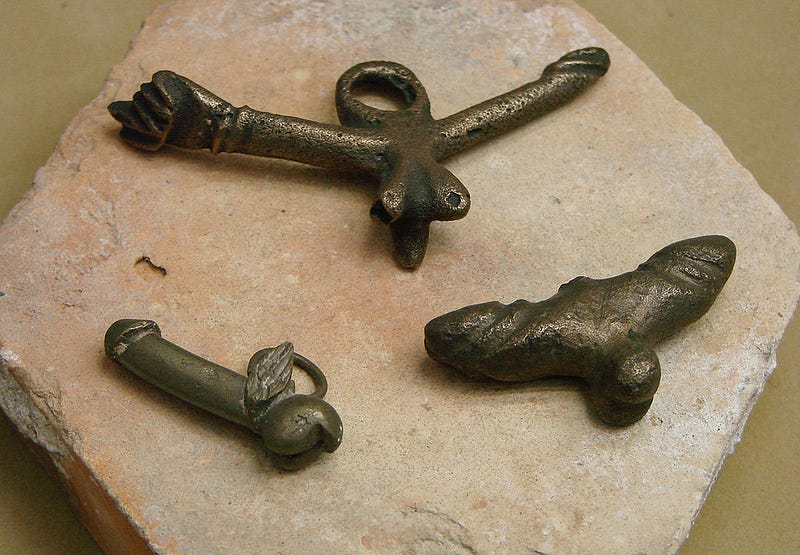
Bronze fascinum found in Reims, France. Public domain.

The manu fica or fig sign — a fist with the thumb protruding between the middle and forefingers — represents sexual intercourse and was also traditionally used by the Romans to chase away evil spirits. A talisman with a fascinum on one side and a fig sign on the other was twice as powerful! The lower left fascinum has wings (a very common feature) and the other one is a double fascinum with two erections!

Protector of freeborn Roman boys

In ancient Rome, it was illegal for a Roman man to sleep with a freeborn Roman woman except his wife nor was he allowed to sleep with freeborn Roman boys and men. Yes, the Romans had no concept of gay versus straight and a healthy man was expected to enjoy sex with men and women so long he was their superior and they were slaves or prostitutes or foreigners. When freeborn Roman boys were in the public baths, they wore necklaces with fascini on them to signify their privileged status while they were naked. In this case, the fascini signaled to adult Roman men that these boys were off limits and that they should not be molested or raped!

Modern equivalents

The concept of envy bringing about misfortune and bad luck survives to this day in Mediterranean countries, long after the fall of the Roman Empire. The belief is still particularly strong in Southern Italy, Greece and Turkey.

In modern Turkey, the more proper and thankfully much-less-obscene nazar boncuğu is hung in homes, workspaces and public areas to provide protection from the evil eye in much the same way as the fascinum. It even appears on Turkish airplanes!

Linguistic descendants

The word “fascinum” gave rise to the Latin “fascinare” meaning “to enchant or bewitch”. This was borrowed into English where it became “fascinate’, “fascinating” and “fascinator”.

Every time I watch Star Trek and hear Mr Spock say “fascinating”, I can’t help but chuckle at the fact that he is invoking the fascinum, often multiple times per episode.

The Duchess of Cambridge in a fascinator. Image credit: Pat Pilon

Or for that matter, when I see pictures of the (in)famous fascinators worn by fashionable modern Englishwomen to very posh social events.

I wonder whether anyone would be keen to inform Kate Middleton or Meghan Markle that those little fascinators they are wearing on their heads are really named after the old Roman word for an obscene but powerful penis talisman?

References:

Daniel Ogden, Magic, Witchcraft, and Ghosts in the Greek and Roman Worlds: A Sourcebook (Oxford University Press, 2002)

Grant, Michael. Erotic Art in Pompeii: The Secret Collection of the National Museum of Naples. London: Octopus Books Ltd., 1975.

Johns, C. 1982. Sex or Symbol? Erotic Images of Greece and Rome. London, British Museum.

Richlin, Amy. The Garden of Priapus: Sexuality and Aggression in Roman Humor. New Haven: Yale University Press, 1983.

The Fascinum — The Meaning of the Symbol: https://primeclinicatx.com/the-fascinum-the-meaning-of-the-symbol/

Art
Roman History
Archaeology
Magic
Superstition
Recommended from ReadMedium