avatarfrnkflwrs

Free AI web copilot to create summaries, insights and extended knowledge, download it at here

665

Abstract

car door blocks transverse sunlight from hitting the foam core so the projection is crisp and the only light source to land upon the surface is transmuted through the telescope first.</p><p id="9329">The challenge with the photograph was to set the exposure so it captured the details of the eclipse in the shadows while still showing the sun.</p><p id="fa22">I used a wide-angle lens to find a balance point (which was lucky because it was the only lens I owned at the time). I metered the exposure for the sun’s projection and not the sun itself, then focused mainly on placing the mid-tone brightness of the projection more-or-less along the left side rule of th

Options

irds, then I took physical steps to the left so as to pivot the composition and “nudge” the sun’s rays a little further from the edge and more towards the center of the frame. Keeping the horizon flat while also not letting the sunlight through the viewfinder cause damage to my eye took up the rest of my attention.</p><p id="e0ea">That’s the camera geek in me emergent. I’m always been more fascinated with the movement of energy than the documentation, or measurement, of the energy itself.</p><p id="93ee">(<a href="https://bradleyflora.medium.com/membership">If you would like to support my writing then use this link to join Medium</a>.)</p></article></body>

Photo by bradleyflora.com

A Partial Eclipse of the Sun

September Six Word Photo Story Challenge: Clouds

“Stand back! This is science, folks.”

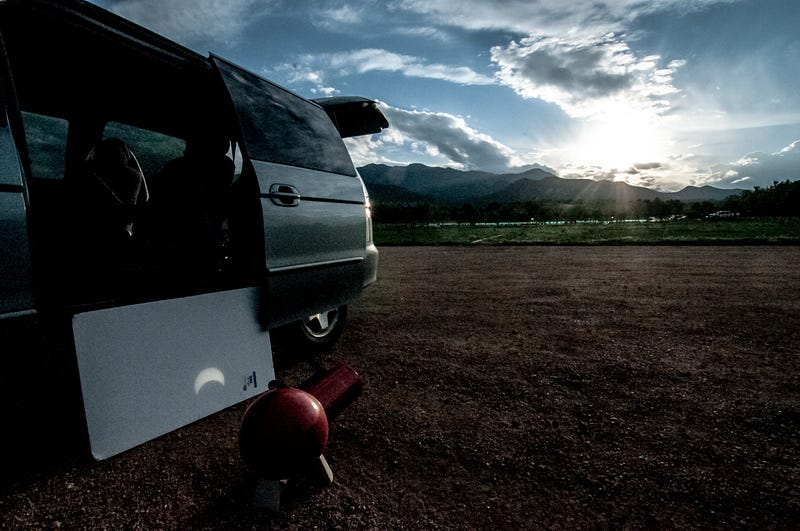
This is a photo of the homemade telescope rig used to observe the partial eclipse of the Sun, May 20th, 2012. In the photo, you can see a telescope projecting the sun’s shape, as the moon moved across it, onto a white piece of foam core. The shadow of the car door blocks transverse sunlight from hitting the foam core so the projection is crisp and the only light source to land upon the surface is transmuted through the telescope first.

The challenge with the photograph was to set the exposure so it captured the details of the eclipse in the shadows while still showing the sun.

I used a wide-angle lens to find a balance point (which was lucky because it was the only lens I owned at the time). I metered the exposure for the sun’s projection and not the sun itself, then focused mainly on placing the mid-tone brightness of the projection more-or-less along the left side rule of thirds, *then* I took physical steps to the left so as to pivot the composition and “nudge” the sun’s rays a little further from the edge and more towards the center of the frame. Keeping the horizon flat while also not letting the sunlight through the viewfinder cause damage to my eye took up the rest of my attention.

That’s the camera geek in me emergent. I’m always been more fascinated with the movement of energy than the documentation, or measurement, of the energy itself.

(If you would like to support my writing then use this link to join Medium.)

Photography
Six Word Photo Story
Monthly Challenge
Science
Eclipse
Recommended from ReadMedium