
A Once in a Lifetime Explosion
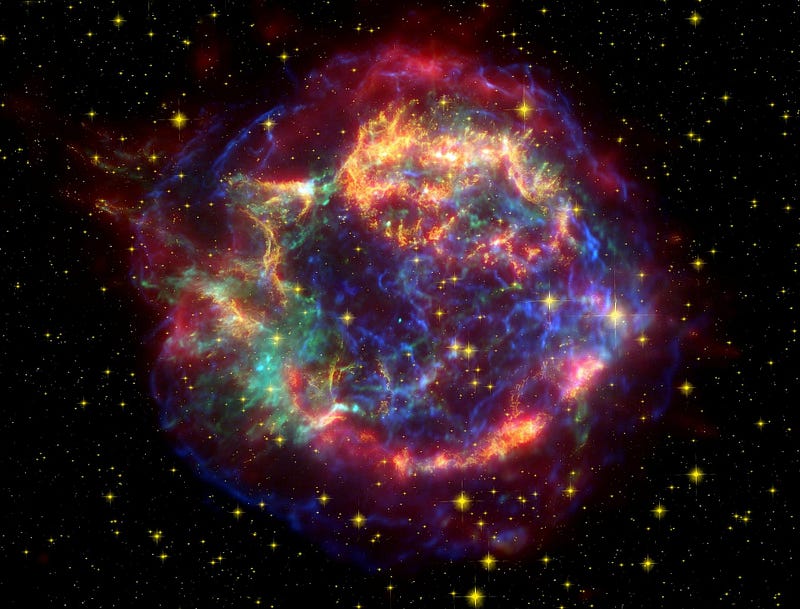
A billion years ago, a star exploded and we can watch it today.
Can you imagine working in a field where your job is to study the light that an object emits?
To add to the mystery, most of what you are looking at happened billions of years ago.
When something amazing happens, you might not see it because you might not be looking in the right place at the right time.
I’m talking about the study of Space.
It’s just so… Big.
The study of space is a combination of observation and extrapolation with the addition of years of accumulated scientific data. We’ve been watching the stars since the beginning of time.
This year, researchers released a report on new data that shows a massive star exploding. They could see the explosion happen, right from the earliest moments. This was a first and it’s important.
A supernova is a cataclysmic explosion of a massive star.
We’ve never seen what happens at the beginning of one. We usually only notice them as they get brighter and brighter before they explode.
Patrick Armstrong, a Ph.D. student at the Australian National University noticed the event on data from NASA’s Kepler space telescope. The explosion occurred more than one billion light-years away from Earth.
That means we were looking at something that happened a billion years ago.
It’s an amazing find.
“In order to capture this, you have to be looking at the right part of the sky, at the right time, with the right amount of detail, to be able to see everything,” Armstrong said.
This data will help us understand what happens to stars when they die.
How is it possible to figure things out using only light?
I can tell you how. Here are the basics:
Metal Salts in High School
Most people don’t realize that metal salts are often in high school labs to show how colored light reveals what they are made up of.
Metal salts are made of pairs of ions . (An ion is an electrically charged atom.) One ion is a metallic element and the other ion has an electrical charge to balance it.
The color comes from excited electrons. They’re excited when you add the energy of fire to the salt. As the salt burns, the extra energy is lost as light.
The color reveals what elements are contained in the fire.
Here are some examples.
Lithium -red Sodium -strong, persistent orange Potassium -lilac (pink) Rubidium -red (red-violet) Cesium -blue/violet (see below) Calcium -orange-red Strontium -red Barium -pale green Copper -blue-green (often with white flashes) Lead -gray-white Thallium -green Indium -indigo
We could figure out what elements were in things based on what color they were when we put a flame on them.
How did we use this to study Space?
We figured out how to see the colors in a wave.
The Spectroscope Was a GameChanger
Joseph Fraunhofer invented this tool in 1818. He figured out how to measure the wavelengths of colors. The spectroscopy measures each element’s pattern and identifies what is burning. It’s like a fingerprint.
We no longer had to be there to burn something to get the color of its light. The Spectroscope could read the rainbow of light from an object at a distance.
Back to the Supernova
Scientists are studying the rainbow of light from the supernova to find out what elements it contained.
There is a lot of information from the Kepler telescope because it took frequent images of the event. The light curve was recorded from beginning to end.
It's a treasure trove for space research.
Source: The Guardian, University of Waterloo, Hubblesite,


